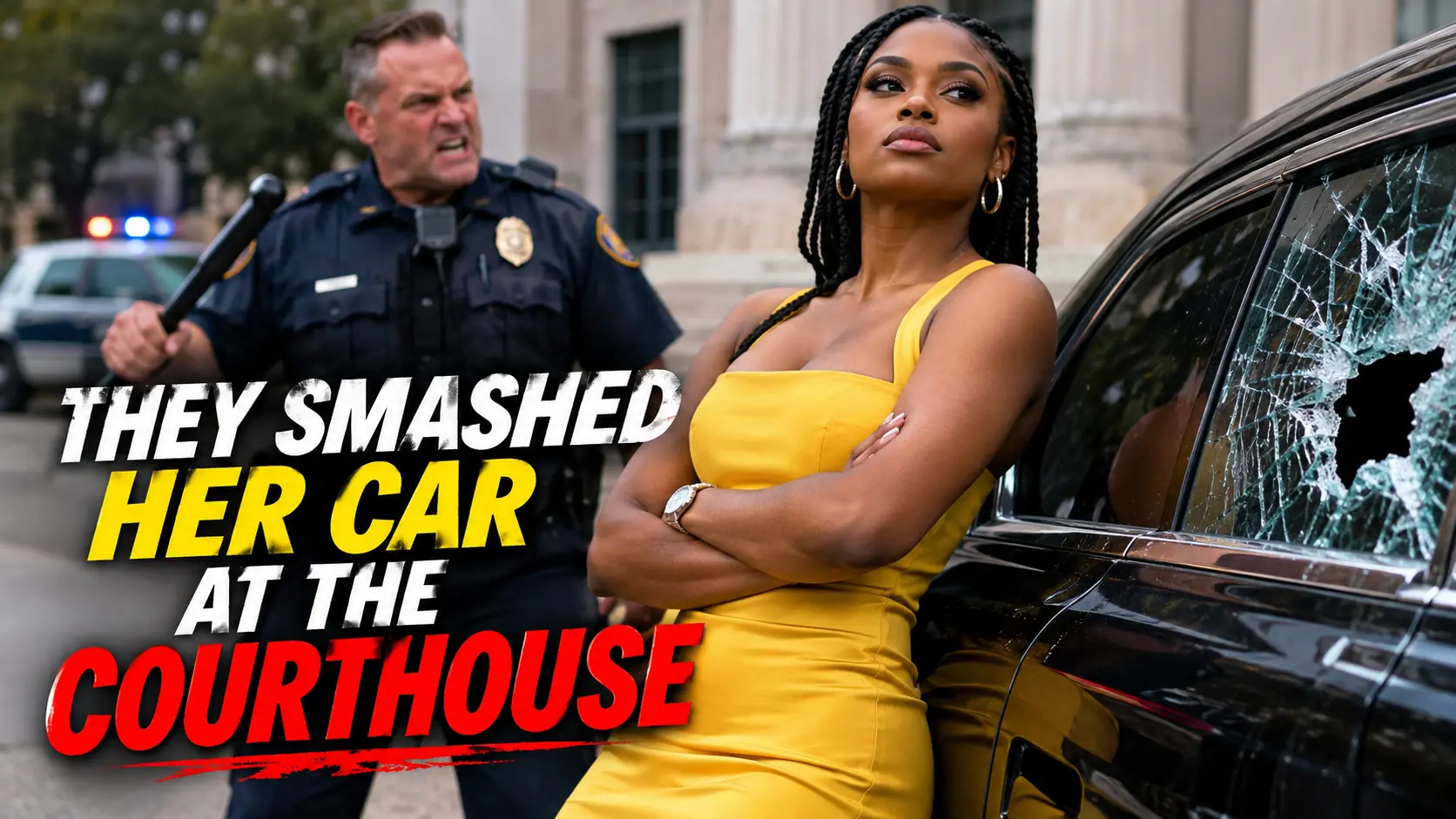
The third blow shattered the last unbroken section of my windshield.
I was on my knees in the gravel, my wrists handcuffed behind my back, when Deputy Garrett Gity turned toward me and smiled.
“You should've told me who you stole this car from.”
My name is Renata Cole. I was forty-two years old, and until that afternoon, I had believed I understood how dangerous a routine traffic stop could become.
I had spent fifteen years investigating civil-rights violations committed under color of law. I had interviewed mothers whose sons never came home, drivers whose vehicles had been searched without justification, and ordinary people who discovered that knowing their rights did not necessarily protect them from someone determined to violate those rights.
But there is a difference between studying fear and feeling it.
And lying on a sun-baked county road while a man with a badge destroys your car is a lesson no courtroom transcript can fully teach.
The deputy raised his baton again.
“Garrett, that's enough!”
The voice belonged to Deputy Miles Ansar, the younger officer who had accompanied Gity.
He stood beside the patrol cruiser, one hand extended, his face pale.
Gity ignored him.
He swung.
The baton struck the Rolls-Royce's front quarter panel with a metallic crack.
My stomach tightened.
The Phantom was a black 2025 model, purchased through my family's investment company after my father's retirement. It was beautiful, certainly, but it was not the car's price that frightened me.
It was the deputy's pleasure.
He wasn't searching for contraband.
He wasn't securing evidence.
He wasn't responding to an emergency.
He was enjoying the destruction.
“Deputy,” I said, keeping my voice steady, “I am asking you to stop damaging my vehicle.”
He turned.
“Are you giving me orders?”
“No.”
“Sounds like you're giving me orders.”
“I'm asking you to follow the law.”
He laughed.
Then walked toward me.
I could see sweat running down his temple.
His eyes were pale blue, almost colorless in the afternoon sunlight.
“You people always think money makes you untouchable.”
I looked at him.
“What people?”
He crouched.
“Don't play stupid.”
Miles moved closer.
“Garrett, dispatch hasn't confirmed any stolen vehicle report. We need to slow down.”
Gity pointed the baton at him.
“Get back to the cruiser.”
“Sir—”
“Now!”
Miles stopped.
For one brief second, our eyes met.
His expression told me something important.
He knew this was wrong.
But knowing and acting were not the same thing.
I had built much of my career around that distinction.
Gity grabbed my chin.
“Where'd you get the car?”
“I own it.”
He laughed.
“Sure you do.”
“The registration is in the glove compartment. My driver's license is in my handbag.”
“Your handbag?”
“Yes.”
“Where?”
“On the passenger seat.”
He glanced toward the shattered window.
Then smiled.
“Let's see what else you've got in there.”
He stood.
I felt my pulse quicken.
Not because my handbag contained anything illegal.
It didn't.
But because it contained information I had deliberately kept out of sight.
My federal credentials.
A secure communications device.
And a sealed envelope from the meeting I had attended forty minutes earlier.
The meeting had been confidential.
The people involved had taken enormous risks to arrange it.
And if Garrett Gity opened that envelope, he might learn something he was never supposed to know.
I looked toward Miles.
“Deputy Ansar, I want you to document that I do not consent to a search of my personal belongings.”
Miles swallowed.
“I understand.”
Gity stopped.
Slowly, he turned.
“What did you just say?”
I looked directly at him.
“I do not consent to a search.”
His face hardened.
Then he smiled.
It was the kind of smile I had seen described in too many witness statements.
The smile of someone who believed consequences belonged to other people.
“Well,” he said, “that's unfortunate.”
He walked toward the car.
And reached through the broken window.
At that exact moment, somewhere beneath the Phantom's damaged dashboard, a small indicator light began blinking red.
Gity didn't notice.
Neither did Miles.
But I did.
And despite the pain in my wrists, I felt the first small flicker of hope.
Because the car had already sent a message.
And someone was coming.
Chapter 2: The Woman in the Black Phantom
To understand why I was driving through Ashford County that afternoon, you have to understand something about my family.
My father, Nathaniel Cole, was born in a two-room house outside Albany, Georgia.
His mother cleaned hotel rooms.
His father repaired farm equipment.
By the time he turned seventeen, he had worked three jobs, buried his younger brother, and learned that some people could look directly at you without ever seeing you as an equal.
He eventually built a transportation company.
One truck became three.
Three became twenty.
Twenty became a regional logistics business operating across six states.
He made money.
A great deal of it.
But he never forgot the years when a police cruiser following him down a rural highway could turn an ordinary delivery into an ordeal.
When I was sixteen, he told me a story I never forgot.
He had been driving a company truck through southern Georgia when a deputy stopped him.
The deputy searched the cab.
Dumped his paperwork onto the road.