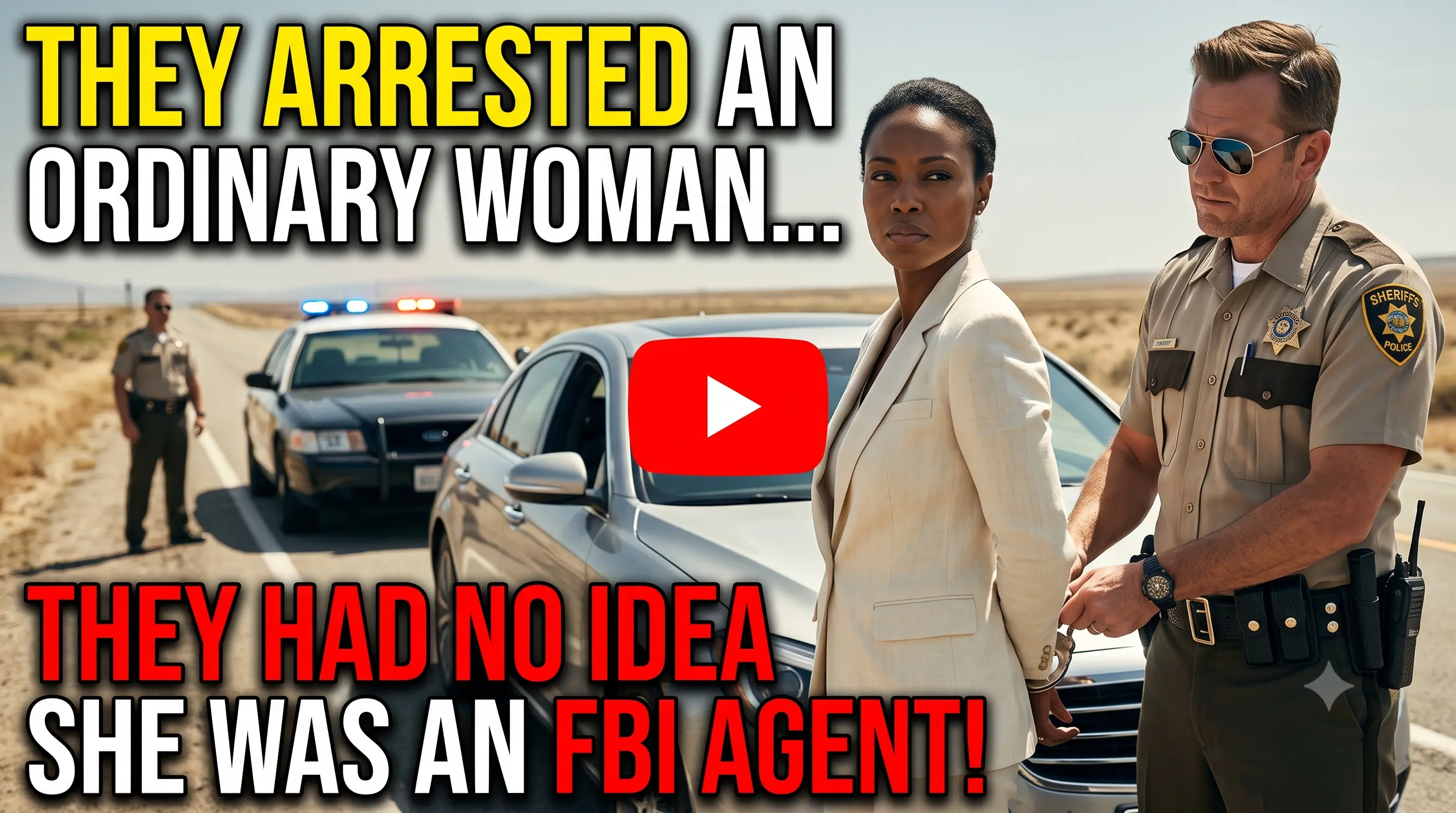
The Invisible Trap on the Interstate Highway
The first thing Sarah Hayes noticed after the helicopters disappeared was how quickly Oak Haven returned to its usual silence.
The dust settled on the sheriff's parking lot. The little flag above the municipal building stopped whipping in the rotor wash. Across the street, a woman carrying a bag of groceries stepped out of the pharmacy and stared at the empty sky. Someone inside the diner switched off the television. By six that evening, the highway was once again full of ordinary cars whose drivers had no reason to know that a brigadier general had spent part of the afternoon in the town jail.
Sheriff Boyd Cleary remained behind his desk, looking at the overturned trash can outside his window. His deputies had seen him angry, triumphant, bored, and occasionally cheerful. None had ever seen him quite so still.
Toby Miller stood in the doorway. He was twenty-six and had been a deputy for eleven months. Until that day, his understanding of the job had come mostly from his training academy and the instructions of the men who had been there longer. He had learned to check the jail log, secure property, and keep the booking counter clean. He had also learned that asking too many questions about the sheriff's decisions was an excellent way to get assigned the overnight shift.
"Sir," Toby said, "we need to finish the incident report."
Cleary did not look up. "Then finish it."
"I wasn't the arresting officer."
"You saw what happened."
"I saw what happened after she got here."
Cleary finally turned. "You have something to say?"
Toby felt his face grow warm. He thought of the woman standing beside the old wall phone, speaking with the steady voice of someone who expected to be heard. He thought of the sheriff laughing when she asked that her property be handled carefully. He thought of the number on the speed gun: forty-four.
"The citation says seventy-one miles per hour," Toby said.
"That's what I wrote."
"The radar printout says forty-four."
For several seconds Cleary said nothing. Then he stood, walked around the desk, and shut the office door. Toby heard the latch click.
"Listen carefully," Cleary said. "You're new. You don't know how things work. A speed reading isn't the only reason to stop a car."
"Then the report should say what the other reason was."
"You want to tell me how to write my report?"
"No, sir."
"Good. Go home. I'll handle it."
Toby left without another word. He had already copied the booking record into the department's ordinary case-management system. The timestamp could not be changed from his terminal. That was a small comfort, but it was something.
He drove home with the radio off. At a red light, he took his phone from the cup holder and called his sister, who worked as a public defender two counties away.
"I think something happened today," he said when she answered.
"Something always happens," she replied. "What kind?"
"The kind where I need to know who I'm supposed to tell."
She did not ask him to explain over the phone. She told him to write down exactly what he remembered, not what he assumed, and to keep the notes somewhere secure. He parked outside his apartment and wrote until his hand cramped. He included the radar reading, the confiscated device, the general's request for a call, and the way Cleary had looked when the emergency phone rang.
He ended with one sentence: I do not know whether I can keep working here if the truth is something we are expected to edit.
***
Sarah was not thinking about Cleary when the helicopter carried her away. She was thinking about a missed call from her daughter.
At fifty-two, Brigadier General Sarah Hayes had spent enough years in uniform to understand the strange distance between a public crisis and a private one. A delay that produced three conference calls, an incident report, and a dozen worried officials could still mean only that she had missed dinner with someone she loved. Her daughter, Maya, was twenty-four and lived in Baltimore. They had planned to meet that evening before Sarah returned to Washington.
The colonel seated across from her had introduced himself as Daniel Foster. He was part of the regional military coordination team that had been asked to establish Sarah's location and ensure her safe release. He had not arrived with a combat mission. The aircraft had been diverted from a nearby training movement, and the soldiers who accompanied him had been instructed to avoid any confrontation with local law enforcement. They had landed on a cleared municipal lot after coordination with civilian authorities. The sight had been dramatic; the actual work was paperwork, phone calls, and restraint.
"Ma'am, medical personnel can examine your wrists when we land," Foster said.
"They can," Sarah answered. "But first I want the civilian incident report preserved."
"The state police have been notified."
"And the body-camera recording?"
"We requested preservation through counsel."
Sarah nodded. "Good. I don't want anybody improvising because I have stars on my shoulders."
Foster glanced up. "Understood."
"What happened to me matters. What happens to the next driver matters more."
He made a note.
She called Maya when they reached the airfield. Her daughter answered on the first ring.
"Mom? Your office said you were delayed. Are you okay?"
"I'm okay. I had a problem on the road."
"What kind of problem?"
"A traffic stop that became an arrest."
There was a pause. "Were you hurt?"