“I don’t have enough.”
Jimmy Henderson’s voice was flat, almost embarrassed, as he patted down the pockets of his leather vest.
“I don’t have my wallet.”
The manager’s hand was already reaching for the phone.
“Then I’m calling the cops right now.”
Emily Carter did not even look up from her papers when she said it.
“Put it on my card.”
Nobody in that diner understood what that one sentence was about to summon by morning.
Not the manager.
Not the cook watching through the kitchen window.
Not Jimmy himself.
None of them knew that one quiet act of decency was about to bring one hundred eighty motorcycles to a high school before the next sunrise.
The diner was called Pop’s.
At 11:40 on a Tuesday night, it was the kind of empty that made every sound feel too loud.
The buzz of the overhead lights.
The hum of the refrigerator case by the register.
The scratch of a red pen against paper.
Emily Carter sat in the corner booth, the one under the flickering bulb nobody had bothered to fix in two years, with a stack of junior year history essays in front of her and a cup of coffee that had gone cold an hour ago.
She was thirty-four years old, and she felt fifty.
Her blonde hair was pulled back in a knot that had stopped looking neat sometime around six that evening. Her cardigan had a coffee stain on the cuff she had not noticed yet.
She was not grading papers because she wanted to.
She was grading them because if she went home, she would just sit in her apartment and stare at the stack of bills on the kitchen counter, and that felt worse than red ink and run-on sentences.
The bell over the door jingled.
Emily did not look up.
People came and went from Pop’s all night, mostly truckers, sometimes insomniacs, sometimes people who had nowhere else to sit when the rest of the city had gone quiet.
She was three sentences into a paragraph about the Missouri Compromise when she heard the booth across the aisle groan under weight.
Real weight.
The kind of weight that made vinyl seats sound like they were filing a complaint.
That was when she looked.
The man filled the entire booth.
He had to be six foot four, maybe taller, with shoulders so wide he had to angle himself sideways just to slide all the way in. His arms were sleeves of ink, faded blue-green tattoos that told stories Emily could not read from across the room.
His beard was gray and trimmed close. His hair was slicked back and tucked under a worn leather skull cap.
The vest he wore over a black T-shirt had patches on it, and even from twenty feet away, Emily could read the big one across the back.
Hell’s Angels.
She felt her stomach tighten the way it always did around men like that.
Not because she had ever had trouble with bikers specifically.
Because she had had trouble with men who took up space like they owned it.
And this man took up space like the whole world was already his.
The waitress, a tired woman named Donna who had worked the night shift at Pop’s for longer than Emily had been a teacher, approached his table with the forced cheerfulness that came from twenty years of customer service.
“What can I get you, hon?”
“Whatever’s biggest,” the man said.
His voice was low and rough, like gravel dragged over concrete.
“Burger, fries, the works. And coffee. Black.”
“You got it.”
Emily went back to her papers.
She told herself she was not watching him, but she was, in the way a person watches a storm cloud on the horizon, even when she is pretty sure it is heading the other direction.
Twenty minutes later, the food came.
He ate like a man who had not eaten all day.
Methodical and quiet, his eyes occasionally drifting to the window, to the parking lot, to the dark street beyond it.
Emily noticed he never fully relaxed.
Even eating a burger at midnight, some part of him was watching the exits.
She went back to her essays.
A student named Marcus had written three pages about the Civil War without once mentioning slavery, and she sat there with her pen hovering, trying to figure out how to write a comment that would not crush a sixteen-year-old’s confidence while still telling him the truth that he had missed the entire point.
That was when she heard the manager’s voice rise.
“Excuse me.”
The manager, a thin, balding man named Carl, who Emily had seen maybe a dozen times and never liked, was standing at the biker’s table with his arms crossed.
“Sir, the bill.”
The big man was patting his vest, then his jeans, then his vest again, like maybe the wallet would materialize on the second pass.
“I don’t have enough,” he said.
His voice was flat, almost embarrassed.
“I don’t have my wallet.”
Carl’s face went from annoyed to something harder.
“Then I’m calling the cops right now.”
“Sir, just give me a minute. I can—”
“I’ve heard that before.”
Carl was already moving toward the register, his hand reaching for the phone mounted on the wall.
“You people come in here, you eat, and then suddenly there’s no wallet. I’m not doing this tonight.”
You people.
Emily felt something in her chest tighten at those two words.
The biker’s jaw flexed.
His hands, which had been resting flat on the table, curled slightly.
Not into fists exactly, but close.
“I’m not running out on the bill,” he said. “I live twenty minutes from here. Let me leave my bike as collateral. Let me call somebody. I’m good for it.”
“Sure you are.”
Carl’s hand was on the phone now.
“911’s real quick around here. You know that?”
The air in the diner changed.
Emily felt it the way a person feels a drop in pressure before a storm.
Donna had backed up against the counter, her eyes wide. The cook had appeared at the kitchen window, wiping his hands nervously on a towel.
The biker had not moved.
He had not raised his voice.
He had not done a single threatening thing.
And yet the entire room felt like it was holding its breath, waiting to see whether this would end in handcuffs or worse.
Emily had spent eleven years in classrooms watching tension build between teenagers right before a fight broke out.
She knew the signs.
The stillness that was not calm, but control.
The way Carl’s voice had gotten higher, more nervous, masking fear with aggression.
The way the biker’s eyes had gone flat and careful, a man calculating exactly how bad this could get and deciding, for now, to absorb the insult rather than answer it.
She thought about Marcus’s essay.
About slavery.
About history.
About how easy it was to watch injustice happen in slow motion and tell yourself it was not your problem.
She thought about every time in her life someone had looked at her and decided who she was before she opened her mouth.
Too young to be taken seriously as a teacher.
Too soft to handle a classroom full of kids surrounded by violence and pressure.
Too broke to matter.
She stood up.
“Carl.”
Her voice surprised her with how steady it came out.
“How much is the bill?”
Carl blinked at her like she had spoken a foreign language.
“Emily, this isn’t your—”
“How much?”
“Eighteen fifty,” Donna said quietly from behind the counter, eager to defuse anything that might result in broken plates.
Emily was already pulling her wallet out of her bag.
She had exactly forty-one dollars to last her until Friday’s paycheck.
She set a twenty on the counter.
“Keep the change for Donna’s tip,” she said.
The diner went silent in a different way now.
Carl’s mouth opened and closed.
The biker turned in his booth, slow and deliberate, and looked at Emily for the first time.
Up close, his eyes were not what she expected.
She had expected hard.
Mean, maybe.
Drunk.
Instead, she found something tired.
Something that looked almost like the exhaustion she saw in her own bathroom mirror every morning.
“You don’t have to do that,” he said.
“I know.”
Emily zipped her bag shut.
“I’m not doing it for you. I’m doing it because he”—she nodded at Carl without looking at him—“was about thirty seconds from making a bad night a lot worse for no reason.”
Carl sputtered.
“Now hold on. I was just—”
“You were about to call the police on a man for forgetting his wallet,” Emily said, and something in her voice had teacher in it now, the same tone she used to shut down a hallway fight. “That’s not a crime, Carl. That’s Tuesday.”
The biker watched her with an expression she could not read.
Something complicated was happening behind those eyes.
Something that looked like surprise wrestling with suspicion, like a man trying to find the angle, trying to find the catch, and slowly realizing there was not one.
“What’s your name?” he asked.
Emily hesitated.
Some old instinct, some leftover voice from every safety seminar she had ever sat through, told her not to give it.
But she was tired.
It was midnight.
She had forty more essays to grade and rent due in nine days.
None of that mattered more than the simple fact that she had just done something true.
“Emily,” she said. “Emily Carter.”
He nodded slowly, like he was filing it away somewhere permanent.
“Jimmy Henderson.”
“Well, Jimmy Henderson, eat your fries before they get cold.”
She slid back into her booth and picked up her pen like nothing had happened at all.
But something had happened.
Carl stood frozen by the register, his ego too bruised to apologize, too embarrassed to keep arguing.
Donna gave Emily a small, grateful smile from across the room.
And Jimmy Henderson sat very still in his booth, watching the blonde woman in the coffee-stained cardigan go back to grading papers like she had not just done something that, in his world, was not small at all.
In Jimmy’s world, debts were sacred.
You did not forget who helped you when you were down.
You did not forget who stood between you and trouble for no reason except that it was the right thing to do.
He finished his fries slowly.
He drank his coffee slower.
He watched Emily Carter for almost twenty more minutes.
Watched her circle sentences.
Watched her rub her eyes when she thought no one was looking.
Watched the particular exhaustion of someone carrying more weight than they let on.
When he finally stood to leave, he paused beside her booth.
Emily looked up.
“Thank you,” he said.
Two words.
No flourish.
No charm.
Nothing performative about it.
“You’re welcome.”
She almost smiled.
“Get home safe.”
He nodded once.
Then he walked out into the parking lot, and a moment later, Emily heard the unmistakable thunder of a motorcycle engine roaring to life, the sound rattling the diner’s windows before fading into the night.
She did not think much more about it.
She finished Marcus’s essay, wrote a comment about primary sources and perspective that took her ten minutes to get right, and packed up her bag a little after one in the morning.
She had no idea, walking out to her seven-year-old Honda in the empty parking lot, that the man she had just helped did not forget kindness.
He collected it like a debt owed.
And Jimmy Henderson always paid his debts.
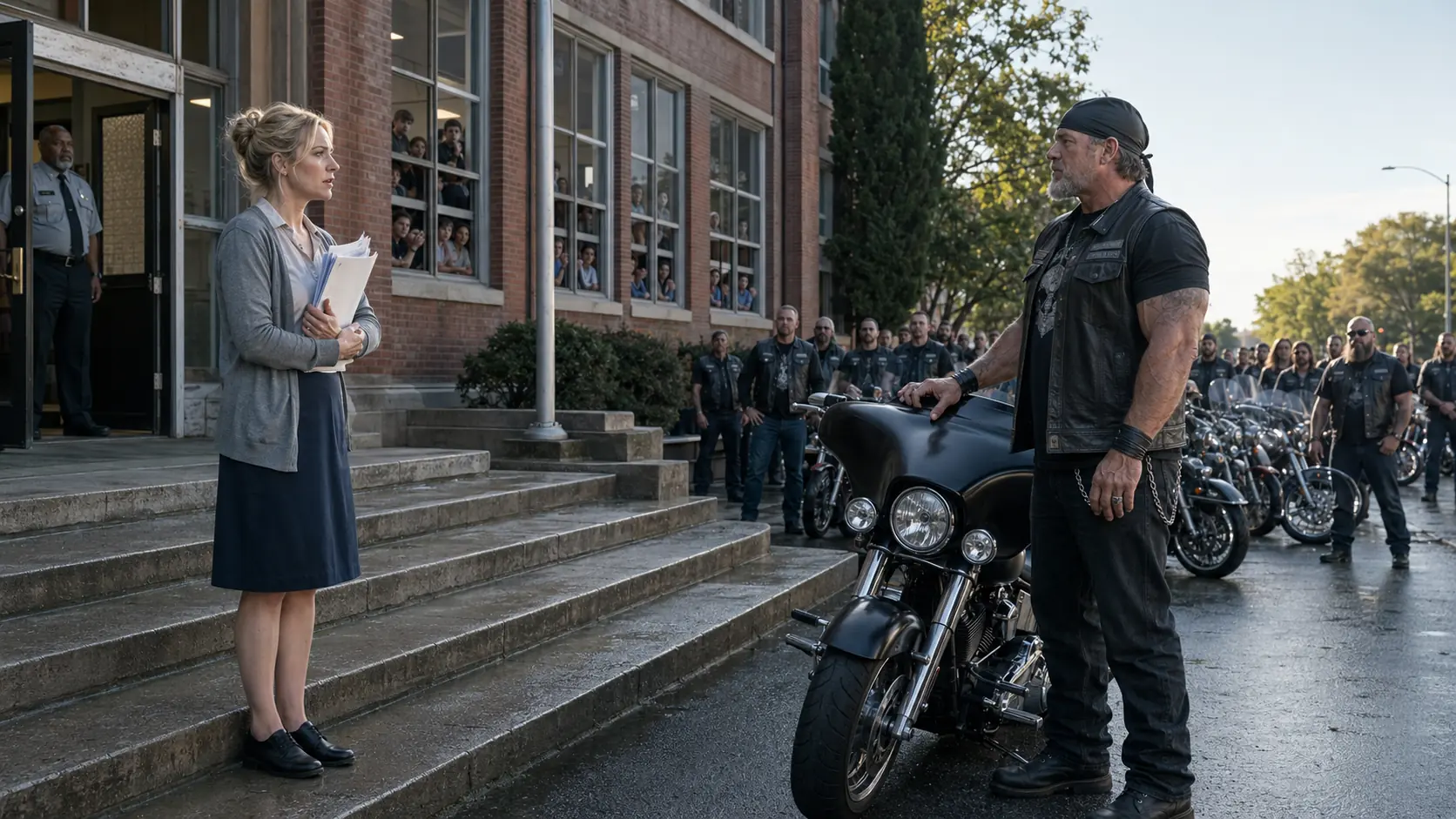
Roosevelt High School sat on the east side of a city that had stopped pretending it could fix itself.
The building had been beautiful once, eighty years ago, with its brick facade, tall windows, and a bell tower that did not ring anymore because some kid had broken the mechanism back in 2019 and the district never had the money to fix it.
Emily pulled into the staff lot at 7:15 the next morning, her eyes gritty from four hours of sleep, a granola bar serving as breakfast because that was all she had time for.
She had taught American history at Roosevelt for six years.
She had watched it slide from struggling, to surviving, to something closer to a war zone with a school bell.
The metal detectors at the front entrance had been installed her second year.
The security guard, a heavyset man named Reggie, who Emily genuinely liked, gave her a tired nod as she walked through.
“Morning, Miss Carter.”
“Morning, Reggie.”
“Quiet so far.”
Reggie’s eyes flicked toward the east hallway, toward the cluster of boys in red bandanas loitering by the lockers, and Emily understood his silence perfectly.
Quiet was relative at Roosevelt High.
The East Side Kings had been operating in and around the school for almost three years now.
What started as a handful of older brothers and cousins running small-time stuff on the corner had metastasized into something that controlled entire hallways, extorted lunch money from freshmen, and made sure everyone—students, teachers, the principal himself—understood who really ran the building between eight and three.
Emily made her way to her classroom, room 214, and found Tyler Brooks already waiting outside her door, hunched against the wall, a fresh bruise blooming under his left eye.
“Tyler.”
Emily’s voice softened immediately, the teacher voice falling away into something more like a worried aunt.
“What happened?”
“Nothing.”
He would not look at her.
He was fifteen, skinny, the kind of kid who carried three different library books at once because reading was the only place he felt safe.
“I fell.”
“Tyler.”
“I fell, Miss Carter.”
His eyes finally met hers, and there was a warning in them.
A plea, really.
Do not make this worse.
Please.
Emily had been down this road enough times to know that if you pushed too hard, you lost them entirely.
She unlocked her door instead.
“Come sit in here until the bell rings. I’ve got ice in my desk.”
She always kept ice in her desk.
A small cooler restocked every week, because at Roosevelt High, a teacher who did not keep first-aid supplies on hand was a teacher who was not paying attention.