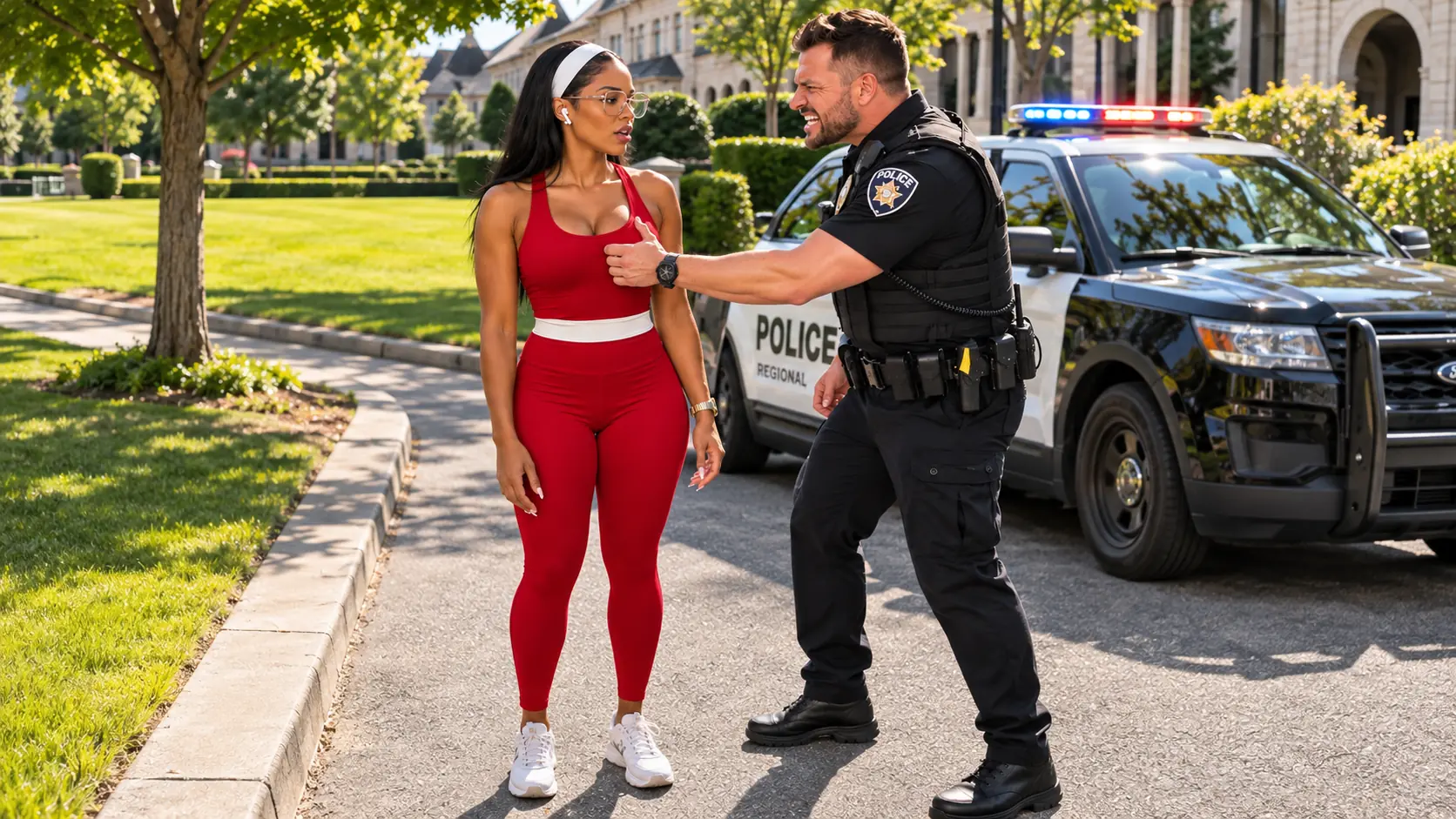
The first thing I noticed was the patrol car slowing down behind me.
The second was that the officer had already decided I was suspicious.
It was 6:18 on a Tuesday morning, and I had exactly forty-two minutes before I needed to become somebody important.
Until then, I wanted to be nobody.
No uniform. No conference room. No polished briefing folder waiting on a long table. No reporters. No city manager introducing me with carefully rehearsed language about new leadership and rebuilding community trust.
Just a woman running.
My name is Dr. Simone Alexandra Bennett. I was forty-three years old, a former deputy commissioner with twenty years in law enforcement, and the newly appointed police chief of the city of Brookhaven Ridge, a prosperous Atlanta suburb that had spent the previous eighteen months pretending its police department didn't have a serious problem.
At seven that morning, I was scheduled to meet the command staff privately. At nine, the city would formally introduce me to the public.
At 6:18, however, I was wearing pale-lavender leggings, a fitted athletic top with a cream-white waist panel, white running shoes, a slim gold fitness watch, and a wide white headband holding back my shoulder-length black hair.
I had moved into the city four days earlier.
My apartment still smelled like cardboard boxes and furniture polish.
I hadn't even unpacked my coffee mugs.
I was running because I needed twenty minutes to remember what it felt like to exist without carrying an entire institution on my shoulders.
Then the patrol car pulled alongside me.
“Ma'am!”
I kept running for another two steps before realizing the officer was speaking to me.
“Ma'am! Stop right there!”
I slowed, removed one earbud, and turned.
The officer behind the wheel was white, perhaps thirty-five, with a square jaw and closely cropped sandy hair. His uniform was immaculate. His expression wasn't.
He looked irritated before we'd exchanged a single sentence.
“Can I help you, Officer?”
“Where are you going?”
I glanced down the sidewalk.
“Running.”
His eyes narrowed.
“Don't get smart with me.”
I looked at his nameplate.
OFFICER BRENT KELLER.
I committed the name to memory.
“I'm answering your question.”
“Where do you live?”
“Nearby.”
“That's not an address.”
“No, it isn't.”
He opened the driver's door.
I watched him step onto the pavement.
There are moments in policing when the first thirty seconds determine whether an encounter becomes a conversation or a confrontation.
This was one of those moments.
I knew the signs.
The unnecessary volume.
The squared shoulders.
The hand resting near the duty belt.
The officer who had stopped asking questions to gather information and had started asking them to establish dominance.
“Identification,” Keller demanded.
“I don't have my wallet with me.”
His mouth tightened.
“Convenient.”
“I'm out for a morning run.”
“People carry identification.”
“Some do.”
He looked me up and down.
“What's your business in this neighborhood?”
I studied him.
“Officer, am I being detained?”
His expression changed.
“What did you say?”
“Am I being detained, or am I free to continue my run?”
He took a step closer.
“You don't get to decide how this conversation goes.”
I kept my voice level.
“I'm asking you to clarify the nature of the encounter.”
He laughed.
Not because anything was funny.
Because he wanted me to understand that he considered my question ridiculous.
“You people always think you know the law.”
I felt something cold move through my chest.
There it was.
Not proof of everything he believed.
But enough to tell me the encounter had taken a dangerous turn.
I looked at him.
“What people?”
His jaw tightened.
“Don't start.”
“I'm asking what you meant.”
“Turn around.”
I didn't move.
“On what grounds?”
He reached for his radio.
“Dispatch, show me out with a suspicious female pedestrian on Willow Bend Drive.”
I glanced at my watch.
6:20.
Forty minutes until the command briefing.
I had spent months reviewing complaints from this department.
Now I was watching one unfold in front of me.
And Officer Brent Keller had no idea.
Chapter 2: The Complaint Nobody Wanted to Read
Three weeks earlier, I had sat in a conference room in Atlanta reviewing the Brookhaven Ridge Police Department's internal reports.
The city manager, Evelyn Ross, had placed three binders in front of me.
“Before you accept the appointment,” she'd said, “you need to understand what you're walking into.”
I opened the first binder.
Use-of-force complaints.
The second.
Traffic-stop disparities.
The third.
Internal disciplinary findings.
Or rather, the absence of them.
Over eighteen months, the department had received seventy-three formal complaints involving officer conduct.
Only four had resulted in sustained findings.
Two involved paperwork violations.
One involved a missed court appearance.
The fourth involved an officer who had damaged a patrol vehicle while backing into a parking barrier.
I looked up.
“Where are the sustained findings for improper stops?”
Evelyn hesitated.
“There aren't any.”
“Unlawful searches?”
“None.”
“Retaliatory arrests?”
“None.”
I closed the binder.
“That's statistically unusual for a department with this complaint volume.”
She nodded.
“We know.”
I turned another page.
One officer's name appeared repeatedly.
Brent Keller.
Seven complaints.
Three involving Black motorists.
Two involving pedestrians.
One involving a teenage boy stopped while walking home from basketball practice.
Another involving an elderly woman questioned outside her own house.
Every complaint had been marked:
NOT SUSTAINED.
I looked at Evelyn.