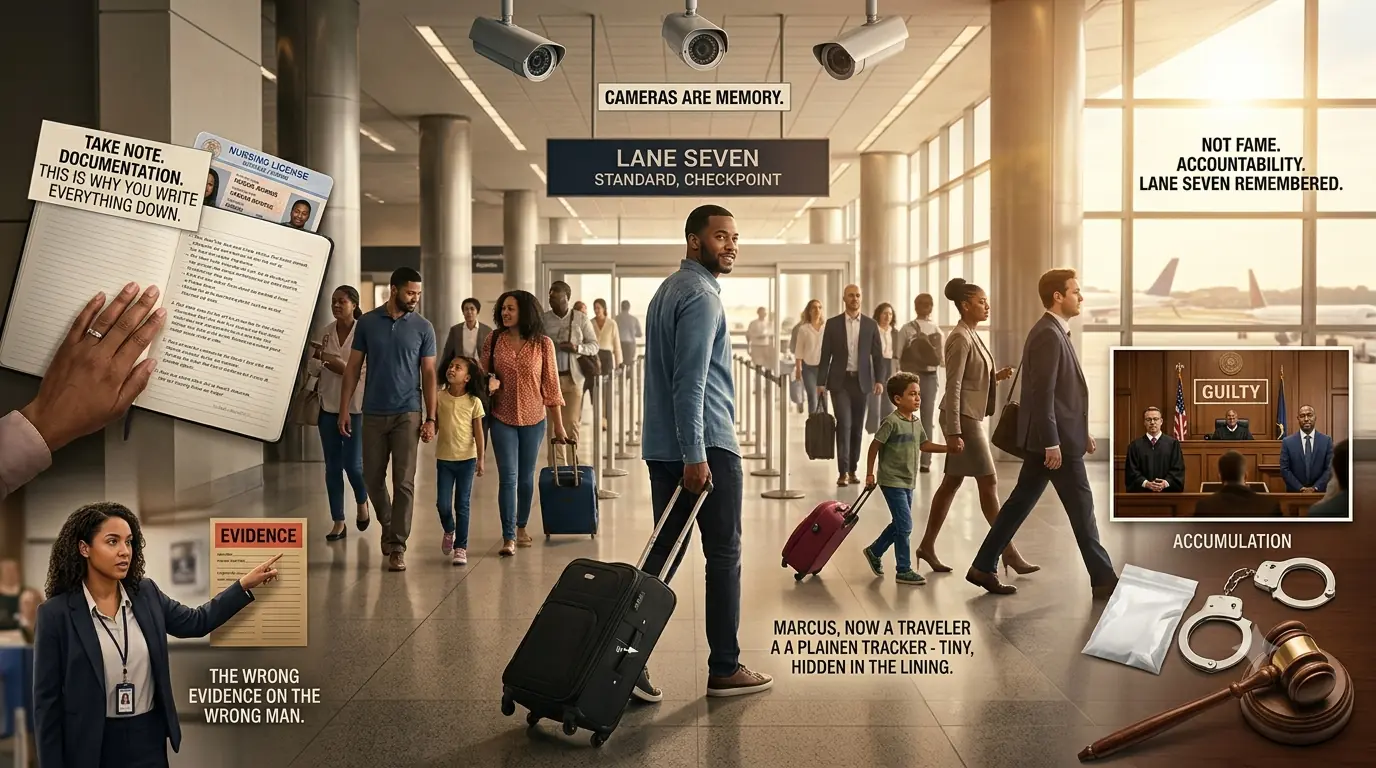
The digital clock on the car's dashboard flashed 7:18 a.m. It was a cold, gray Monday morning. Inside the vast underground parking garage of Hartsfield-Jackson Atlanta International Airport, Marcus Hail stood silently beside his rented sedan. The yellowish light from the neon lamps cast a long shadow of him on the damp concrete. His gaze remained fixed on the black suitcase sitting neatly on the passenger seat.
It looked incredibly ordinary. A dull, canvas suitcase, the kind you could easily find at any grocery store or cheap supermarket.
But that normalcy is at the heart of the entire campaign.
Inside that suitcase were items meticulously calculated with surgical precision: four neatly folded shirts, two pairs of dark trousers, a pair of worn-out running shoes, a hastily bought paperback novel at the gas station, a compact toiletry bag, a phone charger, and a foldable raincoat.
Nothing unusual. Nothing expensive. Nothing, not even the smallest detail, that could attract the attention of airport police or security screening personnel.
However, hidden beneath the fabric lining of the zippered drawer, expertly sewn shut by top FBI technicians, was a tiny GPS tracking device, no bigger than a coin. Not only that, a directional audio recording chip was also embedded in the pull handle. Every item inside the suitcase had been photographed from multiple angles. Every zipper had been examined under a magnifying glass. Every gram of the suitcase's weight had been meticulously recorded in documents signed by three high-ranking agents.
The suitcase was sealed, opened under security camera surveillance, sealed again, and photographed a second time. It was no longer a container for clothes; it was a legal ticking time bomb.
Marcus glanced at his watch. 7:19.
The phone in his jacket pocket vibrated with a dry, rhythmic beat. An encrypted text message appeared on the screen: SUPPORT TEAM READY.
Marcus didn't blink, his thumb gliding across the screen, instantly deleting the message. Three seconds later, a second message arrived: CAMERA IS ON LIVE.
He continued deleting it. Putting the phone back in his pocket, Marcus stepped out of the car, the door slamming shut with a solid "thump" in the quiet parking lot.
At forty-five, Marcus was tall and muscular, yet exuded the unusual calmness of a man who rarely needed to raise his voice to be heard. His shaved head reflected the dim lights of the garage, and his dark brown eyes were as still as a winter lake as he walked toward the passenger terminal.
Today, he wore a form-fitting black polo shirt, dark trousers, and meticulously polished leather shoes. His gold-plated FBI ID badge was discreetly clipped to his belt, hidden beneath the lapel of his shirt.
Today, he wasn't allowed to project the image of Agent Marcus Hail of the Federal Bureau of Investigation. Today, he was simply Marcus Hale – a middle-class businessman, a weary traveler. A man completely unaware of the terrible things that awaited him at Security Lane Seven.
This campaign took them five grueling months to build. Five months of tearful interviews. Five months of sifting through falsified archives. Five months of witnessing innocent people being stripped of pieces of their lives because of a rotten system.
It all started with an anonymous complaint letter sent to the FBI's Atlanta regional office. Initially, it was dismissed as part of the usual stream of complaints about security personnel behavior. But then, a second letter appeared. Then a third. A fourth. They all shared a disturbing common thread: Passengers claimed airport police had "randomly found" drugs in their luggage during secondary screening.
These arrests always follow a chillingly perfect script. First, a passenger is "selected" at random – or so it seems. Their luggage is moved aside for a closer inspection. An officer opens the suitcase and rummages through it. Another officer cleverly positions themselves between the passenger and the inspection table, completely obscuring their view. And then, as if by dark magic, the drugs appear.
The police reports that followed were always written in the same cold, formulaic style: "Contraband found cleverly concealed in passenger's luggage."
The officers involved in these arrests always appeared confident, cool, and authoritative. In contrast, the passengers being arrested were in a state of extreme panic.
Who were they? The FBI painted a portrait of the victims. They weren't notorious drug kingpins. They were young, inexperienced people. They were immigrants with broken English. They were Black or Latino travelers traveling alone. And above all, they were working-class people – people who knew all too well that a single drug possession charge would destroy their entire lives, livelihoods, and families. Without the money for good lawyers, and lacking a voice in society, most were forced to accept plea deals for reduced sentences. Some, for their unwavering convictions, received brutal prison sentences.
Tasha Monroe was one of those determined individuals.
Tasha's story was an open wound in Marcus's file. She was a thirty-two-year-old nurse, flying home after a vacation visiting her sister. Her suitcase contained only three pale blue nurse uniforms.
When asked to undergo a secondary search, Sergeant Dale Mercer – a veteran airport officer – coldly declared he had found a package of cocaine hidden under her uniform. Tasha was stunned. She repeatedly insisted the drugs weren't hers. She knelt on the cold terminal floor, weeping and begging the officers to check the surveillance cameras. She screamed, demanding to be allowed to call a lawyer.