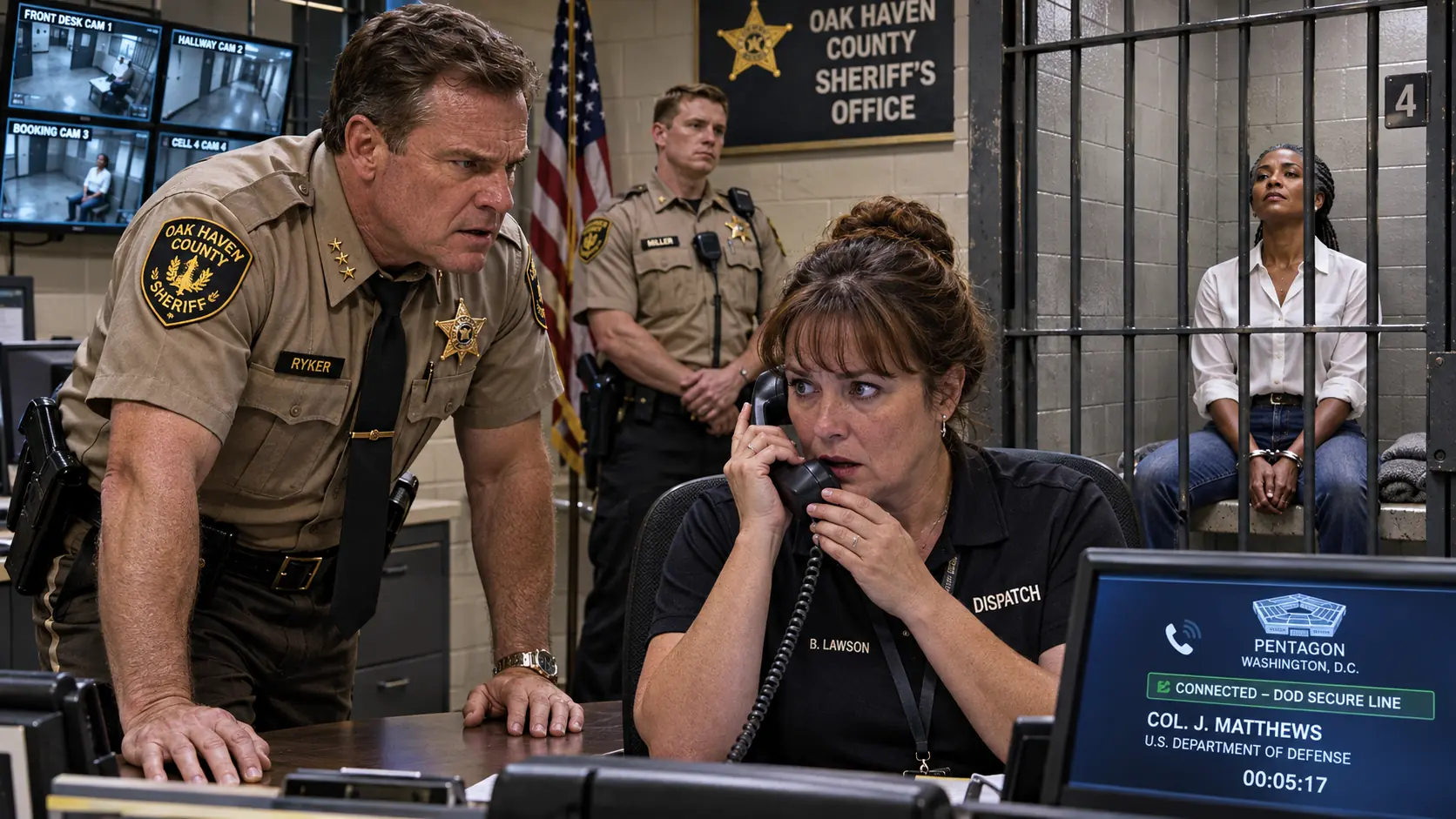
The first thing I heard after the holding cell door slammed shut was Sheriff Thomas Ryker laughing.
Not loudly.
Not with the kind of laughter that came from something genuinely funny.
It was a short, satisfied sound, the kind a man makes when he believes he has just reminded someone of her place.
“Maybe an hour in there will teach her some manners,” he told one of his deputies.
I sat on the narrow concrete bench inside cell four, folded my hands in my lap, and looked at the clock mounted above the hallway.
3:55 p.m.
I had been stopped twenty-four minutes earlier.
In those twenty-four minutes, I had been accused of crossing a center line, ordered out of a rental vehicle, threatened with a search I had not consented to, handcuffed for allegedly resisting, and booked on charges that seemed to grow every time I asked a reasonable question.
My name was Sarah Reynolds.
I was forty-eight years old.
I was a major general in the United States Army.
And I had spent the previous seventy-two hours coordinating a sensitive Department of Defense logistics operation involving multiple commands, civilian contractors, and transportation networks.
But none of that was relevant to whether Sheriff Ryker had lawful grounds to arrest me.
That was precisely why I hadn't mentioned it.
I wanted him to treat me according to the law.
Not according to the number of stars I wore when I was in uniform.
Across the hallway, Deputy Jared Miller stood beside a desk, filling out paperwork.
He was twenty-seven, with closely cropped brown hair and a nervous habit of clicking his pen whenever someone asked him a question he didn't want to answer.
He had clicked it eleven times during my booking.
I counted.
I also remembered his badge number.
417.
Sheriff Ryker's was 101.
The booking deputy, a woman named Nora Ellis, wore badge 263.
The dispatcher at the front desk was Brenda Lawson.
And there were four visible cameras between the booking counter and my holding cell.
One above the front entrance.
One in the booking area.
One covering the corridor.
And one mounted in the corner above cell four's door.
I had noticed that last camera before Ryker ordered the cell locked.
I had also noticed something else.
The small red indicator light was illuminated.
Whether the camera was recording properly, I couldn't know.
But I knew where it was.
And I knew what it could potentially show.
At 3:56, I heard Deputy Miller say, “Sheriff, the vehicle registration came back clean.”
Ryker answered without looking up.
“Didn't ask you.”
Miller hesitated.
“I just thought—”
“That's your problem, Jared. You think too much.”
I looked toward the hallway.
Miller lowered his head.
Ryker continued writing.
Then he said, “Put reckless driving on the sheet.”
Miller stopped clicking his pen.
“Sir?”
“You heard me.”
“The original stop was for failure to maintain lane.”
Ryker looked up.
“Were you there?”
Miller swallowed.
“Yes, sir.”
“Then you saw how she was driving.”
Miller said nothing.
Ryker leaned back in his chair.
“Reckless driving.”
I closed my eyes for one second.
Then opened them.
I had spent most of my career teaching officers and senior leaders the importance of accurate reporting.
An inaccurate record could distort an entire operation.
A missing timestamp could invalidate a logistical decision.
A fabricated entry could turn a routine problem into a national security crisis.
And now, in a rural Georgia sheriff's office, I was listening to a man order a subordinate to add a charge that had not been mentioned at the roadside.
I didn't interrupt.
I didn't shout.
I simply remembered.
At 3:57, Deputy Ellis approached the cell.
“Ma'am?”
I looked up.
“Yes?”
She hesitated.
“Are you comfortable?”
I glanced at the concrete bench.
“As comfortable as circumstances permit.”
She almost smiled.
Then looked toward the front desk.
“Can I get you some water?”
“Yes, please.”
She nodded.
As she turned away, I asked, “Deputy Ellis?”
She stopped.
“Yes?”
“I requested an opportunity to contact an attorney during booking. Can you tell me when that request will be addressed?”
Her expression tightened.
“I'll ask the sheriff.”
“Thank you.”
She walked away.
I watched her approach Ryker.
They spoke quietly.
I couldn't hear every word.
But I heard his answer.
“She can wait.”
Ellis looked toward the cell.
Then returned to her desk.
At 3:59, the front telephone rang.
Brenda Lawson answered.
“Oak Haven Sheriff's Office. Dispatcher Lawson speaking.”
A pause.
“Yes, sir.”
Another pause.
Her posture changed.
She straightened in her chair.
“Could you repeat the name, please?”
I looked toward the clock.
4:00 p.m.
Brenda picked up a pen.
Wrote something.
Then looked toward the hallway.
“Yes, Colonel. One moment.”