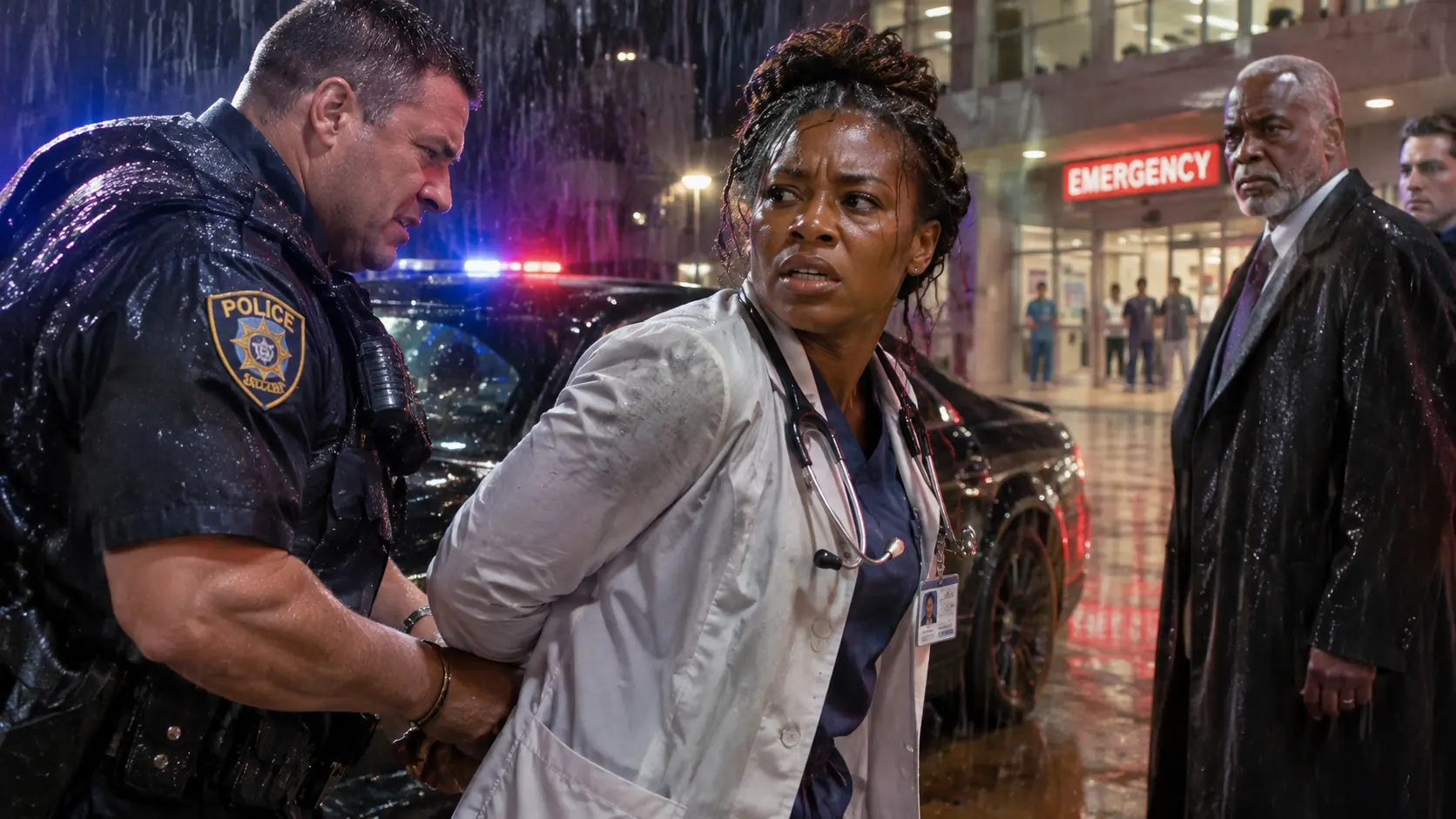
The first time I saw Officer Dale Shuman again, he was sitting across from me in a federal conference room, wearing a gray suit that was too large for his shoulders.
He had lost his badge.
He had lost his job.
And he had spent the better part of three years insisting that he had done nothing wrong.
Now he wanted to tell me something he claimed could change everything.
“Dr. Okafor,” he said, his voice barely above a whisper, “I wasn't supposed to stop you that night.”
I studied him across the table.
“Then why did you?”
He looked toward the attorney sitting beside him.
She gave him a small nod.
Shuman swallowed.
“Because somebody told me your car would be coming.”
For a moment, the room seemed to become very quiet.
I had spent three years trying to put that night behind me.
The rain.
The flashing lights.
The cold metal around my wrists.
The knowledge that a patient was waiting for me inside an operating room while an officer refused to believe my identification.
I had testified.
I had answered questions.
I had watched attorneys examine footage of my detention frame by frame.
And I had returned to work because people still needed surgery, regardless of what had happened to me.
But this was different.
Shuman wasn't simply admitting that he had made an unsupported decision.
He was suggesting that someone had known I would be driving toward Hargrove Federal Medical Center before I ever received the emergency call.
I leaned forward.
“Who told you?”
His eyes dropped to the table.
“That,” he said, “is why I asked for this meeting.”
My name is Dr. Lydia Renee Okafor.
I was forty-six years old when a police officer handcuffed me outside the hospital where I served as chief of neurosurgery.
I had been called in to operate on Congressman Devon Ashworth, who had suffered a critical head injury.
The hospital had assembled an emergency surgical team.
Every minute mattered.
And I was less than a minute from the restricted staff entrance when Officer Dale Shuman stopped my car.
He questioned my identity.
He dismissed my hospital credentials.
He detained me even after receiving information that supported my explanation.
I spent forty-two minutes in the back of his patrol vehicle.
Forty-two minutes during which a patient in critical condition waited for the surgeon who had been called to treat him.
Director Raymond Collier, the congressman's father-in-law, arrived and intervened.
I reached the operating room.
The surgery succeeded.
Congressman Ashworth survived.
Shuman faced criminal and administrative consequences for his conduct.
The hospital reviewed its emergency access procedures.
And Congress began debating legislation concerning the protection of emergency medical personnel.
For a while, people called it a story about justice.
I never thought it was that simple.
I thought it was a story about how quickly someone could lose precious time when another person decided that an assumption mattered more than evidence.
Then Shuman asked to meet me.
And the story became something else.
The meeting had been arranged through my attorney, Rebecca Lawson.
Rebecca was fifty-three, sharp-eyed, and extraordinarily difficult to intimidate.
She had represented physicians, hospitals, and healthcare organizations for more than twenty years.
When Shuman's attorney first contacted her, she advised me not to respond.
“He's already been through the legal process,” she told me.
“I know.”
“He may be trying to reopen issues that were decided.”
“Possibly.”
“And you have no obligation to meet him.”
I looked at her.
“Then why did his attorney contact you?”
Rebecca hesitated.
“She says he has information concerning the events before your traffic stop.”
“What information?”
“She won't say without a formal meeting.”
I considered that.
“Has she contacted investigators?”
“Yes. According to her, she has also submitted materials to the appropriate authorities.”
“Have those materials been verified?”
“Not yet, as far as we know.”
I nodded.
“Then I want any meeting documented, and I want to understand its purpose before agreeing.”
Rebecca studied me.
“You're considering it?”
“Yes.”
“Why?”
I looked toward the window.
“Because I still don't know why he stopped me.”
Three weeks later, I sat across from Dale Shuman in a conference room at Rebecca's law firm.
A neutral facilitator was present.
Both attorneys had agreed on the boundaries of the discussion.
Nothing about the meeting would replace official investigative procedures.
No one would promise immunity.
No one would make unsupported public accusations.
And I was free to leave whenever I wanted.
Shuman looked older than I remembered.
His hair had thinned.
His face was drawn.
The confidence he had displayed on the restricted access road was gone.