The city manager, the police chief, and the city attorney sat on one side. Marcus and David sat on the other. The city attorney looked exhausted. Dr. Sterling, we are prepared to offer the full amount demanded in the suit, $2.1 million.
We admit no liability, but we want to close this chapter. Money is fine, Marcus said, his hands folded on the table. But I have conditions. Conditions, the chief bristled. This is a monetary settlement.
Not anymore, Marcus said. If you want me to sign, Officer Branigan is terminated immediately. Not allowed to resign, terminated for cause. And you will report the termination to the state certification board so he cannot be hired by the department down the road. He loses his badge forever.
The room went silent. The police union would fight that. It was unprecedented to demand a firing as part of a civil settlement. We can't guarantee the certification board's decision, the city attorney said. Then you will testify at the hearing, Marcus countered.
You will present the evidence we found. You will do everything in your power to ensure he never carries a weapon under the color of law again. Or we can go to trial and I will put the chief on the stand and ask him about that memo he ignored. The chief looked at the city manager. The city manager looked at the budget forecast for a jury trial loss.
Done. The city manager said he's gone. One more thing. Marcus said the department will implement a mandatory policy. No ID checks on private property without reasonable articulable suspicion of a specific crime.
Suspicious person is not enough. You will write that into the manual and you will name it the Sterling rule. The chief ground his teeth. Fine. The papers were signed.
The fallout was swift. Kyle Brangan was fired the next day. The union tried to make noise, but the video was too damning. And the discovery of the ignored memo made him radioactive. He was descertified by the state board 3 months later.
At 28, his career in law enforcement was over. He ended up working as a dispatcher for a trucking logistics company, answering phones far away from any position of power. Marcus sat in his garage. It was Saturday morning, one year after the incident. The garage door was open.
The spring breeze was blowing. The 1967 Mustang sat on its tires, the suspension work finally finished. He held the check for $1.4 million, the post tax, postlegal fee amount, in his hand. It was a life-changing amount of money for most people. For Marcus, it was a tool.
He picked up his phone and called David. It's time to set up the trust, Marcus said. The Sterling Justice Initiative," David asked. "Yes, I want this money to pay for legal defense for homeowners who can't afford you. The next time a Branigan tries to bully a janitor or a teacher in their own driveway, I want a lawyer there within the hour. " "You're a good man, Marcus.
I'm a lucky man," Marcus corrected. "That's the problem. " He hung up the phone. He walked over to the Mustang and wiped a speck of dust from the fender. He picked up his torque wrench, the same tool that had almost gotten him killed. He waited in his hand.
It was heavy, solid, reel. He looked out at the street. A patrol car drove by. It was a new officer, a young woman. She slowed down, looked at Marcus, and gave a polite wave.
Marcus watched her carefully. He didn't wave back immediately. He waited to see if she would keep driving. She did. Only then did he raise his hand.
Sir, drop the weapon now. Get on the ground or this turns lethal. Officer, this is a torque wrench. I'm in my own garage. I am not a threat.
Drop it. Hands on your head. Stop resisting. I'm standing still. My hands are visible.
You are pointing a gun at a homeowner. Turn around now. Sir, drop the weapon. I said, "Drop the weapon and get on the ground right now. You are trembling on the edge of a lethal force encounter. " The voice cracked with an unstable mixture of adrenaline and fear, shattering the quiet hum of a Saturday morning in the upscale suburb of Oak Creek.
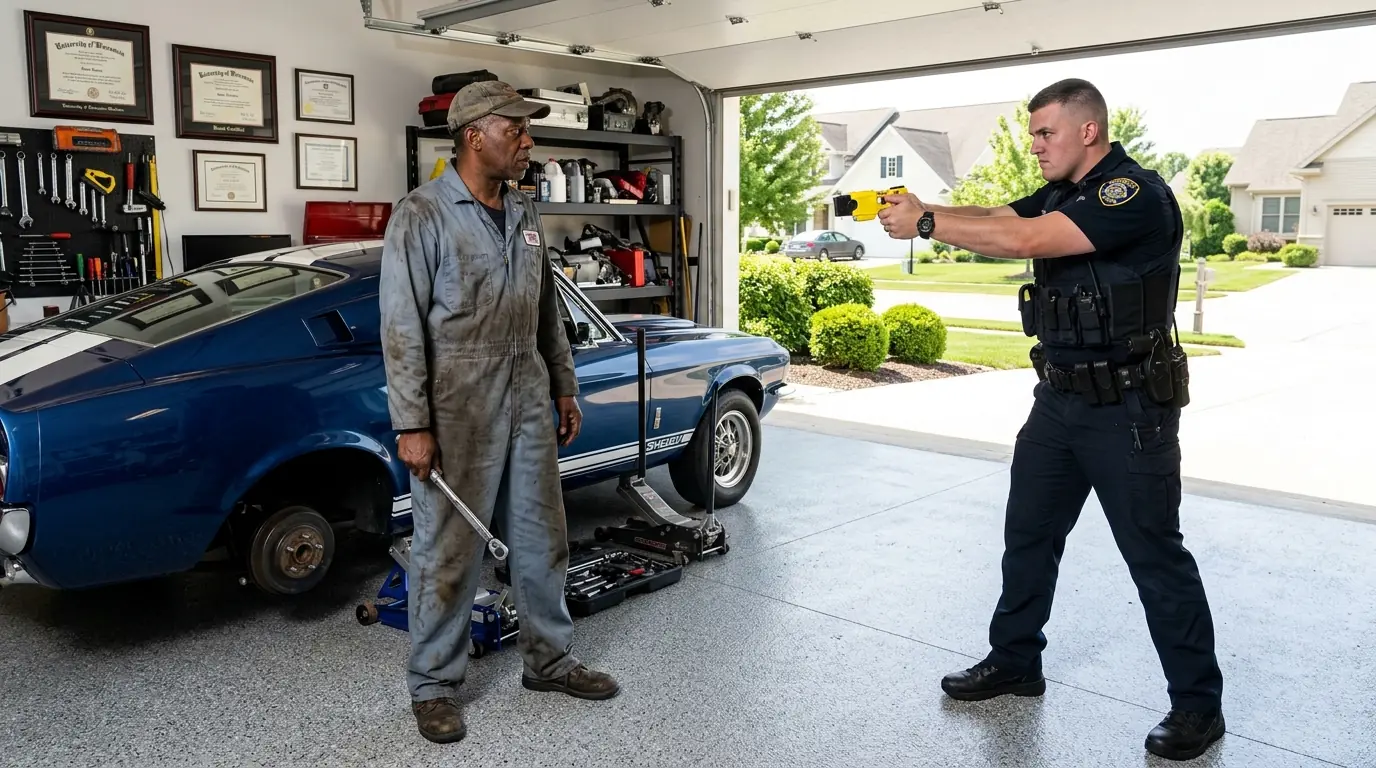
But the man on the receiving end of the order wasn't holding a weapon. He was holding a calibrated torque wrench. And he wasn't a criminal. He was Dr. Marcus Sterling, the 58-year-old chief of neurosurgery at St.
Jude's Medical Center, a man whose hands had saved more lives than the entire police department combined. Officer Marcus said his voice terrifyingly calm. The kind of calm that comes from decades of operating on aneurisms where a millimeter of tremble means death. This is a torque wrench. I am tightening the lug nuts on my vehicle.
I am standing in my own garage. I'm not going to ask you again. Drop it some. Officer Kyle Brangan screamed his service pistol unholstered and leveled at Marcus' chest. Brangan was 27 years old, a transfer hire from a rural county with a haircut that was too tight and a temper that was too short.
He saw a black man in a garage with a metal tool and his training had seemingly evaporated, replaced by a dangerous tunnel vision. The scene was surreal. The garage was pristine, the floor coated in gray epoxy, the walls lined with framed medical degrees, and photos of Marcus with governors and senators. In the center sat a 1967 Shelby GT500 Mustang, partially disassembled a labor of love that Marcus had been restoring for 3 years. Marcus stood next to the left rear tire, wearing grease stained coveralls and a vintage cap.
I am slowly placing the tool on the workbench, Marcus announced, moving with deliberate slowness. He knew that any sudden twitch could end his life. He placed the wrench on the metal table. My hands are empty. I am now raising them.
Officer, you are making a catastrophic error. Look around you. Does this look like a burglary? Turn around. Hands on your head.
Interlace your fingers. Brandan advanced, weapons still drawn. We had a call of a suspicious individual breaking into a garage at this address. You fit the description. The description?
Marcus asked his back now to the officer, his hands laced behind a head that held enough medical knowledge to fill a library. Let me guess. A black male in a garage officer. I own this home. My name is on the deed.
My name is on the mailbox. If you take a breath and look at the registration on the windshield of this car, you will see it matches the name on the house. "Shut up. Stop resisting," Branigan yelled, closing the distance. "I am standing perfectly still," Marcus said, his voice dropping an octave, becoming the voice he used when a resident made a mistake in the O.
"I am not resisting, I am explaining. " And you are currently pointing a loaded firearm at a homeowner in a gated community. The camera above my garage door is recording this. The camera on your chest is recording this. Before you touch me, I want you to ask yourself if you are absolutely certain that you are right. Brangan hesitated.
For a split second, the reality of the situation almost pierced through his bias. The house was a $3 million colonial. The car was worth six figures. The man spoke with the diction of an Ivy League graduate. But Brangan had already committed.
He had drawn his weapon. He had shouted commands. To back down now would be to admit he had panicked. It would be a loss of face. And for a man like Kyle Brangan, losing face was worse than being wrong.
We'll figure out who owns what when you're in cuffs. Brenan snapped, holstering his weapon and reaching for his restraints. "Right now, you're detained for investigation of burglary and failure to obey a lawful order. " "I am not a suspect," Marcus said, feeling the officer's hand grab his wrist. "I am a citizen in his own home, and you are about to end your career. " "To understand how this Saturday morning turned into a constitutional crisis, we have to step back 20 minutes. Marcus Sterling had woken up at 600 a.m.