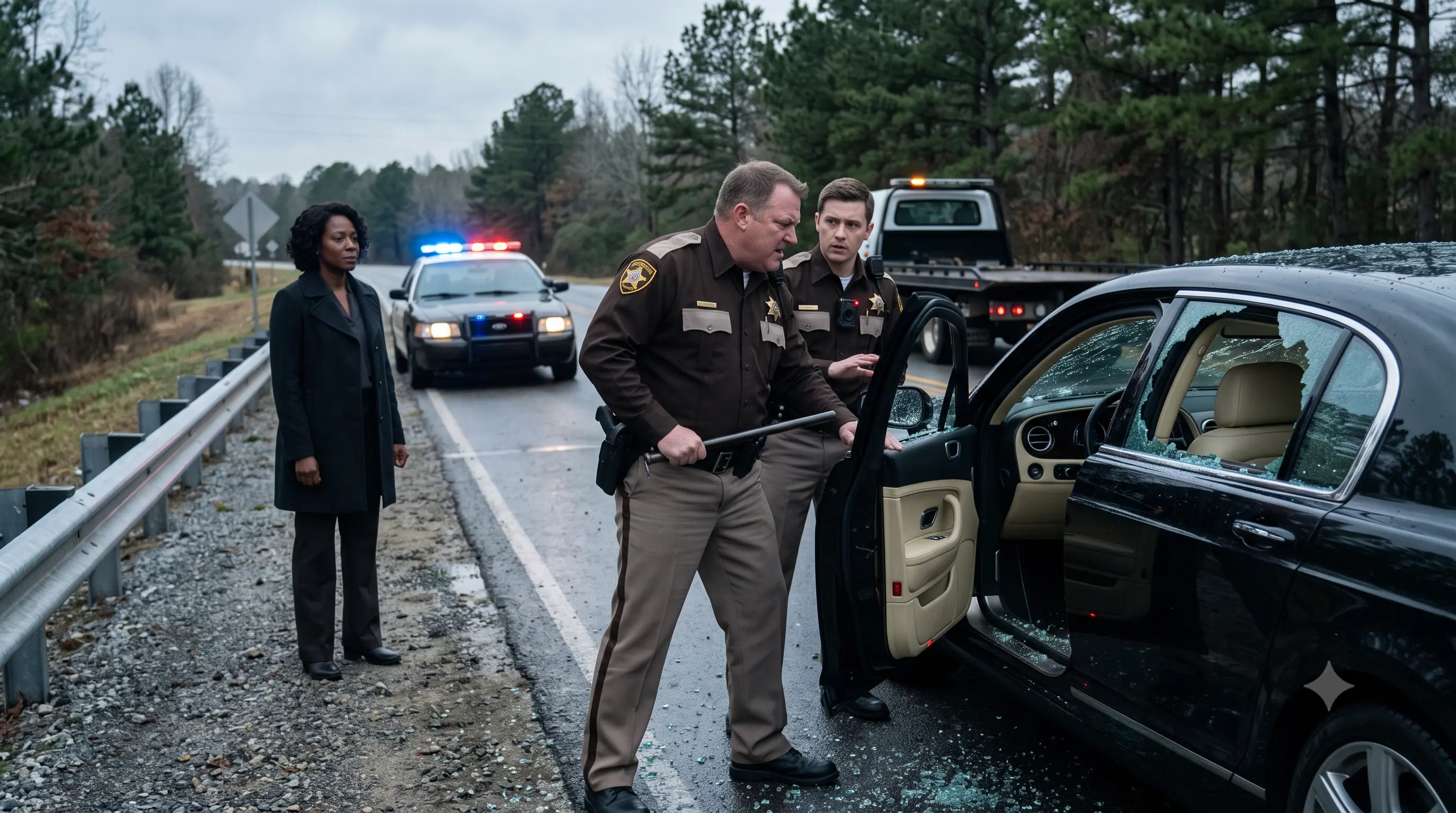
The last thing Deputy Derek Maddox expected on that Sunday was to lose control of the story he had always been able to tell about himself. By midnight, the woman whose Bentley he had damaged on County Road 14 would become the sheriff of Cedar Ridge County. But the important part of that day was not the surprise at the station. It was what happened before anyone knew her title: a driver asked why she had been stopped, a deputy treated questions as defiance, and a younger officer had to decide whether to report what he saw.
Maya Whitfield was forty-eight, a former prosecutor and public-integrity investigator. She had accepted the county commission's appointment after a troubled period for the sheriff's office. On the way to Cedar Ridge, Deputy Maddox pulled her over, alleging an administrative problem with her Bentley's registration. Deputy Aaron Bell checked the plate and VIN and found them valid. Maddox nevertheless demanded permission to search. Maya refused. Maddox struck the windows with his baton, then searched the vehicle and found nothing unlawful. Aaron eventually activated his body camera and objected. A passing motorist stopped; a tow operator took the damaged car away. Maya wrote down the names, times, and incident number. At 11:47 p.m. she arrived at the station, where the change of command would put the encounter in a different light.
“You have no idea who you're dealing with.”
Maya looked at Derek Maddox without answering. She had heard variations of that sentence in courthouses, interview rooms, and conference calls where officials mistook an impressive title for a legal argument. Usually it was spoken by someone who had begun to realize that the facts were no longer helping him.
Rain ran down the side of the tow truck. The operator had finished securing the Bentley, but he remained by the cab, looking from the deputy to the woman standing on the shoulder. Maya could tell he wanted to leave and also did not want to abandon her there.
“I've asked for the incident number,” she said. “Deputy Bell provided it. I'd also like to know whether I am being detained.”
Derek glanced at Aaron, as though the younger deputy had personally arranged the question.
“You can go,” Derek said.
“Thank you.”
Maya walked toward the tow operator. She had booked a room at a small hotel in Cedar Ridge, and the operator said he could take her there after dropping the car at a secured lot. She asked him to photograph the vehicle as it was loaded, including the interior and the glass on the pavement. He agreed. She took her own photographs from a safe distance, then wrote down his name and the towing company's number.
Aaron followed her a few steps. “Ma'am?”
She turned.
“My camera was on for the last part,” he said. “I didn't switch it on soon enough.”
Maya studied him. His rain-darkened uniform looked suddenly too large for his shoulders.
“Tell your supervisor exactly when you activated it,” she said. “Don't try to improve the story. Don't make it worse. Just tell it accurately.”
Aaron nodded. Behind him, Derek had already climbed into his cruiser. He was speaking into his radio with the windows closed.
“And Deputy Bell,” Maya added, “write down what you remember while it's fresh.”
He looked at her as if he wanted to ask why she cared about his account after everything that had happened. Instead, he said, “Yes, ma'am.”
The tow truck pulled away at 5:31. Maya watched the patrol cars diminish in the side mirror. The road curved through a stand of pines, and within a minute the broken Bentley was out of sight behind the truck's rear window. She folded her hands in her lap. She could still hear the first impact. She wondered whether that sound would return later, when she was trying to sleep.
The driver, whose name was Calvin Ross, kept his eyes on the road.
“Are you going to file a complaint?” he asked.
“Yes.”
“Good.” He hesitated. “People around here don't always do that.”
“Why not?”
Calvin gave a humorless laugh. “You saw him.”
Maya looked out at the wet fields. The appointment packet in her briefcase contained summaries of civilian complaints going back five years. Derek Maddox's name appeared in several. The complaints had been marked unsubstantiated or resolved through informal counseling. One described an unnecessary vehicle search. Another alleged that a driver had been threatened with arrest for asking to speak to a supervisor. None had resulted in sustained discipline.
She had read those summaries the night before. She had intended to ask for the underlying files after taking office.
Now she knew that the summaries were not enough.
At the hotel, Maya checked in under her own name. She did not ask the clerk to treat her differently. She asked whether there was a quiet place where she could make a call, and the clerk directed her to a small business room beside the lobby. It held a printer, two chairs, and a computer that looked older than the building.