No evidence of a crime had been found.
But to the people outside, none of that was visible.
What they saw was a line of patrol vehicles in front of the shop.
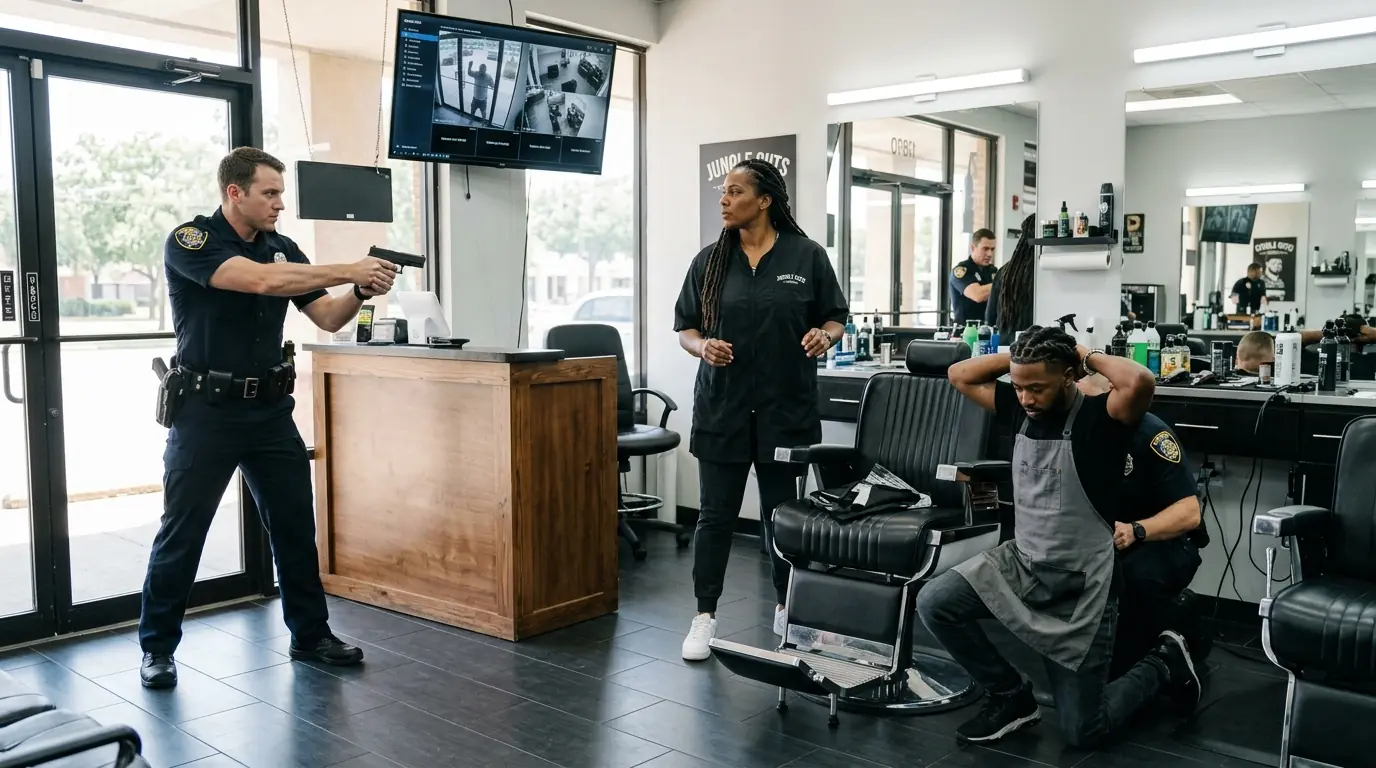
They saw barbers and customers being led out with their hands raised.
They saw Teal Weaver, the owner, placed against a police cruiser while officers searched her building.
Phones appeared almost immediately.
A teenager across the street recorded through the fence of the high school.
A woman leaving the pharmacy slowed her car and filmed.
A delivery driver posted a short video online with the caption:
Police raid barbershop across from Westfield High.
Before the officers had finished clearing the first room, the video had begun spreading.
Teal had opened Jungle Cuts because she wanted a place that felt safe.
Not fashionable.
Not exclusive.
Safe.
Her father had cut hair in their kitchen when she was a child. Men from the neighborhood sat beneath an old bedsheet while he worked with a pair of clippers plugged into an extension cord.
Teal remembered the conversations more clearly than the haircuts.
Men discussed jobs they had lost and jobs they hoped to find. Teenagers asked questions they were too embarrassed to ask their parents. Fathers brought sons who had stopped speaking to them and found that sitting side by side made silence easier.
A barbershop was never only a barbershop.
After working for several salon chains, Teal saved enough money to lease a narrow storefront across from Westfield High School.
The first year nearly ended her dream.
A barber she hired caused a confrontation on his first day. Two customers argued, a chair was damaged, and a video posted online made the shop look like a place where fights happened regularly.
Teal fired the barber and paid for the repairs herself.
Three years later, one of her longest-serving barbers, Marcus Hill, died unexpectedly from a heart condition after closing the shop one evening. His empty chair remained covered for a month.
Police had visited the building before.
Once, officers came looking for teenagers who had damaged cars in the school parking lot.
Another time, a special-needs adult who regularly jogged along the street went missing, and officers asked whether anyone in the shop had seen him.
On one occasion, Teal called police herself after several teenagers refused to leave and began threatening customers.
Every visit created rumors.
People driving past saw patrol cars and formed their own explanations.
Drugs.
Fighting.
Gang activity.
Trouble.
Teal spent years trying to build a reputation strong enough to survive assumptions.
She sponsored youth basketball uniforms.
She gave free haircuts before the first day of school.
Every December, Jungle Cuts collected coats and toys for local families.
Students who maintained good grades received discounted cuts.
A retired teacher sat near the entrance on Saturdays and helped children with homework while they waited.
The shop was not perfect.
No real place was.
But it belonged to the community.
That Saturday afternoon, every chair was occupied.
A college student waited for a haircut before a job interview.
A father brought both sons for their monthly cuts.
An elderly customer slept beneath a warm towel near the shampoo station.
There were four children under twelve inside.
Twenty minutes before police arrived, a man Teal did not recognize approached the side entrance.
The side door was normally used by employees and delivery workers. A small coded lockbox beside it held a spare key for emergencies.
Security footage later showed the man pulling hard on the lockbox.
When it did not open, he struck it with the palm of his hand.
Then he pulled again.
Malik noticed through the back window.
“Somebody’s messing with the side door,” he told Teal.
She walked into the service hallway and looked through the glass.
The stranger wore a gray hooded sweatshirt despite the heat. He had a short beard and a red baseball cap.
Teal opened the inner door but kept the security door locked.
“Can I help you?”