“Cole… is that really you?”
Eleanor Whitaker’s voice trembled so badly that she almost did not recognize it as her own.
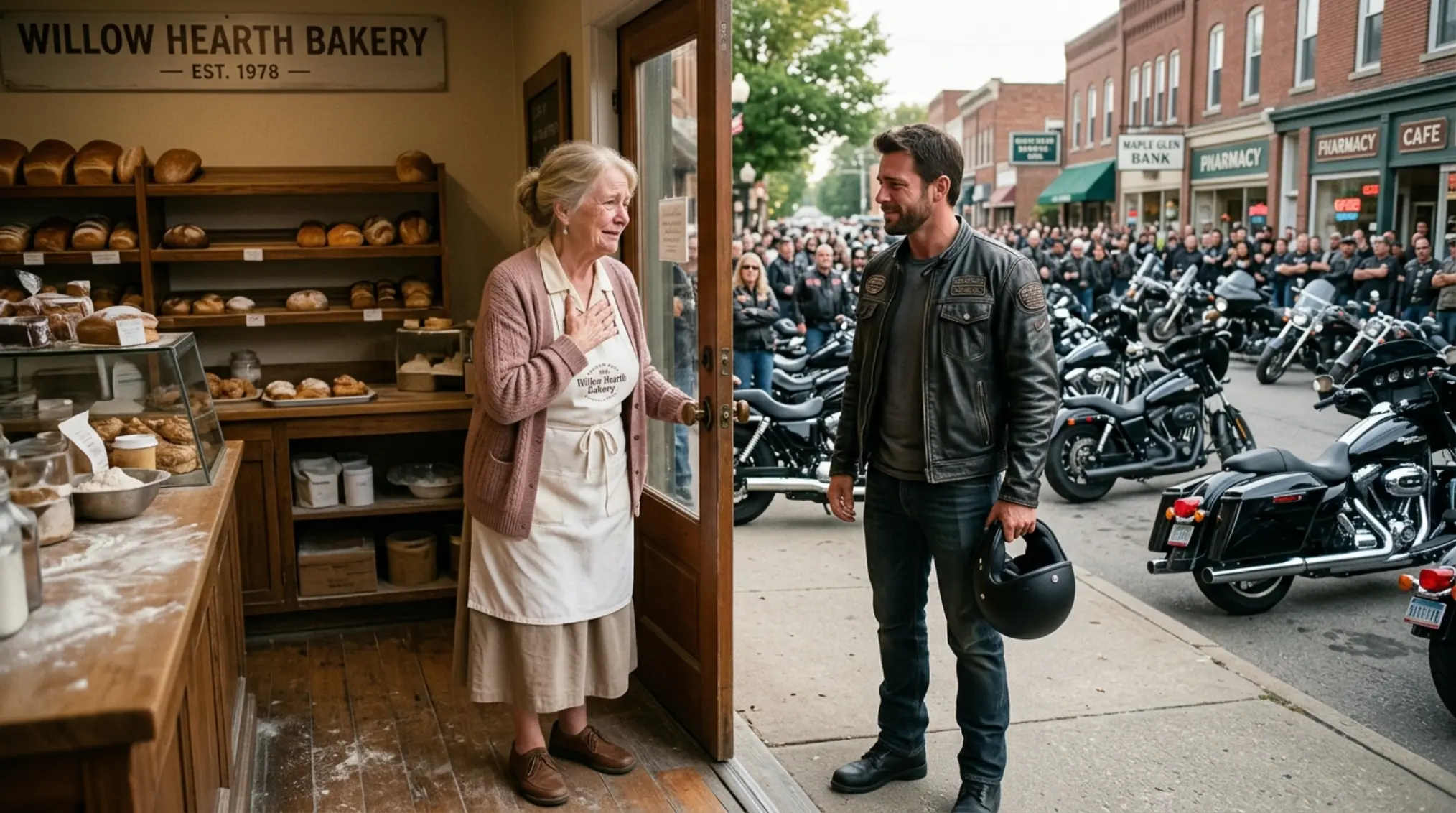
She stood just inside the open doorway of Willow Hearth Bakery in Maple Glen, Indiana, one hand pressed against the soft dusty-pink cardigan covering her chest. Morning sunlight spilled across the old wooden floor behind her, illuminating trays of cinnamon rolls, loaves of bread, and butter cookies she had arranged before sunrise as she had done nearly every morning for twenty-five years. Yet for once, Eleanor was not thinking about dough, ovens, customers, or the coffee she had forgotten to turn off.
She was staring at the man standing outside.
He looked nothing like the sixteen-year-old boy she remembered.
The frightened teenager had been painfully thin, wrapped inside an oversized coat with torn cuffs, his hair dirty from days without proper shelter, his eyes hollow from hunger and exhaustion. This man was thirty-seven now, broad-shouldered and strong, with short dark-brown hair, a neatly trimmed beard, and an old black leather jacket fitted across an athletic frame.
A black motorcycle helmet hung from one hand.
Behind him, Main Street had almost disappeared beneath motorcycles.
Rows of them.
Black touring bikes, cruisers, old custom machines, polished chrome reflecting morning light.
Eleanor had counted them through the bakery window before anyone stopped moving.
Ninety-seven.
And around those motorcycles stood riders in leather jackets and denim, men and women ranging from their twenties into their seventies. Some had gray beards. Some wore patched vests. Some held helmets under their arms.
All of them were silent.
Waiting.
The man outside the bakery looked directly at Eleanor.
Then he smiled.
“You told a hungry kid he mattered, Mrs. Whitaker,” he said softly. “I never forgot it.”
Eleanor’s breath caught.
Twenty-one years disappeared.
Suddenly she could see him again exactly as he had been.
Sixteen.
Cold.
Hungry.
Standing outside her bakery before sunrise.
The memory began on a bitter January morning when Maple Glen was buried beneath snow.
Eleanor had been forty-five then.
Her husband, Daniel, had died five months earlier after a sudden heart attack while repairing a loose railing behind the bakery. They had been married twenty-three years. Willow Hearth had been their dream, built from savings, borrowed money, and years of twelve-hour days.
After Daniel died, Eleanor nearly sold it.
Every corner reminded her of him.
The wooden front counter had been built by his hands.
The brass bell above the entrance had been something he found at an antique market.
The heavy wooden window frame overlooking Main Street still carried a tiny dent where he once dropped a hammer during renovations and blamed “structural personality.”
Even the bakery’s name had been his idea.
“A hearth is where people come when they need warmth,” Daniel had told her.