The rain had turned Fisherman Street into a sheet of dark glass when seven-year-old Maya Brooks stepped onto the yellow center line. The small Black American girl wore a pale pink raincoat that reached her knees, red rubber boots, and a hood that barely contained her wet black curls. She stretched both arms as wide as they could go while five hundred motorcycles thundered toward her beneath a sky heavy with storm clouds. Every headlight reflected against the pavement like a moving wall of fire.
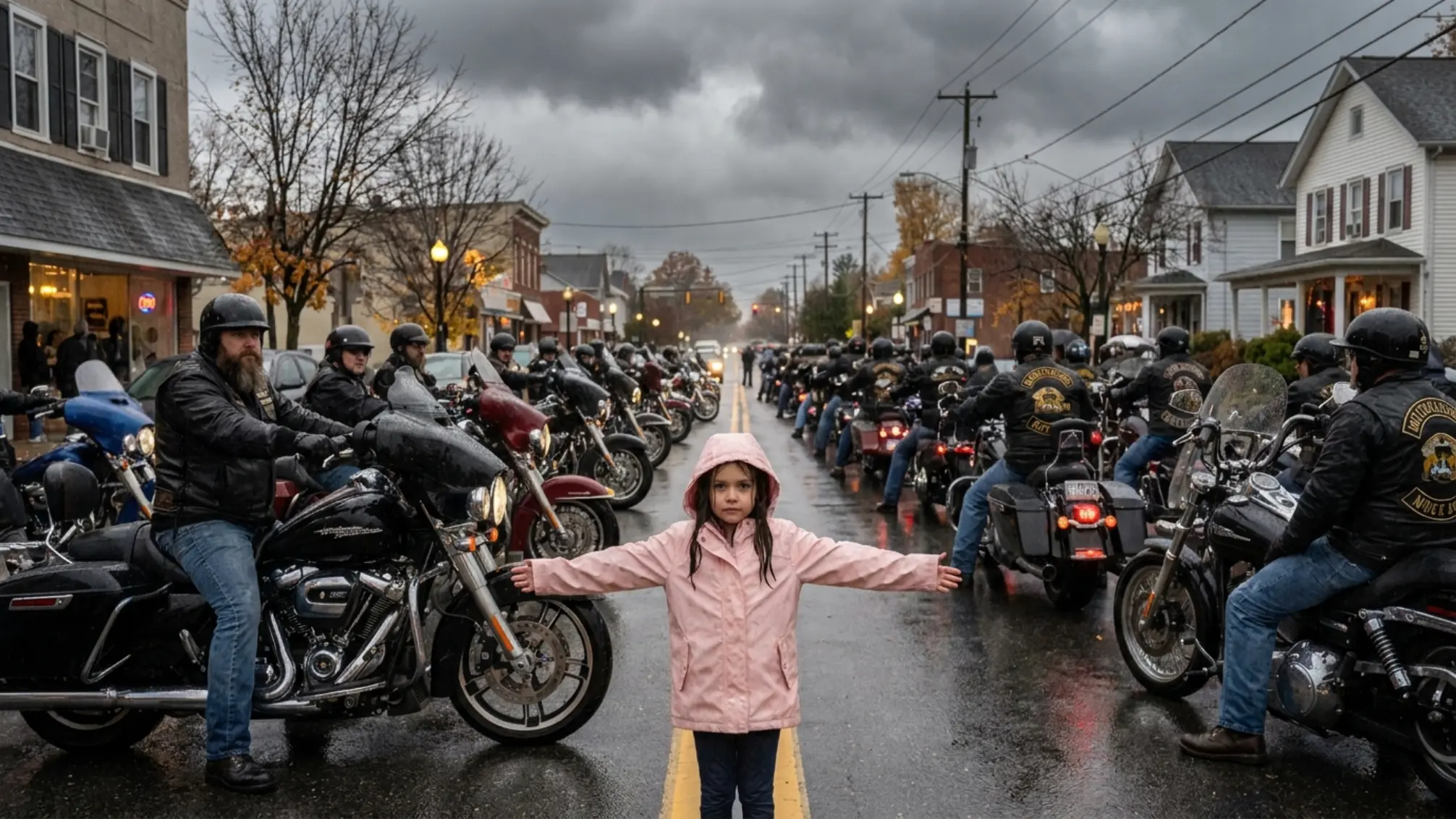
At the front of the formation rode Jack “Grizzly” Mercer, a forty-six-year-old white American biker with broad shoulders, a thick brown-and-gray beard, and pale blue eyes hardened by thirty years on the road. He saw Maya only seconds before reaching the intersection. His hand closed around the brake, his rear tire shifted slightly on the wet asphalt, and the enormous black motorcycle stopped less than twenty feet from her. Behind him, hundreds of riders slowed one by one until the deafening roar became a scattered rumble and then complete silence.
Five hundred leather-clad American bikers stared at one little girl.
Maya’s arms trembled, but she did not lower them.
“Don’t touch your bikes,” she called, her voice nearly disappearing beneath the rain. “Please come with me.”
Jack placed both boots on the road but kept his hands on the handlebars. “Why are you standing out here, sweetheart?”
Maya swallowed. “Because my daddy said bikers help people.”
Her lower lip began to shake.
“And my mommy won’t wake up.”
Jack shut off his engine.
The riders behind him did the same without being told. The remaining mechanical vibration faded from the street, leaving the hiss of rain against leather, chrome, and pavement. Jack stepped away from his motorcycle and approached slowly, careful not to frighten the child.
“Where is your mother?”
Maya pointed toward an abandoned four-story textile warehouse near the end of the block. Its upper windows were broken, its bricks were stained black by decades of weather, and plywood covered most of the ground-floor openings. A faded sign above the entrance still displayed the words MILLER TEXTILES, though the company had closed more than twenty years earlier.
“She’s inside,” Maya said. “But you can’t start the motorcycles again.”
“Why not?”
“The air smells wrong.”
Jack looked toward the warehouse. Even through the rain, he detected a faint chemical odor drifting from that direction. It was not ordinary smoke. It smelled like gasoline mixed with rotten eggs and hot metal.
“How many people are in there?” he asked.
Maya hesitated. “A lot.”
The answer changed Jack’s expression.
He turned toward the first rows of riders. “No engines. Nobody lights a cigarette. Boone, call emergency services and tell them we may have a gas leak with multiple victims. Doc, bring every medical kit we have.”
A massive white American biker named Boone Harrison lifted his phone immediately. Beside him, Dr. Samuel Reed, a fifty-eight-year-old Black American emergency physician who rode with the club on weekends, removed two bright red trauma bags from his touring motorcycle.