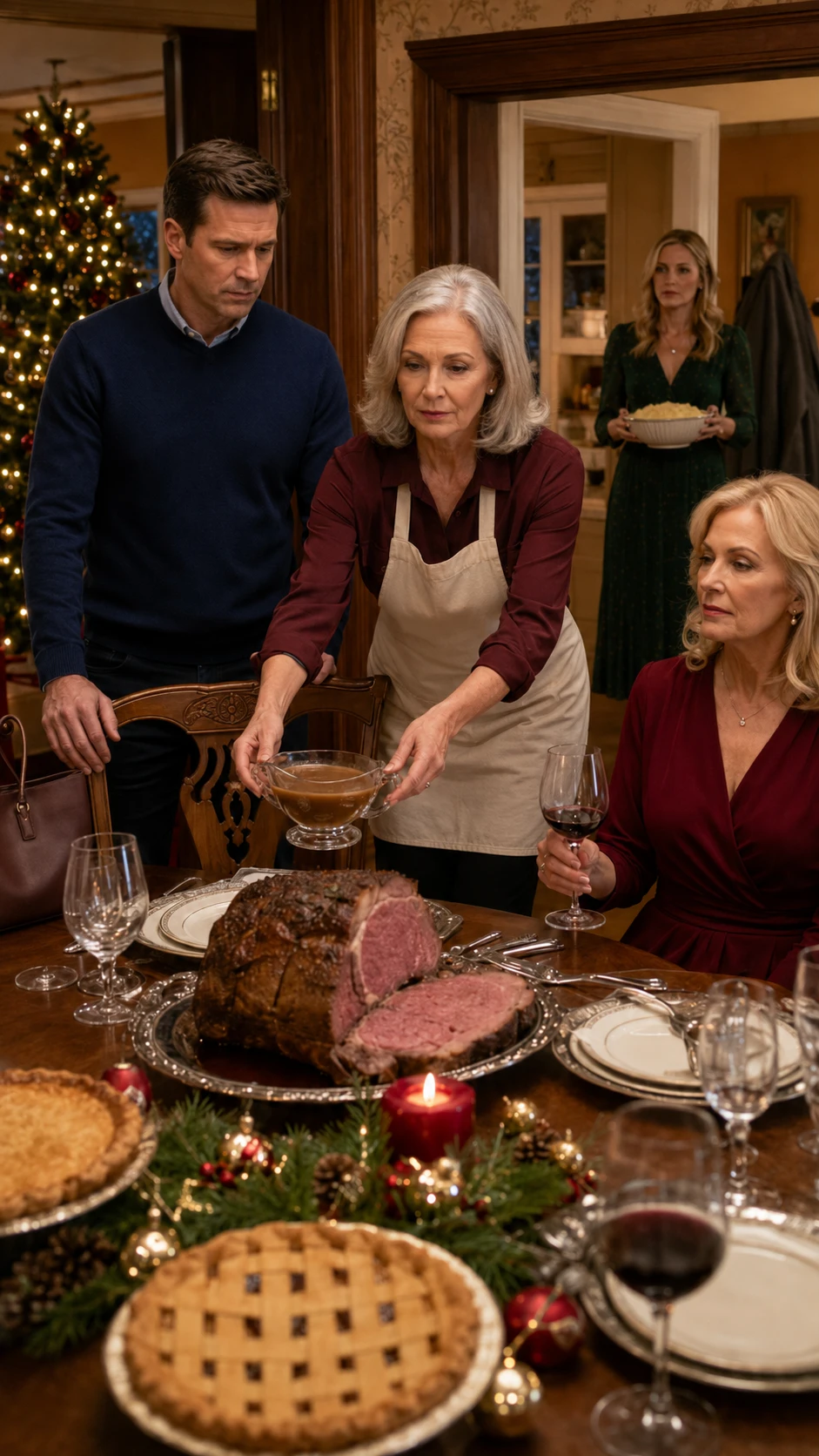
“You can’t sit here.”
My son-in-law, Brandon Whitaker, spoke quietly enough that the children in the living room couldn’t hear, yet clearly enough to make everyone around the dining table fall silent.
The chair he gestured toward was mine.
Not officially labeled, obviously. There wasn’t any brass nameplate attached to the back. Still, it was the chair at the head of the table in the home my late husband and I had purchased thirty-one years before, the chair where I had served Thanksgiving dinners, birthday cakes, graduation meals, and every Christmas feast since my daughter Claire was six years old.
My gaze moved from Brandon’s hand to his face. He was wearing the new navy sweater I had given him, still crisp around the collar.
Behind him, his mother, Donna, lowered her wineglass with an expression of courteous em.bar.rass.ment that seemed carefully practiced.
“Pardon me?” I asked.
Brandon offered me a smile that never reached his eyes. “Mom’s sitting there. It makes sense. She’s the guest of honor this year.”
Claire stood near the kitchen doorway, pale, clutching a bowl of mashed potatoes with both hands. Her eyes found mine for a moment, then quickly fell toward the floor.
That was when I understood.
This had not happened by chance.
Every seat was occupied. My grandchildren, Lily and Owen, were squeezed between their cousins.
Brandon’s brother and sister-in-law had claimed seats along the side.
Donna sat at the head, her red fingernails curled around the stem of her glass, pretending she wasn’t enjoying the moment.
I spent two days cooking. I had purchased the prime rib, the pies, the presents beneath the tree, the wine Donna said she liked, and the toys Brandon claimed were “a little expensive this year.” I had welcomed everyone into my home because Claire had whispered, “Please, Mom. Just one peaceful Christmas.”
And now I stood inside my own dining room while a man who had entered my daughter’s life like a whirlwind informed me there was no place for me at my own table.
“Brandon,” Claire said softly.
He turned toward her without lifting his voice. “Don’t start. Your mother makes everything about herself.”
Something inside me became completely still.
Not angry. Not loud. Just still.
I placed the gravy boat carefully in the middle of the table. The crystal gave a faint click against the wood. Everyone noticed it.
“You’re correct,” I said.
Brandon blinked. “What?”
“I can’t sit here.”
Claire raised her head quickly.
I loosened my apron, folded it neatly once, and set it beside my plate.
Then I collected my purse from the sideboard, retrieved my coat from the hallway closet, and headed toward the front door.
“Mom?” Claire called.
I looked back just once.
“The meal is finished,” I said. “The house is not.”
Then I pulled open the door, walked into the cold Ohio night, and left every one of them sitting there.
The freezing Ohio wind hit my face like a physical blow the moment I stepped off the porch, but I barely felt it. My boots crunched against the freshly fallen snow, leaving deep, deliberate tracks down the driveway toward my car. I didn't rush. I didn't stumble. My hands, which should have been trembling from adrenaline or heartbreak, were surprisingly steady as I unlocked my Lexus and slid into the driver’s seat.
Through the frosted windshield, I looked back at the house. Thirty-one years of memories were contained within those brick walls. From the street, it looked like the quintessential Christmas postcard—golden light spilling onto the snow from the dining room windows, the silhouette of the massive Fraser fir tree glowing in the corner, and the shadows of my family gathered around the table.
For a fleeting second, a wave of profound sorrow washed over me. I thought of my late husband, Richard, carving the turkey in that very room, his laughter booming over the clatter of silverware. I thought of Claire as a little girl, running down the stairs in her footed pajamas. But the sorrow was instantly incinerated by a cold, blinding clarity.
Brandon thought he had won. He thought this was the final psychological checkmate in a three-year campaign to break me, isolate my daughter, and usurp my family’s legacy. He believed that by humiliating me in my own home, in front of his insufferable mother and his complacent brother, he was establishing himself as the undisputed patriarch.
He had no idea what he had just set in motion.
I started the engine, the heater roaring to life, and picked up my cell phone from the center console. I dialed a number I had memorized months ago. It rang twice.
"Evelyn," the deep, gravelly voice of Arthur Pendelton answered. Arthur wasn't just my lawyer; he had been Richard’s closest friend and a notoriously ruthless corporate litigator.
"It's done, Arthur," I said, my voice eerily calm. "He took the bait. He claimed the head of the table and explicitly kicked me out in front of witnesses."
A low chuckle echoed through the receiver. "Textbook narcissist. They can never resist the theatrical power play. Are you safe?"
"I’m in the car. I’m heading to the hotel now."
"Good. The trap is primed. Get some rest, Evelyn. Tomorrow morning, we burn his world to ashes."
I hung up, shifted the car into drive, and pulled away from the curb without looking back.
To understand the sheer magnitude of what was about to happen, you have to understand the nightmare the last three years had been. When Claire first brought Brandon Whitaker home, he seemed like a dream. He was charismatic, ambitious, and seemingly obsessed with my daughter. But within six months of their wedding, the mask began to slip.
It started with small things. Brandon convincing Claire to quit her job at the art gallery because he "wanted to provide for her." Brandon subtly alienating Claire from her childhood friends, claiming they didn't respect their marriage. Then came the financial requests. A loan for a startup venture that mysteriously failed. A demand that I pay for their children's private school tuition because Brandon’s wealth was "tied up in investments."