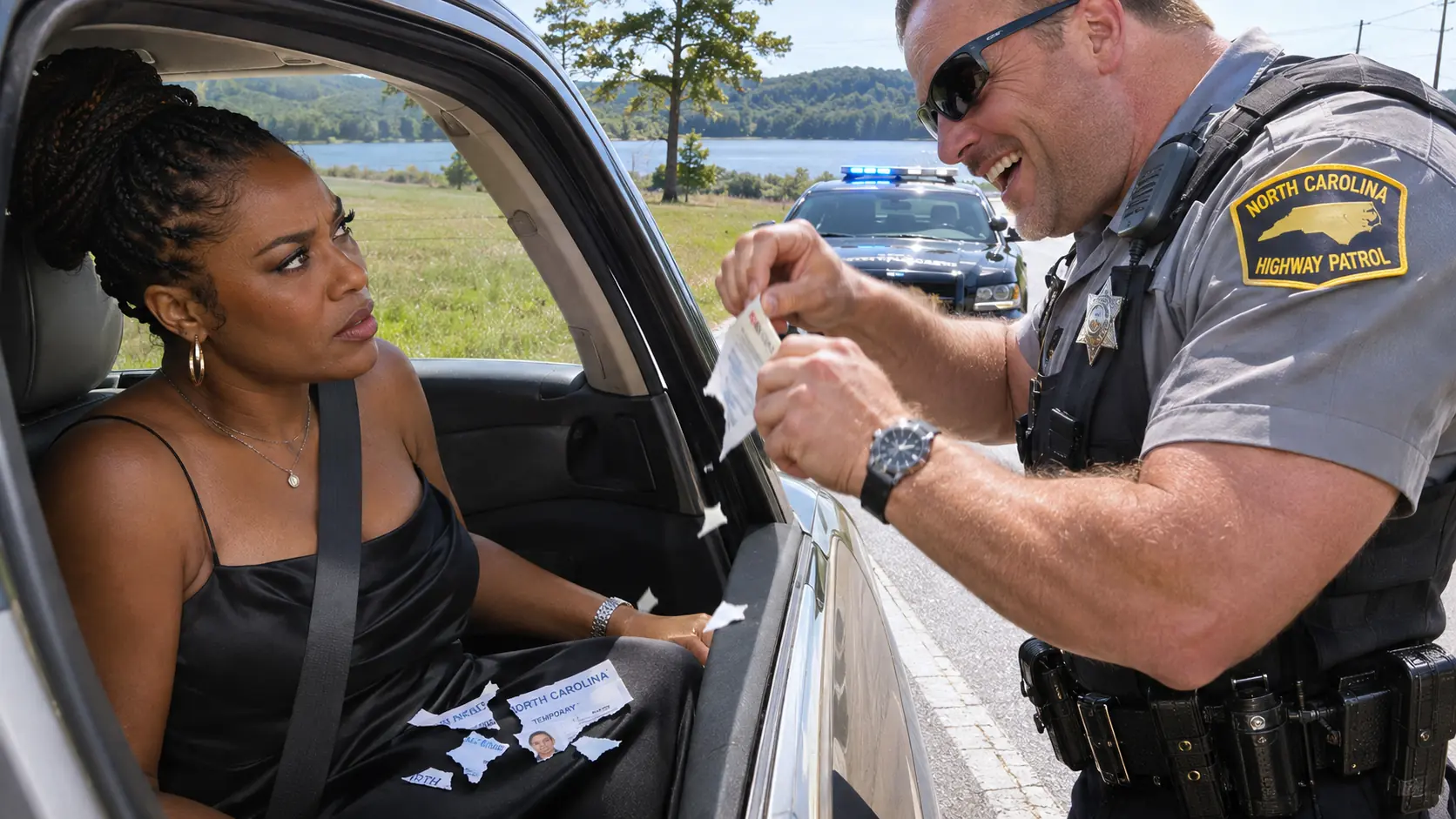
OFFICER TORE UP A WOMAN’S DRIVER’S LICENSE — THEN ONE CREDENTIAL CHANGED EVERYTHING
The sound of Officer Graham Voss's palm striking the roof of my Lexus was sharp enough to make me flinch.
“I'm not interested in your opinion of the law,” he snapped. “I'm the one wearing the badge.”
I looked at the torn pieces of my temporary driver's license scattered across my black satin skirt.
Then I looked at him.
“And I'm the person who just watched you deliberately destroy a government-issued document.”
His jaw tightened.
“You want to make this difficult?”
“No, Officer. I want you to explain why you destroyed my license.”
He leaned closer, his shadow falling across the steering wheel.
“Because I told you it wasn't acceptable.”
“Then you could have verified it.”
“I don't need instructions from you.”
“Apparently, you do.”
The words escaped before I could stop them.
For the first time since he'd approached my window, Voss stopped smiling.
Behind him, the afternoon sunlight glimmered across Lake Juniper. A red pickup passed in the opposite direction, its driver slowing briefly to look at the patrol vehicle parked behind my Lexus.
Voss straightened.
“Step out of the car.”
I took a slow breath.
“Am I being ordered to exit?”
“Did I stutter?”
“No.”
“Then move.”
I opened the door carefully.
The heels of my black pumps touched the gravel shoulder. I stood beside the Lexus, smoothing my skirt while keeping my hands visible.
Voss looked me up and down.
His eyes lingered on my clothes.
“Pretty fancy outfit for somebody driving around with a piece of paper instead of a real license.”
“My permanent license is being replaced.”
“Convenient.”
“My wallet was stolen three days ago. I reported it, requested replacement documents, and obtained a temporary license from the DMV this morning.”
He shrugged.
“That's your story.”
“It's also verifiable.”
Voss stepped closer.
“Here's what we're going to do. You're going to stop talking, put your hands behind your back, and learn what happens when you argue with law enforcement.”
My stomach tightened.
I had spent twelve years in the United States Navy.
I had stood on the bridge of a destroyer during violent storms, supervised sensitive operations, and made decisions under conditions where hesitation could cost lives.
Yet standing on that peaceful North Carolina roadside, I felt something I hadn't experienced in years.
Not fear of physical danger.
Fear of being trapped inside another person's version of events.
Because Officer Graham Voss had already demonstrated that he was willing to destroy evidence to manufacture a violation.
And I had no reason to believe he intended to stop there.
“Officer,” I said carefully, “I am not resisting you. I am asking what offense you believe I've committed.”
“Driving without a license.”
“You destroyed the temporary document.”
“Should've brought a better one.”
I stared at him.
Then I asked the question that would eventually become the most important sentence in the entire case.
“Is your body camera recording?”
Voss's expression changed.
Only slightly.
But I noticed.
He glanced down toward the center of his uniform.
A black rectangular camera sat beneath his badge.
A small indicator light was visible.
“Don't worry about my camera.”
“I'd like to know whether it's recording.”
“Lady, you're about thirty seconds away from going to jail.”
I said nothing.
He reached for his handcuffs.
Then his radio crackled.
“Unit Twelve, confirm status.”
Voss lifted his shoulder microphone.
“Traffic stop. Uncooperative driver. Possible license violation.”
The dispatcher replied, “Copy. Need another unit?”
He looked directly at me.
“Affirmative. Send backup.”
I watched him release the microphone.
He smiled again.
“Now you've done it.”
I looked toward the lake.
Then back at him.
“No, Officer.”
My voice remained steady.
“You have.”
My name is Simone Avery.
I was thirty-four years old, a commander in the United States Navy, and the daughter of a public-school teacher who believed every child deserved to understand the Constitution before graduating from high school.
My mother, Dr. Lorraine Avery, had taught American history for thirty-one years.
She was the kind of woman who corrected grammar on birthday cards and kept pocket copies of the Constitution in her kitchen drawer.
My father, Samuel Avery, had worked as an electrician at the Norfolk Naval Shipyard.
He taught me that expensive things could break, powerful people could be wrong, and a person's character became most visible when nobody important was watching.
They were the reasons I joined the Navy.
Not because I loved authority.
Because I believed authority should mean responsibility.
At the time of my traffic stop, I was assigned to a naval command responsible for maritime logistics and operational coordination along the Atlantic coast.