"Never open your door to strangers," Clara Whitmore's grandmother used to say, "unless the storm outside is colder than the fear inside you."
Clara held the cross hanging from her necklace, the one her grandmother had pressed into her palm before the ambulance took her away for the last time.
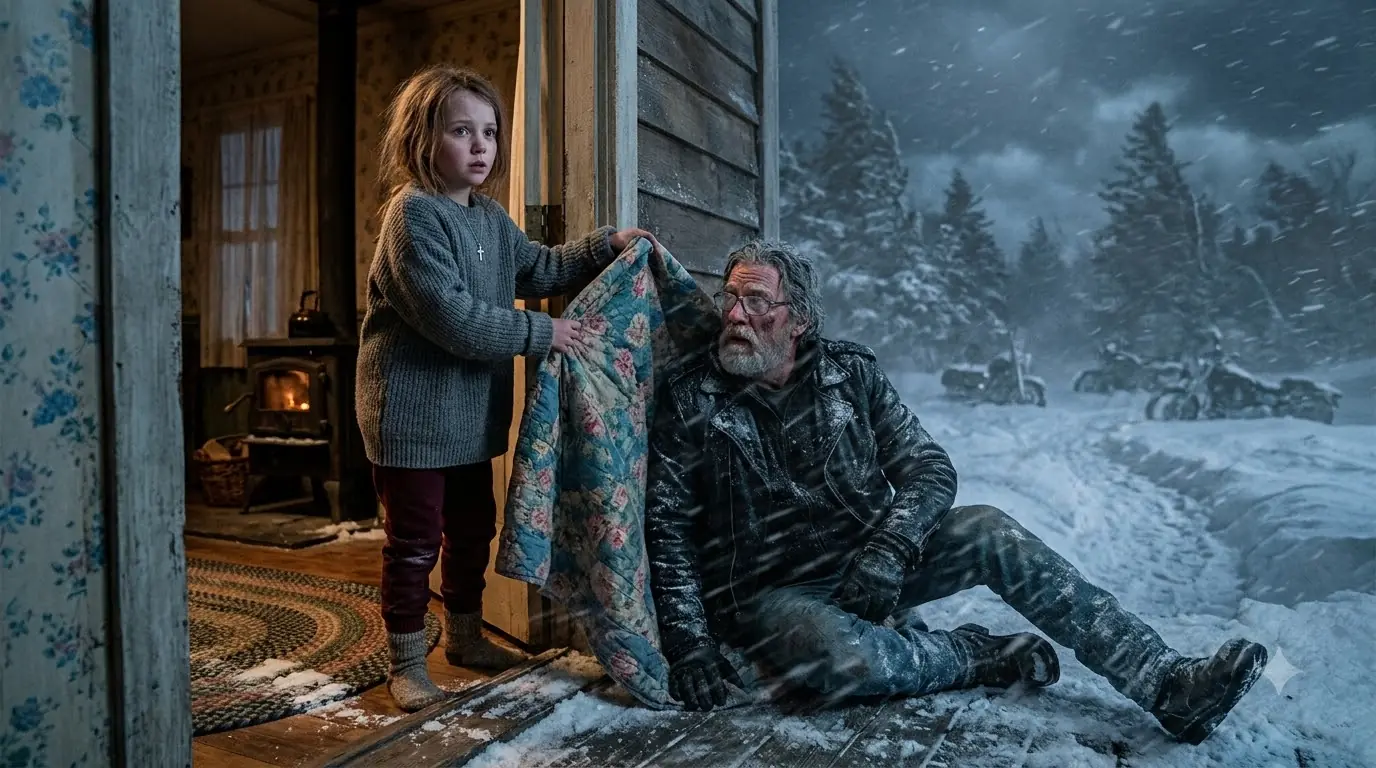
Another knock came, weaker this time. Then a man's voice, roughened by cold but careful, called through the wood.
"Ma'am, we don't want trouble. One of our men is freezing. We just need shelter until morning."
Clara did not move. The word trouble sat in the room like a shadow. She climbed onto the chair by the window and wiped a circle in the frost with her sleeve. Through the glass, she saw three huge shapes on the porch, black leather powdered white, shoulders hunched against the blizzard.
Behind them, several motorcycles leaned in the snow like tired horses. The man in front had ice in his beard, tattoos on his hands, and a patch across his jacket that Clara had once seen on the evening news, the kind adults lowered their voices to talk about. Hells Angels. Every warning she had ever heard told her to run upstairs and hide beneath the bed.
But then the man stepped aside, and Clara saw another rider sitting on the porch boards, shaking so hard his teeth chattered, his gloved hands tucked under his arms. He looked less like a monster than someone's uncle who had stayed out too long in the cold. Clara thought of Grandma Rose, of her soft voice and steady hands, and of the lesson she had repeated whenever Clara judged someone too quickly.
"A coat can scare you, sweetheart, but a heart is harder to see."
The little girl swallowed, slid the chain lock free, and opened the door just wide enough for the storm to rush in around her ankles. The man in front lowered himself slowly until his eyes were level with hers.
"My name is Caleb Maddox," he said. "Folks call me Rook. We will stand right here if you say no."
Clara looked from his frozen face to the shivering man behind him, then back into the lonely house that had not felt warm since her grandmother died. Her voice came out small but clear.
"You can come into the entryway."
The men looked too dark against the faded wallpaper covered in tiny blue flowers. Snow slid from their boots and melted on the braided rug, but none of them moved farther than the doorway until Caleb "Rook" Maddox lifted one hand and said quietly, "Boots off, gentlemen. This is a home."
Clara watched in surprise as the bikers obeyed without complaint, balancing awkwardly as they unlaced frozen boots and set them neatly by the wall. The shivering rider, a gray-haired man with kind eyes behind fogged glasses, sank into the wooden chair near the coat rack. Another rider helped wrap him in the quilt Clara pulled from the back of the couch.
Caleb stayed closest to the door, as if he understood that taking one more step might frighten her. "Are your folks upstairs?" he asked gently.
Clara's fingers tightened around the edge of her grandmother's sweater. For a second, the only sounds were the wind pressing against the walls and the old clock ticking above the kitchen sink.
"No," she said. "My parents are in heaven. Grandma Rose too, now."
The big man became very still. It was not the uncomfortable silence Clara had heard from adults at the funeral, the kind that made people look at their shoes and change the subject. This silence felt different, heavier, as if each man had taken off his hat inside a church.
Caleb lowered his gaze for a moment, then looked back at her with a softness that did not match his scarred hands or black leather jacket. "I am sorry, Clara."
She blinked. "How did you know my name?"
He pointed carefully to the refrigerator, where a crooked crayon drawing was held up by a magnet shaped like a cow. At the bottom, in big purple letters, it said, Clara and Grandma Rose's Spring Picnic.
Clara felt her cheeks warm. "Oh."
The kitchen still looked almost as though Grandma had just stepped into the next room. Her reading glasses sat beside the sugar bowl, her flowered apron hung from a hook, and a half-finished grocery list was written in shaky blue ink. But the house had changed after the funeral. Rooms that once smelled like cinnamon toast and lavender soap now smelled like cold wood and unopened mail.
The bank envelope sat on the table beside the lantern, its red lettering sharp enough to make Clara look away. Caleb noticed it, but he did not touch it. Instead, he nodded toward the stove.
"How long has that been burning low?"
Clara shrugged, embarrassed. "I tried to add wood, but the pieces are too big. I am not supposed to use the hatchet."
"Good," Caleb said at once. "That is a rule worth keeping."
One of the other men, Wade Collins, whom the riders called Preacher, knelt near the stove and examined the draft with the focus of a man reading a weather map. "The pipe may be struggling," he said. "The wind is pushing hard from the north."
Clara hugged the quilt around the cold rider's shoulders and whispered, "I only had one can of soup left. I was saving it for morning because the lady from child services said someone would come when the roads opened."
Caleb's jaw tightened, but his voice stayed calm. "You have been here alone all day?"
"Since yesterday afternoon. Mrs. Bell from down the road was supposed to check on me, but her truck got stuck before dark. She called before the phone died."
Clara pointed to the cordless phone on the counter, useless in its cradle. "The power went out, and my tablet died too. I was not scared at first."
She tried to say it bravely, but the last word trembled.
Caleb slowly removed his leather gloves and placed them on the floor beside him, showing her his empty hands. "Clara, you did something kind tonight. You may have saved my friend from getting much sicker. But after this, I want you to remember something important. You do not open a door alone just because someone asks. You look, you listen, you call for help if you can, and you keep something solid between you and the stranger until you know what is safe."