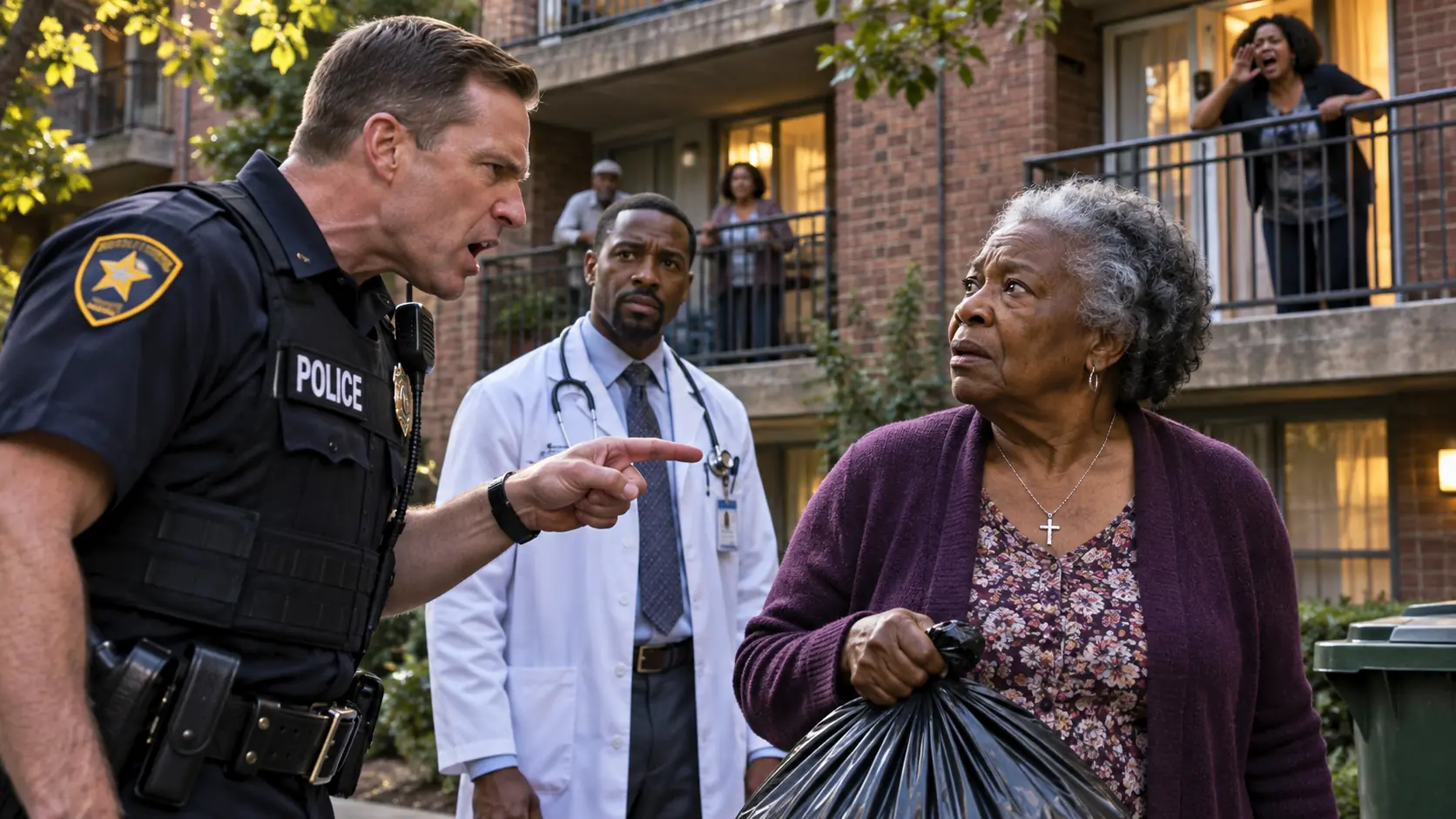
The police officer put his hand on his gun before he asked me my name.
My mother was standing barefoot in the courtyard behind him, clutching a white garbage bag against her chest.
And when she saw what he was doing to me, she screamed something I hadn't heard her say clearly in almost three years.
“DON'T TOUCH MY SON!”
The officer turned.
So did the two residents watching from their balconies.
My mother's voice echoed between the brick apartment buildings.
For one beautiful, terrible second, I thought she recognized me.
Then her expression changed.
The certainty vanished from her eyes.
She looked at me again, frightened and confused.
“Where's my little boy?” she whispered.
I felt something inside my chest break.
“My name is Dr. Daniel Carter,” I told the officer. “I live in this building. That's my mother. She has dementia, and she needs my help.”
Officer Brent Maddox looked at my hospital identification badge, then at the expensive sedan parked beside the curb.
He smiled without warmth.
“That's a nice story.”
I stared at him.
“What?”
He stepped closer.
“I said that's a nice story. But I know who belongs in this neighborhood.”
His hand remained near his holster.
“And you don't.”
Three hours earlier, I had been standing in Operating Room Four at St. Catherine's Medical Center, trying to save a twenty-six-year-old father whose heart had stopped twice before we could get him onto the operating table.
His name was Luis Mendoza.
He had a wife named Sofia.
A daughter who had just turned three.
And a congenital heart condition that had gone undetected until he collapsed at work.
I was the attending cardiothoracic surgeon.
For six hours, my team worked to repair the damage.
There were moments when I believed we would lose him.
Then his heart began beating steadily again.
I remember staring at the monitor, listening to the rhythm.
Beep.
Beep.
Beep.
The sound of another person being given more time.
When we finished, I removed my gloves, washed my hands, and stepped into the family consultation room.
Sofia Mendoza stood immediately.
“Doctor?”
Her voice trembled.
I smiled.
“He made it through surgery.”
She covered her mouth.
“Oh, thank God.”
I nodded.
“He's still critically ill. The next forty-eight hours will be important. But his heart is functioning, and we're cautiously optimistic.”
She began crying.
Her mother embraced her.
Then Sofia reached for my hand.
“Thank you for bringing him back.”
I squeezed her fingers.
“We had a very good team.”
She shook her head.
“You don't understand. Our little girl kept asking if Daddy was coming home.”
I felt my throat tighten.
“I hope he'll be home with you soon.”
I had been awake for almost twenty hours.
My back hurt.
My feet ached.
And I wanted nothing more than a shower, a sandwich, and six uninterrupted hours of sleep.
But at 4:17 that afternoon, my phone rang.
The screen showed my sister's name.
MONICA CARTER.
I answered.
“Hey, Mon.”
“Daniel, are you still at the hospital?”
“Just finished. Why?”
She hesitated.
That was enough to make me stand straighter.
“What's wrong?”
“It's Mom.”
My exhaustion disappeared.
“What happened?”
“Mrs. Whitaker called me. Mom went downstairs to take out the trash, and she hasn't come back.”
I glanced at the clock.
“How long?”
“About twenty minutes.”
“Have you checked the courtyard?”
“I'm driving over now.”
I grabbed my keys.
“I'm leaving.”
“Daniel—”
“I'm leaving right now.”
My mother, Evelyn Carter, had spent forty-one years cleaning buildings that people like me walked through without noticing who kept them clean.
Hospitals.
Schools.
Government offices.
Corporate towers.
She had polished floors beneath the shoes of judges and executives.
She had cleaned emergency rooms after the worst nights of strangers' lives.
She had carried heavy bags down stairwells when elevators broke.
And she had done it all while raising two children after our father died.
My sister Monica was eleven when he passed.
I was seven.
Our father, Samuel Carter, had been a city bus driver.
One winter morning, a truck crossed the center line on a wet highway.
He never came home.
I remembered the police officer who arrived at our apartment.
The way my mother gripped the kitchen counter.
The way Monica began screaming.
And the way my mother, even while crying, reached for me because she knew I was too young to understand.
After the funeral, she worked more shifts.
She stopped buying new clothes.
She learned how to repair appliances.
She cut coupons.
She walked to work when the bus fare became too expensive.
But she never let us believe we were poor in the ways that mattered.
Every Sunday, she cooked dinner.
Every birthday, she baked a cake.