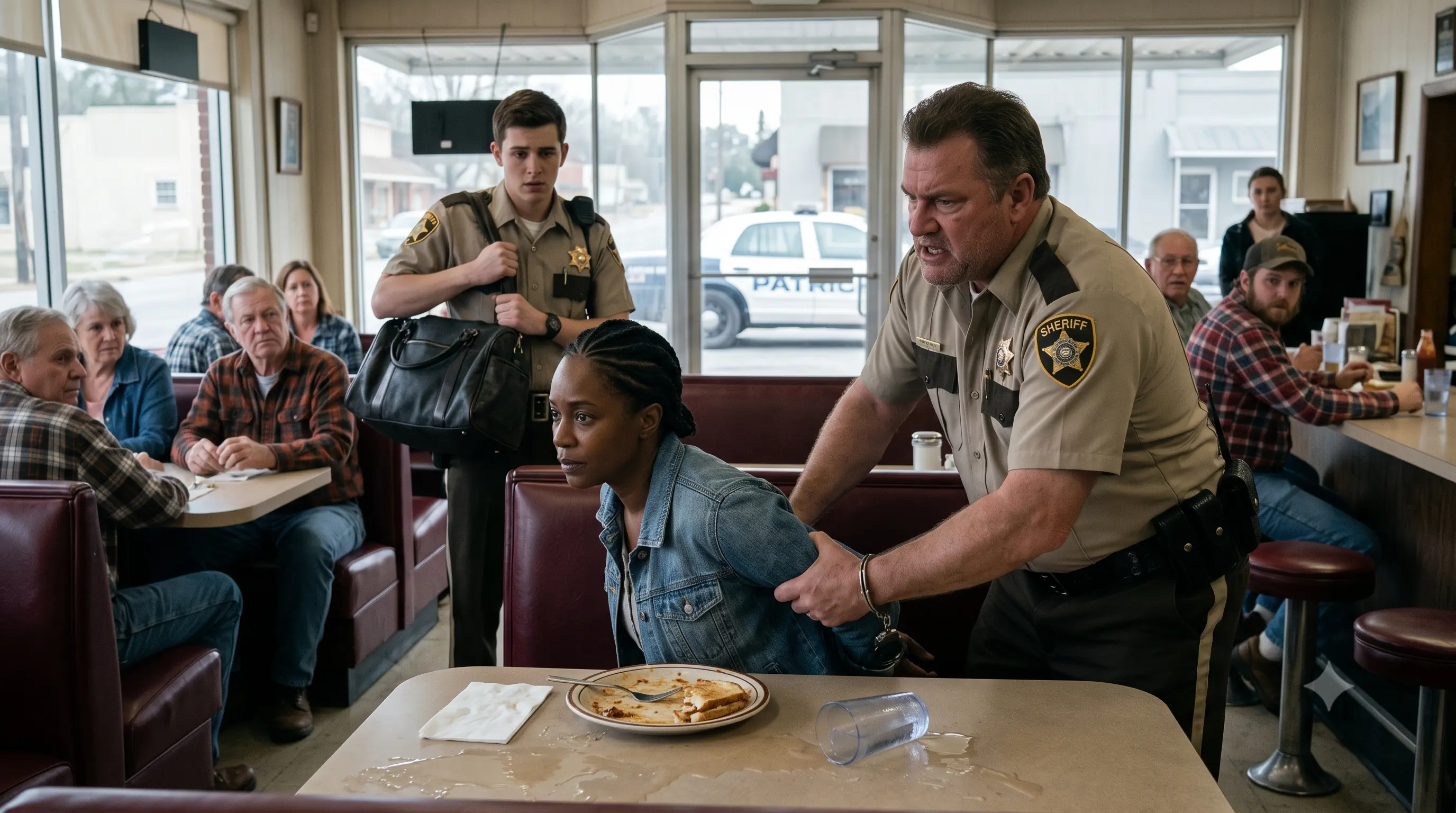
The handcuffs closed around Amara Whitlock's wrists before she could put down her fork. The diner had been noisy a moment earlier: plates knocking against a service counter, a radio murmuring above the kitchen doorway, the cook calling for another order of hash browns. Then Sheriff Dalton Voss entered, said she matched a robbery suspect, and demanded that she stand. He offered no description and answered none of her questions. She did not resist. When he pulled her from the booth, her water glass tipped and rolled across the table, leaving a spreading puddle among the paper napkins.
Amara was forty-four and had served for six years as a United States district judge. She had traveled to Mercer County, Georgia, because complaints about the sheriff's department kept arriving through lawyers and civil-rights organizations, often accompanied by a troubling absence of official records. She was not there to conduct a secret judicial investigation. Judges had no authority to impersonate investigators or privately assemble criminal cases. She had come as a private citizen, during personal time, to meet a former law clerk whose family lived nearby and to understand the setting behind several public allegations. Her judicial position could not make an unlawful arrest lawful, and it could not exempt her from ordinary law. What it gave her was experience recognizing when a legal justification was being invented after the fact.
Voss gripped her elbow. 'You have a choice,' he said. 'Walk or be carried.'
'I'll walk,' she answered.
The waitress, a woman named Lena Price, moved around the counter as if she intended to help. Voss turned his head, and she stopped. He had been sheriff for eleven years. People in town knew the sound of his voice and what could follow when someone challenged it. Amara noticed the waitress's hand trembling as she picked up the fallen glass. She noticed the two men at the back booth looking down at their meals. She noticed the young deputy behind Voss, who had not spoken once.
---
By the time Lena Price reached the back booth, the day had already acquired the tired feeling of unfinished business. There was the coffee urn clicking off. Lena Price had been thinking about a question that was easy to ask and harder to answer: the diner manager had been asked to erase a camera clip. It was not the sort of detail that made a dramatic television interview. It was the sort that decided whether someone else could verify a story six months later, when tempers had cooled and the people involved had begun to remember events differently. Lena paused before doing anything that could not be undone.
The practical step was modest: she copied the original recording to the locked office drive. That step required time, and it required accepting that a careful record might not say what anyone wanted it to say. People around the county had begun treating every new detail as a signal that the whole case was solved. The people actually working with the records understood the opposite. One reliable detail often opened three more questions. It could narrow a timeline, identify a witness, or eliminate an explanation. It could not substitute for the rest of the evidence.
There was also the matter of the footage showed Amara seated with both hands visible. Lena Price wrote that distinction down rather than leaving it to memory. The words looked ordinary on the page, almost disappointingly plain. Yet plain words were what the sheriff's office had so often failed to provide. A person should not need connections or a professional title to know why an officer had stopped them, why property had been taken, or what a report actually said. When the language became vague, power moved into the gaps.
What made the work difficult was not only the paperwork. Lena Price had a private concern: she feared the sheriff could cost the diner its weekend customers. That concern did not vanish when the facts were written down. It followed the work home, into quiet rooms and conversations that ended too quickly. The case had acquired a public name, but the people caught in it still had to pay bills, care for relatives, and return to the same streets where the sheriff had once seemed impossible to question. Their choices carried costs that would never appear in a court docket.
Before leaving, Lena Price checked the sequence once more. A date was confirmed where it could be confirmed; an uncertainty was marked where it remained uncertain. No one declared victory. The next person who opened the file would have to decide what the material meant, and that person deserved to see the limits as well as the facts. Outside the back booth, life went on with an indifference that was both comforting and unsettling. The county could not stop functioning while it decided what accountability required. It had to learn to function differently.
---
At the door, Amara said, 'Please preserve the diner cameras and your body-camera footage.'
Voss laughed. 'You can file your complaints after booking.'
'Yes,' she said. 'I can.'
Outside, evening rain had begun to collect in the cracks of the sidewalk. Her purse hung from the young deputy's shoulder. The deputy looked at her with an expression that was not sympathy exactly, but doubt. His nameplate read ELIAS REED. When she asked whether he had heard the robbery description, he hesitated before answering that dispatch had given them a vehicle description, not a person. She had walked to the diner from a nearby guesthouse. She owned no vehicle matching the alert.