Is this a passport? What kind of rubbish is this? She placed it on the counter. He smirked. “A beggar like you can’t even afford a bus ticket, darling.” Her calmness irritated him. “Did a cat bite your tongue? Do you not understand human language?”
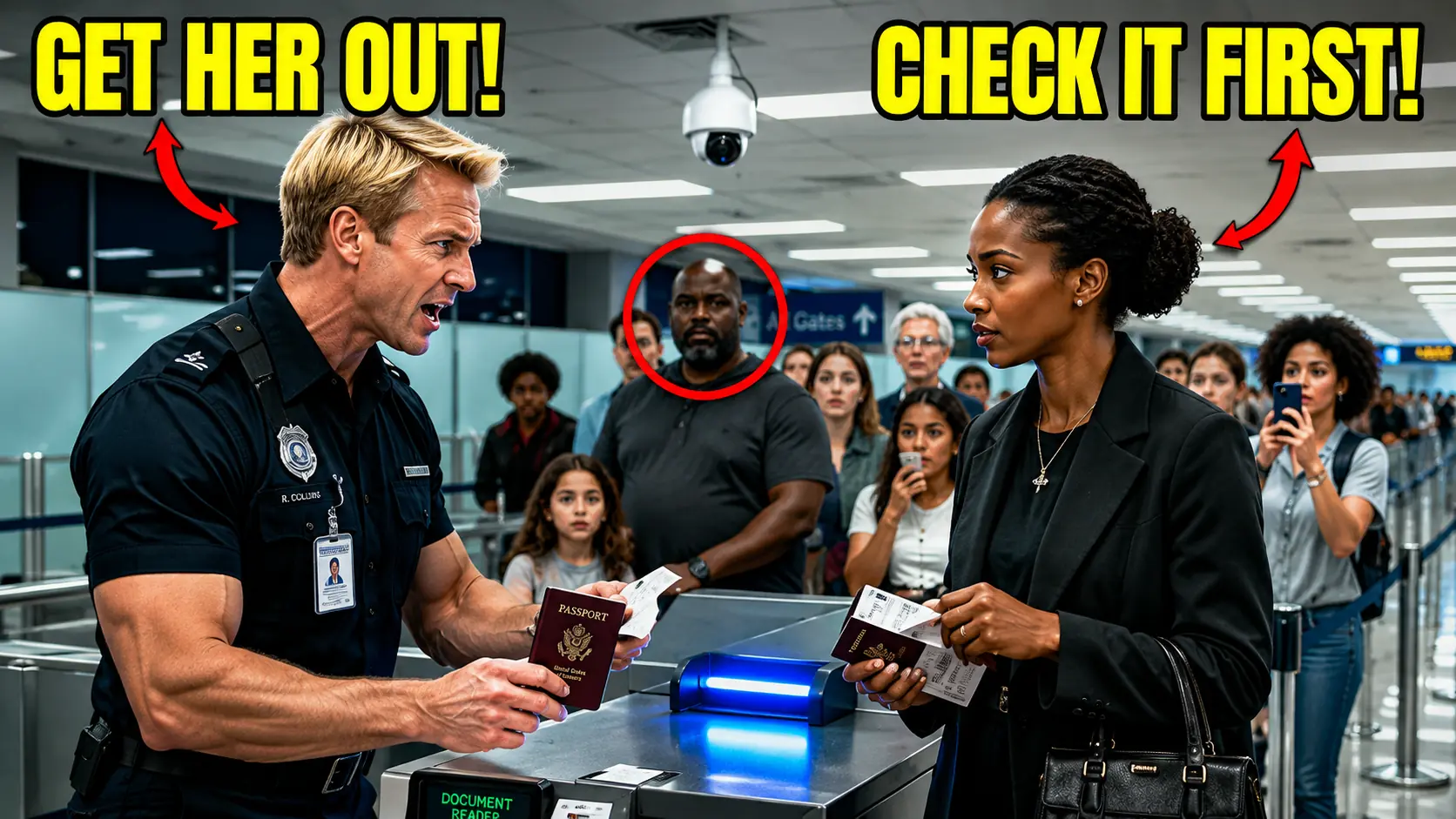
“My name is Paige Carrington. Please double-check my passport.” The whole line fell silent. His smile vanished. “You are not allowed to give orders at my counter.” He scanned the passport. Valid. Again. Still valid. His hands trembled.
“I want to see your superior. Contact 12, your superior.” “Who do you think you are?” He snatched it and tore it in half. The fragments fell like dry leaves. She reached into her coat and pulled something out, something small. The smirk on his face died. His hands dropped. His legs went weak.
What was she holding? Let me rewind a little. Before the torn passport. Before the smirk. Before any of it. There was a woman walking through Terminal A at Dulles International Airport. Her heels clicked quietly on the polished floor. Her coat was dark cashmere, understated. No logos.
Around her neck hung a single piece of jewelry, a small gold cross that belonged to her mother. Twelve hours in the air, but she refused to look tired. Straight back, steady pace, eyes forward. No perfume, no phone in hand. She carried a single leather briefcase.
She moved through the crowd like someone used to walking into rooms where she was the only one who looked like her. Her name was Paige Carrington. Forty-one years old. Born in Detroit, raised in Atlanta by a grandmother who marched in Selma and a father who spent thirty years as a civil rights attorney.
She went to Spelman College, then Harvard Law. Then a federal clerkship that most lawyers would trade a kidney for. After that, eleven years as a federal prosecutor in the Department of Justice, Civil Rights Division. The unit that investigates police brutality, hate crimes, and civil rights violations.
Then, two years ago, the president of the United States picked up a phone. He offered her a job that very few people even know exists. Inspector General of the Department of Homeland Security. Let that sink in for a second. That title meant one thing.
Paige had direct oversight over every CBP officer, every ICE agent, every TSA screener in the country. All three hundred forty thousand of them. If they broke the law, she investigated. If they abused power, she held them accountable. Her office answered to no one but Congress and the president.
Tonight, a late Tuesday in November, 9:48 p.m., she was coming home. Flight UA 982 from Geneva, Switzerland. Twelve hours in the air. She’d spent three days at a United Nations summit. Standing behind a podium with the UN seal, delivering a keynote to the working group on people of African descent.
Her topic? Racial profiling at U.S. border checkpoints. The irony of that, a woman who spent her career fighting racial profiling about to walk straight into it, was almost poetic. Almost cruel. Hold that detail. Because what’s about to happen at counter 12 is the exact thing she told the entire world America needed to fix.
The terminal was quiet at this hour. Fluorescent lights hummed overhead. Luggage wheels rumbled across the tile. A baby cried somewhere near gate 23. A canine unit drifted through the next lane, the dog’s nose brushing bag after bag. The air smelled like recycled ventilation and burned coffee from a kiosk that closed hours ago.
Counter 12 was manned by Officer Hunter Wilson, thirty-four years old, six years on the line, badge 318. Blonde hair buzzed short, jaw permanently tight, a body that spent too many off days at the gym and not enough in a training manual. He cracked jokes during shift change, the kind that made newer officers stare at their shoes.
Tonight he was alone, in a mood. Earlier that evening, he’d told a Haitian family their English wasn’t good enough, made them wait forty minutes for a translator they didn’t need. He’d been flagged twice in internal complaints, both for racial profiling. Both times his supervisor filed the paperwork and let it vanish.
That supervisor, Garrett Coleman, fifty-two, twenty-three years in CBP. Right now he sat in a booth thirty feet behind Wilson, scrolling his phone, chin in hand. He’d made a career of looking the other way. Tonight would be no different. Until it was.
Wilson liked the night shift. Fewer eyes, more freedom. And his way had a pattern. White travelers got a nod and a stamp. Everyone else got questions. Between 8:00 p.m. and 9:45, he’d sent four travelers to secondary screening. All four were Black.
Two lanes over, a twenty-year-old named Tasha Hollis waited in line. Howard University, journalism major. Phone in hand, not scrolling. She’d noticed something about the officer at counter 12. The way he smiled at some passports. The way he didn’t at others. She started recording eleven minutes before Paige reached the front of the line.
And above it all, bolted to the ceiling behind a glass dome, a CBP surveillance camera recording in 4K with audio. Nobody was paying attention to it. They would be soon. Paige Carrington reached the front of the line at 9:52 p.m. She stepped up to counter 12, set her navy passport and customs declaration on the surface, folded her hands.
“Good evening, officer.” Hunter Wilson didn’t look up. He was scribbling on a clipboard, or pretending to. Three seconds passed. Five. Eight. Twelve. He let her stand there, like she was invisible. Like the counter was his living room, and she was a stain on the carpet he hadn’t decided to deal with yet.
The man behind her in line shifted his weight. A child tugged at her mother’s sleeve. The fluorescent light above counter 12 flickered once, then steadied. When Wilson finally raised his eyes, they traveled from her passport to her face, then back to the passport, then to her face again. His jaw tightened.
Something behind his eyes shifted, like a door slamming shut. He had already decided. He picked up the passport, flipped it open. The photo stared back at him. A Black woman in professional attire, unsmiling, dignified. Everything about that photo said, “I belong here.” Everything about Wilson’s face said, “No, you don’t.”
He turned the pages, slowly. Geneva, Vienna, Pretoria, Nairobi, Brasilia. Page after page of international ink. Stamps from countries most people in this terminal had never even heard of, let alone visited. Each stamp seemed to make his jaw tighter, his breathing shorter, like every page was a personal insult he couldn’t explain.
His lip curled. “You call this a passport?” He said it loud enough for the next three travelers to hear. Loud enough for Tasha Hollis, two lanes over, to angle her phone toward counter 12. “What kind of rubbish is this?” Paige didn’t move. She placed her boarding pass beside the passport, calm, unhurried, like she hadn’t heard a word.