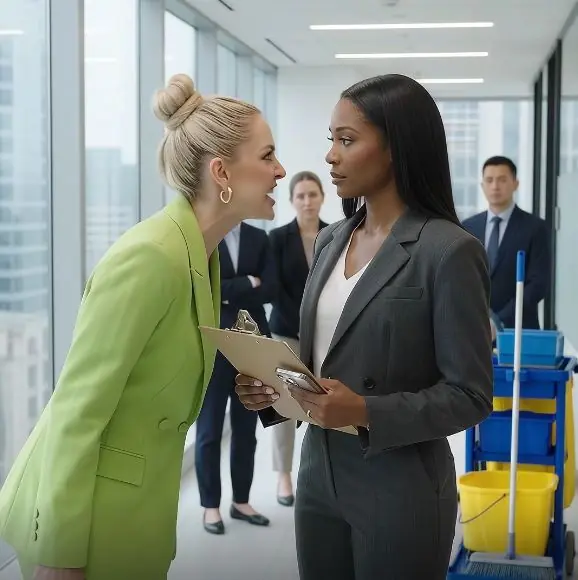
The tower rose out of downtown Atlanta like a held breath. Twenty-six stories of glass and steel, polished to a high, indifferent shine, and at 7:40 on a Monday morning it hummed with the particular energy of people who believed their week was about to go well. Camille Edwards stood on the sidewalk across the street for a full minute, watching.
She had seen buildings like this one from both sides of the glass. As a twenty-two-year-old temp, she had mopped lobbies in buildings like this one. As a thirty-year-old analyst, she had ridden the elevators up with her badge clipped where it could be seen. As a forty-year-old founder, she had bought companies housed inside them. And now, at forty-six, she was about to own this one.
Edwards Strategic Group had closed the acquisition of Apexion Solutions at 6:00 a.m. the previous Thursday. Three thousand employees. Four offices. Two floors in this building leased through the end of the decade. The papers were signed, the wire transfers were scheduled, and somewhere in a law office in Midtown a junior associate had finally taken a shower. The official introduction was set for ten o'clock that morning in the executive boardroom: the new CEO would be welcomed, photographed, applauded. The new CEO was Camille.
She had told no one she was coming early. Not the board. Not the departing founder, who had retired to a lake house in Vermont and had sent her a warm, handwritten note that she kept in her desk drawer. Not even Sofia, though Sofia would have figured it out within the hour — Sofia always did.
Camille believed there were things you could only learn about a company in the hours before anyone knew you were the one who had bought it. How the lobby guards treated a woman without a badge. How the elevator smelled. Whether the people who cleaned the place were spoken to by name. These were not small things. In her experience, they were the only things that reliably predicted how a company treated its customers, its money, and its people.
She checked her reflection in a dark window: navy blazer, gray trousers, low heels, cream blouse. Professional, understated, forgettable on purpose. No jewelry except a plain watch and the thin gold band she always wore. Her hair was pulled back simply. She looked like a competent middle manager, maybe a consultant, maybe someone's assistant. That was the idea.
She crossed the street and walked in.
The lobby was exactly what the photographs had promised: soaring ceiling, polished stone floor, a living wall of green things that someone watered on a strict schedule, and a long reception desk where two young women in matching blazers fielded a steady stream of arrivals. Behind them, a bank of elevators. To the left, a coffee bar that smelled like vanilla and ambition.
Camille stopped ten feet inside the door and waited to be noticed.
She was not.
This, she knew, was a data point, not yet a verdict. People were busy. The receptionists were handling three things at once. It was Monday morning. She stepped closer to the desk, smiled, and said, "Good morning."
"One moment," the blonde receptionist said, without looking up. She finished typing, answered a phone that was already ringing, and directed a delivery man to the service entrance. Ninety seconds passed. The other receptionist appeared from a back room, glanced at Camille, and looked back at her colleague.
"I'm here for—" Camille began.
"Do you have an appointment?" the blonde one asked, eyes still on her screen.
"I don't," Camille said. "I'd like to—"
"You'll need to sign in," the receptionist said, and slid a tablet across the desk without looking. "Name, company, person you're visiting."
Camille signed in as C. Ellis, visiting Facilities, a small fiction she had prepared. It was not, strictly speaking, a lie about anything that mattered yet. The receptionist scanned the tablet, frowned at the name as if it should mean something, and said, "Elevators are that way. Facilities is on four. You'll need an escort—someone will meet you."
Nobody met her.
She stood by the elevators for four minutes, watching. A security guard sat at a podium to the right of the doors, a man in his sixties with a neat mustache and a newspaper folded beside his elbow. He watched the flow of people with the relaxed, professional calm of someone who had done this job for years, and Camille watched him watch. When a young man in a hoodie came through, the guard nodded. When the burgundy-suited woman passed, he smiled and said, "Morning, Ms. Park." When Camille caught his eye and nodded a greeting, his gaze slid past her as if she were part of the wall.
Camille filed it away without bitterness. The guard was not cruel; he was trained. Someone had trained him — a building, a company, a culture — to know exactly who mattered in this lobby and who did not. She wondered what his name was. She wondered whether anyone who worked on the twenty-fourth floor knew it.
On the wall beside the elevators hung a row of framed photographs: the company's founders cutting a ribbon, a team celebrating a product launch, a charity check presentation with oversized smiles. Camille studied them the way she studied everything — slowly, looking for what was missing. The photographs were all of the same kinds of faces. That, too, was data.
A group of young men in hoodies and sneakers swept through, laughing about something that had happened on a group chat, and swiped their badges without breaking stride. A woman in a sharp burgundy suit held the elevator door with her elbow and stared at her phone, and Camille noticed the woman's eyes flick over her once — a quick, automatic assessment — and dismiss her. Camille Edwards had been dismissed by sharper eyes than these, in rooms where the stakes were higher than a Monday elevator. She had built her company on the fuel of those flickers. She stepped into the elevator with the burgundy woman and rode to four in silence.