## PART ONE
## THE ROOM MY MOTHER BUILT
**By the time I saw my husband’s hand resting on another woman’s pregnant stomach, someone had already pushed my suitcase into the corner of the room where I was supposed to wake from surgery.**
The betrayal itself did not shock me as much as the setting.
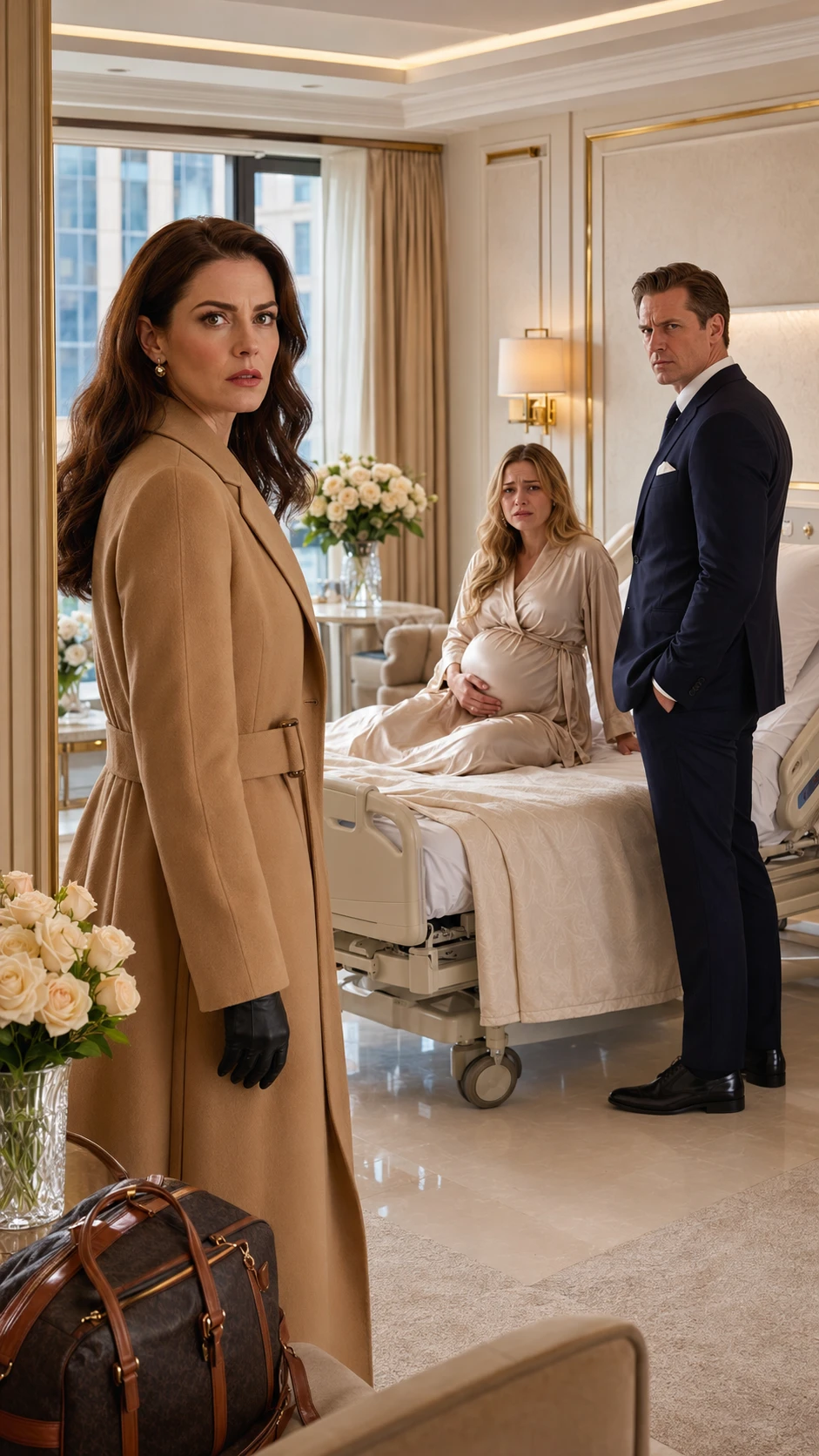
Grant had chosen the Windsor Suite.
He had chosen my mother’s room.
Pale roses crowded every table, their perfume too sweet for a hospital and too funereal for a celebration.
A gold card stood among them.
**To Brielle, our miracle deserves the best.**
Brielle Carson sat upright against the pillows in the silk patient robe reserved for patients of the Archer Pavilion.
She was thirty-seven, perhaps thirty-eight, with honey-colored hair, frightened blue eyes, and one hand curved protectively over a stomach that looked seven months pregnant.
Grant stood beside her in a charcoal suit, calm and polished, as though he had been waiting to greet a business partner.
When he turned toward me, irritation crossed his face before guilt had time to appear.
“Evelyn,” he said.
“You’re early.”
My consultation was scheduled for two o’clock.
The brass clock on the mantel showed one fifty-eight.
Behind me, the young nurse who had escorted me from the private elevator seemed to stop breathing.
I removed my leather gloves one finger at a time.
“My appointment is in two minutes.”
Grant glanced at the nurse.
“There has been a mix-up.”
Nothing in the room looked accidental.
My overnight case had been placed beside the wastebasket.
The roses had been arranged by a florist whose services required at least a day’s notice.
A silver tray held sparkling water, sliced fruit, and a bowl of sugared almonds.
Brielle wore a diamond bracelet Grant had told me belonged to the wife of a client.
Grant had always been careless with facts when he believed charm would carry him past them.
“There was no mix-up,” I said.
Brielle looked down at the bracelet.
“Grant told me you had agreed.”
“To what?”
“To letting me rest here until a room opened upstairs.”
She spoke softly, but not weakly.
There was intelligence in her face, along with a kind of exhausted dread.
Grant moved between us.
“She was frightened, Evelyn.”
“She is sitting in the room reserved for my surgery.”
“The regular maternity floor is crowded.”
“She has not been admitted.”
His jaw tightened.
“You don’t know that.”
“I know this hospital.”
The Windsor Suite was not available to visitors, influential friends, or inconvenient mistresses.
It was a restricted recovery room reserved for complex surgical patients and emergency transfers approved by the chief medical officer.
My father’s foundation had built the Archer Pavilion after my mother died in a shared room separated from three strangers by thin curtains.
May you like

 If Your Baby Is Born Tonight, You’ll Ruin the Wedding.
 THE MAN MY MOTHER WARNED THEM ABOUT
 SHE TORE MY DRESS TO EXPOSE A MISTRESS
She had been fifty-one.
I had been nineteen.
On her final night, the woman beside her screamed for six hours while my father begged for a private space where my mother could die without hearing someone else’s terror.
There had been no room.
The following year, he donated the first ten million dollars.
He named the pavilion for my mother and put only one condition in the donor agreement.
**No patient would ever be displaced for status, wealth, politics, or convenience.**
Grant knew that history.
He had heard my father tell it at every anniversary dinner.
He had held my hand beneath the table when my father’s voice broke.
Now he had placed his pregnant mistress in the most symbolic room in the building.
He had not simply taken my bed.
He had turned my mother’s memory into a stage.
Grant lowered his voice.
“Please don’t make this uglier than it is.”
I looked past him at Brielle.
“How ugly is it?”
Her eyes filled.
“Evelyn,” Grant warned.
“How long?”
Brielle glanced at him.
His expression changed almost imperceptibly.
It was not tenderness.
It was instruction.
She swallowed.
“Fourteen months.”
The answer entered me without sound.
Thirty-four years of marriage did not collapse all at once.
It fell inward, floor by floor, like a building whose supports had been quietly cut during the night.
Fourteen months meant birthdays, holidays, hospital appointments, board dinners, and Sunday breakfasts.
Fourteen months meant the weekend Grant claimed he was comforting an old college friend after surgery.
It meant the business trip to Santa Fe.
It meant the night he returned home smelling of lavender soap and told me the hotel had changed its toiletries.
It meant the bracelet.
It meant the way he had begun carrying his phone from room to room.
Yet I did not cry.
My father had once told me that anger was most useful before anyone knew you possessed it.
I placed my gloves on top of my suitcase.
“Then she can be comfortable somewhere my family didn’t build.”
Grant’s face hardened.
“There it is.”
“What?”
“The entitlement.”
The nurse behind me made a small sound.
Grant continued as if he had rehearsed the speech.
“You think because your name is on the wall, every person in this hospital should kneel when you enter.”
“My name is on the wall because my mother died without dignity.”
“Brielle is carrying a child.”
“Your child?”
His eyes held mine.
“Yes.”
Brielle closed her eyes.
The word should have broken me.
Instead, it sharpened the room.
Grant and I had spent nine years trying to have a child.
We had endured specialists, injections, surgeries, and four failed pregnancies.
The last loss nearly killed me.
Grant had sat beside my bed afterward and said we had to stop before grief consumed us both.
I had believed the grief belonged to both of us.
Now he stood in front of me offering another woman’s pregnancy as proof that the failure had been mine.
He touched Brielle’s shoulder.
“She needs compassion.”
“So did I.”
“This is not about you.”
I almost laughed.
My suitcase was in the corner.
My robe was on his mistress.
My mother’s name was above the door.
Yet somehow, according to my husband, none of it was about me.
Brielle began to cry.
“I never wanted to hurt anyone.”
I looked at her bracelet.
“You didn’t mean to hurt anyone.”
She raised her eyes.
“You meant to replace someone.”
Grant stepped toward me.
“That is enough.”
“No,” I said.
“It is the first honest sentence spoken in this room.”
The door opened behind us.
Dr. Malcolm Howard entered carrying a tablet.
He was sixty-three, broad-shouldered, silver-haired, and incapable of entering any room without giving the impression that time had become more valuable.
He had performed surgery on senators, union carpenters, schoolteachers, and two former governors.
He treated each of them with the same blunt impatience.
His eyes moved from me to Grant, then to Brielle.
“Mrs. Whitaker, why are you standing?”
“I appear to have lost my bed.”
Dr. Howard frowned.
He looked at Brielle’s wristband.
“Who admitted you?”
Brielle touched the band.
“Grant arranged everything.”
“I asked who admitted you.”
“I don’t know.”
Grant stepped forward.
“She is a private guest.”
“This is not a hotel.”
“She needed somewhere quiet while her obstetrician returned her call.”
“Which obstetrician?”
“Dr. Levin.”
Dr. Howard tapped the tablet.
“There is no Dr. Levin with privileges at St. Aurelia.”
Grant’s confidence faltered for the first time.
“He consults externally.”
“Then he cannot admit a patient here.”
Dr. Howard turned to the nurse.
“Pull the access history.”
The nurse’s hands trembled as she worked.
Grant sighed.
“Malcolm, there is no reason to turn this into an inquiry.”
Dr. Howard looked at him.
“My patient is scheduled for a dangerous operation tomorrow morning, and a person with no admitting physician is wearing her identification band.”
Brielle stared at her wrist.
“I thought this meant I had been admitted.”
Dr. Howard took her hand gently and examined the band.
“It identifies you as a private guest.”
Grant spoke quickly.
“She misunderstood.”
“No,” Brielle said.
The word was barely audible.
Grant looked at her.
She removed her hand from his.
“You said I had been admitted.”
“I said you were being taken care of.”
“You told me a doctor had approved this room.”
“I told you not to worry about details.”
Dr. Howard gave Grant a long, cold look.
“In a hospital, details are the difference between treatment and trespassing.”
The private elevator chimed.
Daniel Royce entered with Lydia Sloane, the hospital’s chief legal officer.
Daniel had been my father’s oldest friend.
At seventy-two, he was thin, white-haired, and deceptively gentle in manner.
He had served as chairman of the hospital board for fifteen years and had never once raised his voice at a meeting.
He did not need to.
Lydia carried a navy folder embossed with the seal of the Archer Family Foundation.
Grant’s face lost color.
Daniel paused beneath the dedication plaque.
He looked at the flowers, the suitcase, Brielle’s robe, and Grant’s hand still suspended where Brielle’s shoulder had been.
“What is happening here?”
Grant recovered quickly.
“A private family matter.”
Daniel glanced at Brielle.
“Is this woman a member of your family?”
Grant did not answer.
Brielle did.
“I’m carrying his child.”
The nurse looked down.
Dr. Howard’s mouth became a hard line.
Lydia opened the folder.
Daniel’s gaze settled on Grant.
“Why is a non-admitted guest occupying a restricted donor suite under a false patient designation?”
“She is not under a false designation.”
Lydia held up a printed record.
“The system lists her as B. Whitaker, family obstetric transfer.”
Grant turned toward Brielle.
“I didn’t enter that.”
“You submitted the request,” Lydia said.
“I asked an assistant to arrange temporary accommodations.”
“You used your position on the development council to override the bed-management system.”
“I made a phone call.”
“You also uploaded an authorization bearing Evelyn’s electronic signature.”
Silence gathered in the room.
Lydia removed another page.
The signature was mine.
It appeared beneath a statement allowing Grant to designate immediate family members for temporary access to protected donor facilities.
I had never seen the document.
Grant looked at me.
“Evelyn signed several forms last month.”
“No,” I said.
His voice softened.
“You may not remember.”
There it was.
Not an accusation.
A seed.
He had been planting such seeds for months.
You already told me that.
You misplaced the papers.