The Recruit Nobody Took Seriously
The rain had stopped just before dawn, leaving Redwood Falls washed clean beneath a pale gray sky.
Water clung to the windows of the police academy in thin silver lines. Outside, city buses rolled through wet intersections, tires whispering against the pavement. Store owners were beginning to raise their metal shutters. Somewhere beyond the academy grounds, a church bell marked seven o’clock.
Inside the defensive tactics gym, however, morning had already begun badly.
The room smelled of sweat, rubber mats, old leather, and disinfectant.
Thirty-two recruits stood in two uneven lines beneath fluorescent lights.
Some had been college athletes.
A few had military backgrounds.
Several had spent years working security or corrections while waiting for an opportunity to join a police department.
Every person in the room had something to prove.
At the far end of the second line stood Nia Williams.
Five feet six.
Lean rather than muscular.
Quiet enough that most of the class had barely heard her speak during the first week.
She was also the only Black woman in the class.
That fact had not escaped anyone.
Nia wore the same navy training uniform as everyone else. Her dark hair was pulled tightly back. Her hands rested naturally at her sides.
Nothing about her posture suggested nervousness.
That seemed to bother Sergeant Calvin Rourke.
Rourke paced in front of the recruits with the slow confidence of a man who knew the room belonged to him.
He was six feet four and well over two hundred pounds. He had spent nearly two decades in law enforcement, first on patrol, later as a field-training officer, and finally at the academy.
Inside Redwood Falls Police Department, stories about him had become part of the culture.
Some people called him demanding.
Some called him old-school.
Others, usually when he wasn't nearby, used different words.
Cruel.
Vindictive.
A bully.
Rourke preferred to say he prepared recruits for reality.
“Police work isn’t for everybody,” he announced.
Nobody moved.
“Some of you walked through those doors thinking passing a written exam made you cops.”
He stopped in front of a young recruit named Tyler Grant.
Tyler was twenty-six, broad-shouldered, confident, and had played linebacker at a small college in Ohio.
Rourke looked him up and down.
“You think you're a cop, Grant?”
“No, Sergeant.”
“Good. Because right now you're somebody wearing department-issued pajamas.”
A few recruits laughed.
Rourke moved on.
He liked laughter when he controlled it.
Nia had noticed that on the first day.
He used humor the way some officers used handcuffs: to establish who had power and who didn't.
Sometimes the jokes were harmless.
Sometimes they weren't.
On Monday, he had mocked a recruit's accent.
Tuesday, he had told a female recruit she should consider dispatch because “criminals don't care about equal opportunity.”
Wednesday, he had made Nia repeat a physical drill after everyone else had finished.
Yesterday, he had paired her against Tyler three times.
She had completed every exercise.
Rourke had looked disappointed.
Now his eyes traveled down the line.
They stopped on her.
Nia knew what was coming.
“Williams.”
“Yes, Sergeant.”
“Step forward.”
She stepped onto the center mat.
Around her, several recruits exchanged glances.
Tyler looked at the floor.
Another recruit, Emily Carter, gave Nia the smallest shake of her head.
Be careful.
Nia understood.
Rourke smiled.
“Today we're going to learn about leverage.”
“Yes, Sergeant.”
“Do you know what leverage is?”
“Yes.”
His smile tightened.
“Yes what?”
“Yes, Sergeant.”
“Good.”
He walked around her slowly.
“Because apparently some people need to learn that courage doesn't make you physically capable.”
A few recruits laughed nervously.
Nia didn't.
Rourke stopped directly in front of her.
“You understand me?”
“I understand English, Sergeant.”
The laughter died instantly.
Tyler's eyebrows rose.
Emily stared straight ahead.
For one second, Rourke looked genuinely surprised.
Then his expression changed.
“Good,” he said quietly. “Then listen carefully.”
He turned toward the class.
“Officer safety begins with knowing your limitations. If you're weak, you admit you're weak.”
His eyes returned to Nia.
“You don't pretend otherwise because somebody lowered the standards.”
Nobody laughed this time.
The implication was too obvious.
Nia could feel thirty-one people waiting to see how she would react.
That was what Rourke wanted.
Anger would prove she was emotional.
Silence would prove she was intimidated.
A complaint would prove she was weak.
It was a game built so that he controlled every acceptable response.
Nia had encountered games like that before.
She took a slow breath.
“What would you like me to demonstrate, Sergeant?”
Something flashed in his eyes.
He removed his training jacket.
“Get on the mat.”
Nia obeyed.
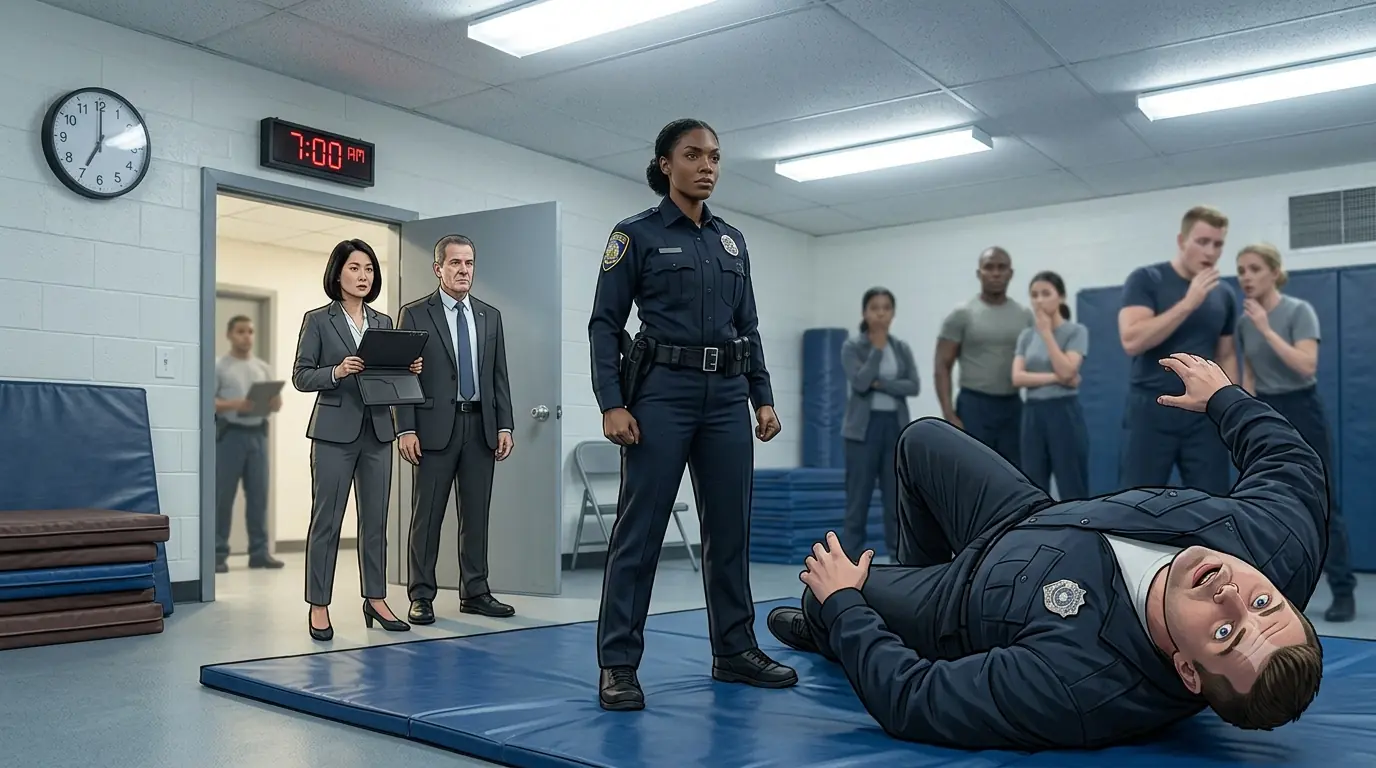
Rourke demonstrated a ground-control position.
At first, everything remained within normal defensive-tactics procedure.
He explained balance.
Weight distribution.
Arm control.
Then his pressure increased.
Nia felt the difference immediately.
This was no longer demonstration pressure.
Rourke drove his weight down.
One hand controlled her wrist.
His other forearm moved dangerously high across her upper chest.
“This,” he told the class, “is what happens when you're overpowered.”
Nia stared at the ceiling.
“Is this the lesson, Sergeant?”
Rourke leaned closer.
His voice dropped low enough that he probably thought only she could hear.
“Weak little woman.”
Nia's eyes moved toward him.
“You think this place is for your kind?”
The recruits nearest them heard it.
Nia knew because Emily's expression changed.
So did Tyler's.
The room became completely still.
Rourke must have realized his mistake.
Instead of backing away, he doubled down.
“You hear me?” he said louder. “This job will chew you up.”
His arm pressed higher.
“You're not strong enough.”
Nia remained still.
One second.
Two.
Three.
Rourke mistook patience for surrender.
That was his second mistake.
Nia looked directly into his eyes.
Something changed in her face.
The uncertainty she had deliberately worn for the past week disappeared.
Rourke noticed.
Too late.
Nia trapped his wrist, shifted her hips, created space, and turned sharply.
Rourke tried to compensate with his weight.
That made it easier.
His momentum moved exactly where she needed it.
Nia pivoted.
A second later, the massive training sergeant hit the mat.
Hard.
The impact echoed through the gym.
Nobody moved.
Nia rose.
She adjusted her uniform.
Rourke remained on his back for half a second, staring upward as if the ceiling had personally betrayed him.
Someone near the wall whispered, “Oh my God.”
Rourke sat up.
His face darkened.
“You—”
Nia looked down at him.
“You should never confuse size with control.”
The double doors opened.
Every head turned.
Chief Martin Hayes stood in the doorway.
Beside him was a woman in a charcoal-gray suit carrying a slim black folder.
Rourke scrambled to his feet.
“Chief.”
Hayes didn't answer.
His attention was fixed on Nia.
The woman beside him stepped into the gym.
Nia recognized Special Agent Laura Chen immediately.
For the first time that morning, Nia smiled.
Laura stopped several feet away.
“Agent Williams.”
Rourke froze.
No one breathed.
Laura opened the black folder.
A federal badge caught the fluorescent light.
FEDERAL BUREAU OF INVESTIGATION.
Tyler Grant's mouth fell open.
Emily whispered, “What?”
Rourke stared at the badge.
Then at Nia.
Then back at the badge.
Nia said nothing.
For a week, everyone in the academy had believed she was simply another recruit.
A quiet woman trying to earn a place in a profession that might be too difficult for her.
That assumption had been useful.
Now it was finished.
And so was the first phase of her investigation.
Nia Williams had joined the FBI eleven years earlier.
She hadn't done it because she wanted admiration.
Admiration was almost useless to an undercover investigator.
People behaved differently around someone they admired.
They became careful.
Polite.
Guarded.
Nia needed the opposite.
She needed people to forget she was watching.
That talent had developed long before the Bureau recruited her.
Her father, Marcus Williams, had been a police officer.
When Nia was a child, his uniform had represented something simple.
Safety.
She remembered sitting at the kitchen table while he polished his shoes before night shift.
She remembered the radio clipped to his belt.
The smell of coffee in his travel mug.
The way neighbors waved when his patrol car passed.
To six-year-old Nia, her father had been what good authority looked like.
Then she grew older.
And the world became more complicated.
When Nia was nineteen, Marcus came home unusually early one evening.
He didn't turn on the television.
Didn't ask what her mother had made for dinner.
Didn't complain about traffic.
He sat at the kitchen table.
Removed his badge.
And placed it in front of him.
Nia remembered the small metallic sound it made against the wood.
“What happened?” her mother asked.
Marcus stared at the badge.
“A man was handcuffed tonight.”
Neither woman spoke.
“One of our guys lost his temper.”
Marcus rubbed both hands over his face.
“The man couldn't fight back. Didn't matter.”
“What did you do?” Nia asked.
Her father looked at her.
“I reported it.”
She had expected that to be the end of the story.
It was only the beginning.
The officer involved was popular.
His uncle had worked in the department for decades.
His partner claimed Marcus had misunderstood what happened.
A supervisor suggested the detained man had been resisting.
Marcus refused to change his statement.
Then the small punishments began.
His preferred shifts disappeared.
Someone scratched a word into the paint of his personal car.
His patrol vehicle developed mysterious mechanical problems.
Friends stopped inviting him for coffee.
Officers who had once trusted him on calls became strangely unavailable when he needed backup.
Nobody officially threatened him.
That was what made it effective.
Every individual act could be explained away.
Together, they delivered a clear message.
You chose the wrong side.
Three weeks later, Marcus resigned.
Nia had been furious.
Not at him.
At everyone else.
“Why are you letting them win?” she asked him.
Marcus looked exhausted.
“This isn't winning.”
“It looks like it.”
He was silent for a while.
Then he said something Nia never forgot.
“Corruption isn't always a secret organization meeting in a dark room.”
He pointed toward the badge on the table.
“Sometimes it's just a room full of people deciding not to see what's right in front of them.”
Years later, after law school courses she never finished because investigative work interested her more, after federal training, field assignments, interviews, surveillance, and cases that taught her how power protected itself, she finally understood him.
Bad institutions rarely announced themselves as bad.
They had mission statements.
Awards.
Charity drives.
Retirement dinners.
Good people worked inside them.
That was precisely why investigating them was difficult.
Six months before Nia arrived in Redwood Falls, the FBI received the first credible allegation.
Then another.
Then three more.
Illegal searches.
Selective enforcement.
Evidence disappearing between arrest and prosecution.
Complaints against certain officers being quietly closed.
A former employee claimed officers who challenged misconduct were punished with undesirable assignments.
Another source described an “inner circle” inside the department.
None of that was enough by itself.
Rumors weren't prosecutions.
Suspicion wasn't evidence.
The Bureau needed to understand how the department actually operated when outsiders weren't present.
Nia volunteered for the undercover assignment.
Her cover was simple.
She would enter an accelerated academy program as a new recruit.
Her background had been carefully prepared.
Her federal identity would remain confidential.
Only Laura Chen, the U.S. Attorney's Office, a small investigative team, and Chief Martin Hayes knew the truth.
Even Hayes knew less than he wanted.
That had irritated him during their first private meeting.
“You're asking me to allow a federal agent into my academy without telling my command staff.”