The cruiser turned onto Elm Street, the large concrete block of the precinct coming into view.
He thinks he's taking a nobody to jail to teach him a lesson, Isaiah thought, watching the precinct's automated garage door roll up. In truth, he is driving a bulldozer through his own life.
Briggs pulled into the subterranean booking bay, threw the car in park, and swaggered around to the back door. He yanked it open and hauled Isaiah out by the cuffs.
"Let's go, John Doe. Welcome to the real world."
Isaiah walked in silence, his head held high despite the blood drying on his scraped cheek and busted lip. Briggs marched him through the heavy double doors into the bright, fluorescent glare of the precinct's intake room.
It was shift change. The room was bustling with a dozen officers drinking coffee, typing reports, and exchanging weekend stories. At the elevated front desk sat Sergeant Miller, a twenty-year veteran of the force who had known Isaiah since Isaiah was a city councilman fighting for better police pensions.
"Got a live one, Sarge," Briggs announced loudly, hoping to draw the attention of the room. "Caught him trying to strip the park at Northgate. Fought me the whole way. Refused to ID."
Sergeant Miller, who had been looking down at a stack of paperwork, sighed and looked up over his reading glasses.
His eyes fell on the man in the gray hoodie. He saw the blood. He saw the handcuffs.
The coffee cup in Miller's hand slipped. It hit the desk, spilling hot brown liquid over a stack of arrest warrants, and shattered on the linoleum floor. The loud crack of the ceramic echoed through the room.
Slowly, the chatter in the intake room died down. One by one, every officer in the room turned to look. The typing stopped. The laughter ceased. A suffocating, terrifying silence fell over the precinct, so heavy it felt like the air had been sucked out of the room.
Sergeant Miller stood up slowly, his face completely drained of color.
"Officer Briggs," Miller said, his voice a trembling, horrified whisper that somehow carried to every corner of the room. "What... what have you done?"
Briggs looked around, confused by the sudden deathly silence. His smug smile faltered. "What? He's a vandal. He wouldn't show ID—"
"Take those cuffs off him," Miller commanded, his voice suddenly roaring like thunder, vibrating the glass in the windows. "Take them off him right now!"
Briggs froze, the keys dangling uselessly in his hand. He looked at Sergeant Miller, then at the horrified faces of his fellow officers, and finally, slowly, he turned to look at the man he held by the arm.
Isaiah Whitaker stood tall under the harsh fluorescent lights. He did not look angry. He looked at Briggs with a calm, devastating pity.
"I told you, Officer Briggs," Isaiah said quietly into the silence. "My wallet is in my back pocket."
He called him a thug.
He called him trash.
Then he pulled his fist back and swung like the badge on his chest gave him permission to rewrite the law with his knuckles. Officer Nolan Briggs thought it was just another quiet Sunday morning in Brookhaven, just another chance to remind a man in a gray hoodie who was really in charge.
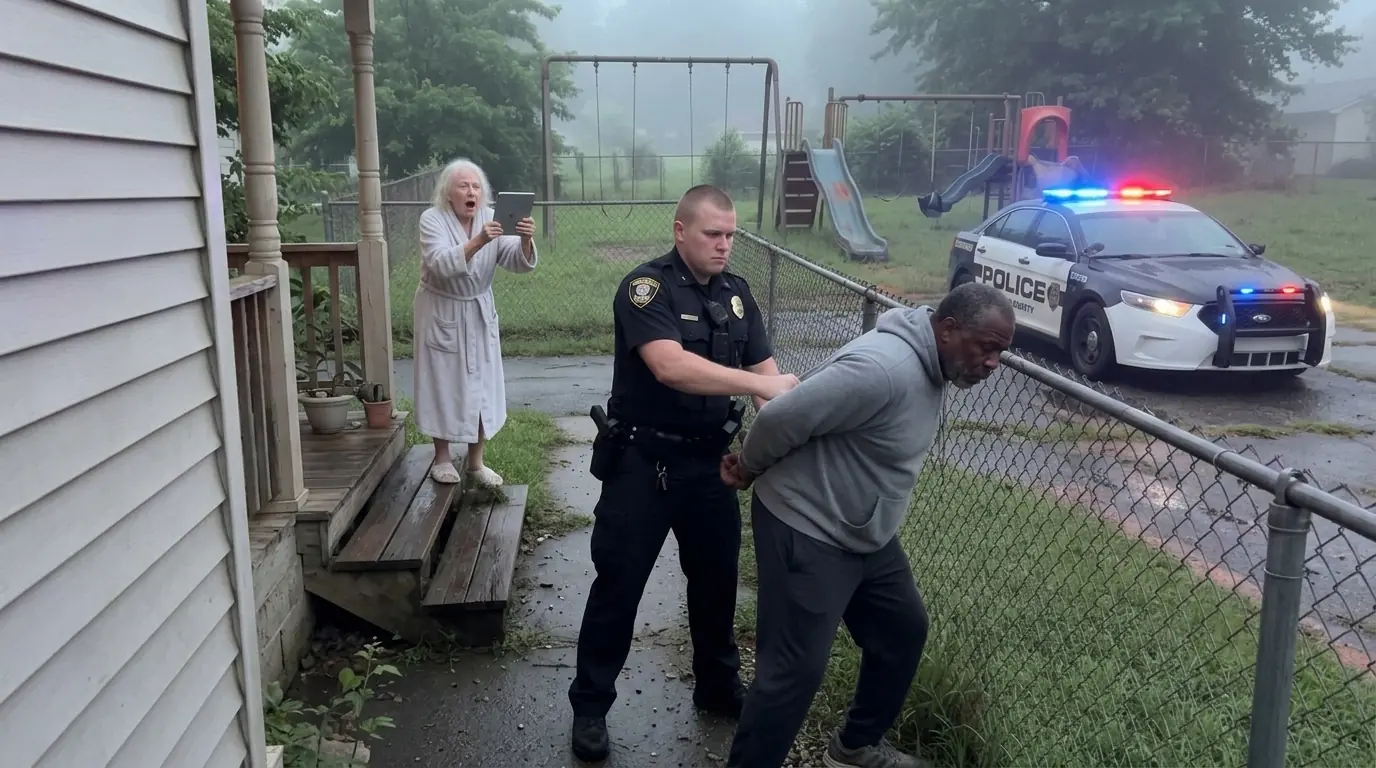
He had no idea the man bent over beside the rusty swing set was the mayor of the city.
Mayor Isaiah Whitaker hit the gravel hard, air punched out of his lungs, cheek scraped against the chain-link fence, hands locked behind his back too tightly to catch himself. For one strange second, all he could hear was the distant creak of the broken swing moving in the wind. Then Briggs leaned over him and said, “Stay down, boy,” and the whole morning changed forever.
This was not just a story about one bad arrest.
It was a story about what happens when a man who thinks power means cruelty finally meets someone who understands power as responsibility. It began before the fog lifted off the Northgate lawns, before church bells rang, before the city woke up enough to realize its mayor had left home without a suit, without a security detail, and without anyone to announce who he was.
Isaiah Whitaker tied the laces on his old running shoes at 6:12 a.m.
At forty-six, he still had the broad shoulders and solid frame of the college linebacker he used to be, though the years had softened the sharpness around his eyes. His wife, Camille, stood in the kitchen with a mug in both hands, watching him pull a plain gray hoodie over his head. She had seen that look on him before, the one that meant somebody had emailed him about a city problem and he was about to go see it with his own eyes.
“You know it’s Sunday, right?” Camille asked. “You remember the concept of a day off?”
Isaiah smiled without turning around. “The swing set at Mason Park.”
Camille sighed. “What about it?”
“Three parents sent photos this week. Rusted chains, sharp bolts, bad slide panel. Parks director says the inspection report will come in ten days.”
“And you do not trust paper more than your own eyes.”
“I trust paper after my eyes.”
That was Isaiah.
He did not lead Brookhaven from behind polished wood and framed photographs. He led from cracked sidewalks, flooded basements, late-night neighborhood meetings, school cafeterias, and city parks where parents asked him questions no press conference ever reached. He had become the first Black mayor in Brookhaven’s 128-year history not because he gave the cleanest speeches, but because people believed he would show up.
And he did.
He jogged out into the cool morning wearing no watch worth noticing, no expensive shoes, no pin on his hoodie, and no visible sign that he was the man who signed budgets, appointed department heads, and could summon half the city government with one phone call. He liked mornings like that. No podium. No cameras. Just a citizen moving through the city he had sworn to serve.
Mason Park sat near Fourth and Linden, on the edge of Northgate, a neighborhood with trimmed hedges, two-car garages, and residents who talked about safety in tones that often meant something else.
By 6:47, Isaiah reached the park and slowed to a walk. The grass was damp, the air smelled faintly of wet leaves, and the playground sat empty beneath a pair of old maple trees. He approached the swing set, crouched near the support beam, and frowned when he saw the rust.
The parents were right.
The chain links were corroded. One bolt near the left swing had worked itself loose, leaving a sharp edge exactly where a child’s hand might grab. The slide had a cracked plastic seam that could catch skin or clothing if a kid came down too fast. Isaiah took out his phone, an older model with a cracked corner on the screen, and began taking pictures.
He was so focused on the bolt that he did not hear the cruiser until the tires crunched over gravel behind him.
“Hey.”
The voice was sharp, not a greeting but an order.
Isaiah stood slowly and turned around. A Brookhaven patrol car idled near the curb, driver’s window down, exhaust curling into the cold morning. The officer behind the wheel was young, maybe late twenties, with a buzz cut, pale eyes, and a mouth shaped like he had been looking for a reason to sneer all day.
The driver’s door opened.
Officer Nolan Briggs stepped out with one hand already resting near his holster.
“Step away from the equipment.”
Isaiah raised his eyebrows, confused but calm. “Good morning, officer. I’m just checking the condition of the playground.”
“I said step away.”
Isaiah put his phone down at his side. “I’m Mayor Isaiah Whitaker. I’m taking photos for the city maintenance request. If you give me a second, I can show you my ID.”
Briggs let out a short laugh.
It had no humor in it.
“Mayor,” he said. “Right. And I’m the governor.”
Isaiah studied him. He knew most of the senior officers, but Briggs was not familiar. Later, he would learn Briggs had transferred from a neighboring county eight months earlier with what the file called a clean disciplinary history. Later, he would learn that clean meant complaints had been settled quietly, reports had been softened, and warning signs had been moved instead of addressed.