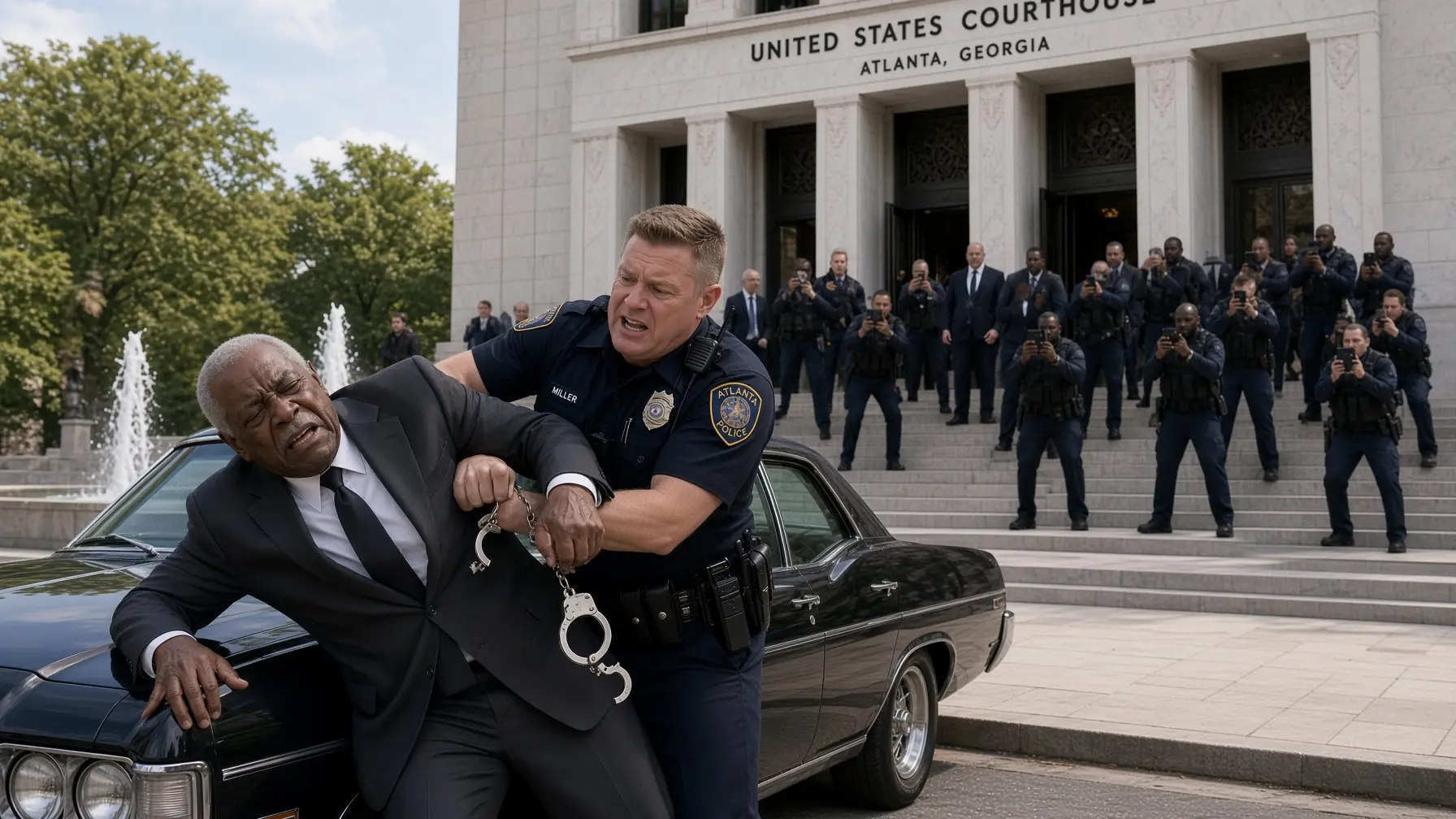
Officer Thomas Miller seemed completely certain that nobody in the courthouse plaza would challenge him when he ordered an eighty-two-year-old Black man away from a gleaming vintage Chevrolet. He stood beneath the Atlanta sun with one hand hovering near his duty belt, speaking in the impatient tone of someone who had already decided that the person in front of him did not belong beside the property he claimed to own. He did not know that inside the old man’s dark Sunday jacket rested a sealed Department of Justice envelope, nor that several people inside the federal courthouse had been waiting for that man to arrive. More important, Miller did not yet understand that none of those facts should have been necessary for Elijah Brooks to receive ordinary lawful treatment.
My name is Elijah Brooks, and I was eighty-two years old that Monday morning, which meant I had learned to respect both the usefulness and the limitations of an aging body. My right knee required several careful movements before it agreed to support me after sleep, arthritis had stiffened three fingers on my left hand, and a wound in my shoulder from Vietnam still announced approaching rain with more accuracy than television forecasts. I moved slowly because speed had stopped impressing me decades earlier, but I could still polish my shoes, press a suit, drive across Atlanta, and complete an errand without assistance. That morning, the errand mattered enough that I woke before my alarm.
I prayed beside the bed, made coffee strong enough to offend my doctor, and removed my best charcoal suit from the closet where my late wife Lillian had once insisted good clothes deserved cedar hangers. The shirt was white, the tie dark blue, and the shoes were older than some attorneys working inside the courthouse but still capable of holding a shine if I gave them enough patience. I placed my wallet in the inside pocket, checked my identification twice, and then took the sealed Department of Justice envelope from the kitchen drawer where I had kept it overnight. The instructions attached to it were simple: bring the envelope personally to the federal courthouse and place it only in the hands of Assistant United States Attorney Maya Franklin or Chief Judge Rebecca Warren.
The envelope did not contain national secrets, criminal evidence, or anything that made me important enough to command federal protection. It contained original documents connected to an oral-history and archival project concerning one of the earliest voting-rights cases handled in northern Georgia after I returned from Vietnam, along with a letter my wife had preserved for almost sixty years. Lillian and I had been interviewed several months earlier because we had both provided statements to federal civil-rights lawyers when we were young, long before anybody imagined those yellowing pages might someday belong in an exhibit about ordinary citizens who documented what they saw. The Department of Justice had sent the sealed archival packet back to me after authentication because the courthouse wanted me to deliver it during a small ceremony that morning.