When children stared at his face, Evelyn taught him to stand tall.
When adults whispered, she squeezed his hand.
When a boy at school called him “monster,” Noah came home silent, went straight to his room, and did not cry until Evelyn sat beside him.
She brushed his hair away from the birthmark and said, “This mark is not your shame, Noah. It is proof that you survived being judged by people too small to see your heart.”
Noah never forgot that.
He grew quieter, but not weaker.
He studied fiercely. While other boys chased games, Noah read anatomy books from the library until their pages curled at the edges. He became fascinated by medicine—not cosmetic perfection, not beauty, not hiding scars, but healing.
He wanted to understand pain.
He wanted to ease it.
He wanted to become the kind of person who stayed when others walked away.
By the time he graduated medical school, Evelyn was sitting in the front row, crying openly as he crossed the stage.
When he became a surgeon at St. Catherine Medical Center, the same hospital where he had been abandoned, Evelyn asked him once, “Are you sure this is where you want to work?”
Noah looked up at the hospital building.
“Yes,” he said. “This is where my story started. Maybe it’s where I’m supposed to help someone else begin again.”
Years passed.
Noah became known not only for his skill, but for his gentleness. Parents trusted him with their children. Elderly patients asked for him by name. Nurses said he could calm a room simply by entering it.
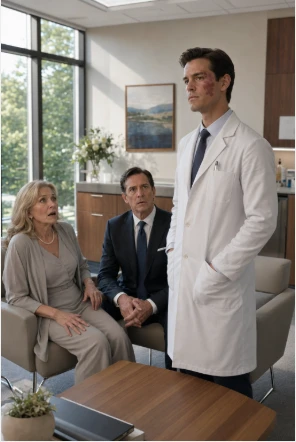
He never searched for the Whitmores.
He told himself he didn’t care.
But healing is not the same as forgetting.
Then came the emergency.
Graham Whitmore had collapsed during a charity event. Celeste had suffered complications shortly after. Their conditions were connected, rare, and urgent. The hospital’s top team gathered quickly, but one name kept rising to the surface.
Dr. Noah Hart.
He specialized in exactly the procedure they needed.
When Noah opened the file and saw their names, the hallway seemed to tilt.