defendant became "belligerent and physically aggressive." He described fearing for his
safety as Marcus allegedly lunged at him, necessitating a forceful restraint. He painted a
picture of a dangerous, unpredictable man, a picture entirely unrecognizable to anyone
who knew Marcus Redmond.
Marcus's court-appointed attorney, a young man overwhelmed by a massive caseload,
offered a tepid cross-examination that barely scratched the surface of Callaway's narrative.
When Marcus took the stand, he told the truth. He spoke of the demand for cash, the sixty
dollars, the sudden violence. He kept his voice level, refusing to be baited by the
prosecutor's condescending questions. But he could see it in the judge's eyes, in the
prosecutor's smirk, in the bored expressions of the bailiffs. Nobody cared. It was the word
of a Black man with a freshly minted resisting arrest charge against a decorated sixteen-
year veteran of the force. The outcome was predetermined before Marcus had even walked
through the courthouse doors.
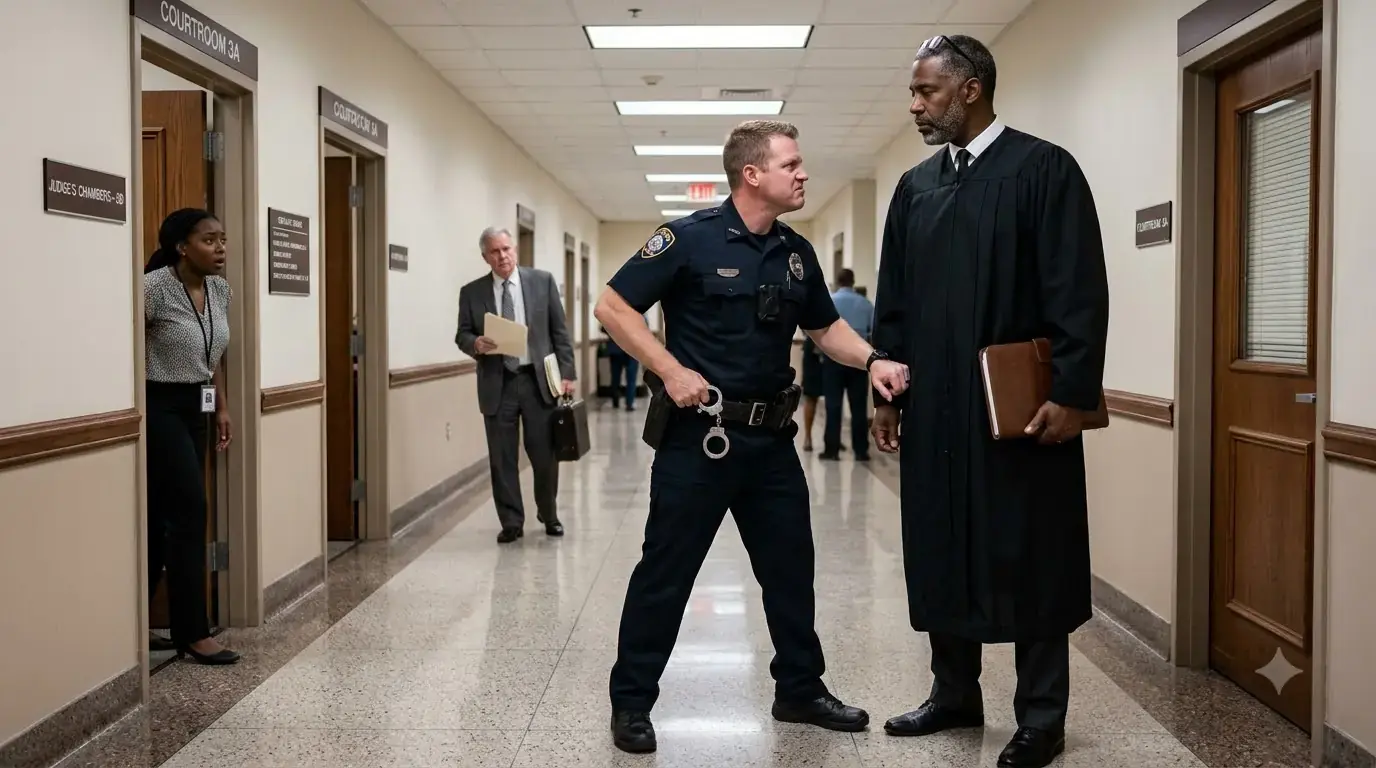
Judge Harrison barely looked up from his notes when he delivered the verdict. Guilty on
both counts. The sentence was a heavy fine, court costs, a suspended license for six months,
and two years of probation. But the legal penalties were only the beginning of the
avalanche that was about to bury Marcus's life.
The conviction acted like a virus, rapidly infecting every aspect of his existence. Two
weeks after the trial, a letter arrived from the state pension board. His retirement benefits
were being suspended pending a formal review due to a felony-level conviction on his
record. Without his pension, Marcus's meticulously balanced budget collapsed overnight.
He fell behind on rent. His landlord, a man who relied heavily on automated background
checks and strict lease clauses regarding criminal activity, issued a thirty-day eviction
notice, citing a breach of the morality clause in the rental agreement.
But the deepest cut came from his own family. Sarah, his daughter, was a single mother
fighting her own battles to keep her head above water. When the news of the conviction
and the impending eviction broke, Marcus asked if he could stay on their couch for a few
weeks while he sorted things out. Sarah sat across from him at her kitchen table, tears
streaming down her face, and delivered the blow that shattered his heart.
"Dad, I can't," she sobbed, unable to meet his eyes. "Elijah's school... the parents... if they
find out he's living with someone on probation, someone convicted of assaulting a police
officer... Child Protective Services could get involved. I can't risk him, Dad. I'm so scared. I
know you say you didn't do it, but the court says you did. The system thinks you're a
criminal. I have to protect my son."
Marcus didn't argue. He packed a single suitcase and walked away from the only family
he had. He found a small, dismal room for rent above a twenty-four-hour laundromat on
Chester Street, on the far edge of the industrial district. The air in the room was
permanently thick with the smell of industrial bleach and damp lint, and the floor vibrated
ceaselessly from the machines below. He applied for jobs—a cashier at a gas station, a
greeter at a hardware store, a night watchman at a warehouse. All three ran background
checks. All three saw the resisting arrest conviction. All three turned him down.
His life became a ghost story. He was a man erased from his own existence. Yet, his love
for Elijah remained the singular anchor tethering him to the world. Every Tuesday and
Thursday, he still drove his Honda—risking everything by driving on a suspended license,
because he felt he had nothing left to lose—to the community center. But he no longer went
inside. He parked across the street, huddled in his coat, and watched the gymnasium doors.
He would wait until the practice ended, watching the kids spill out onto the sidewalk. He
would spot Elijah, tall for his age, laughing with his friends, tossing a basketball in the air.
Marcus would sit in the cold car, the engine off, tears tracking silently down his weathered
cheeks, watching until his grandson climbed into Sarah's car and disappeared around the
corner. Only then would he turn the key and drive back to the bleach-scented room on
Chester Street, a man destroyed by a lie.
Marcus Redmond was the most thoroughly devastated of Sergeant Callaway's victims, but
he was far from the only one. Callaway's operation was an assembly line of extortion, and
as the months ticked by, the collateral damage multiplied across the east side of Ridgemont,
creating a silent chorus of broken lives and shattered livelihoods. The victims were isolated
by their fear, unaware that their personal nightmares were part of a vast, systemic pattern.
Darnell Price was thirty-four years old, a man who measured his self-worth by his ability
to provide for his pregnant wife. He drove a delivery van for a regional logistics company,
working grueling fourteen-hour shifts to secure the overtime pay they desperately needed
for the upcoming medical bills. On a rainy Tuesday night, Callaway pulled the van over on
Route 9. The accusation was an alleged failure to yield at a stop sign three miles back. The
demand was forty dollars. Darnell, a man with a fiery temper but a desperate need to keep
his job, refused to pay the bribe. He knew he hadn't run the sign. He demanded a ticket.
Callaway, angered by the defiance, didn't just write a ticket. He claimed the van's
registration paperwork, which Darnell had momentarily misplaced in the glove
compartment, was fraudulent. He called a tow truck and impounded the commercial
vehicle on the spot, leaving Darnell standing in the freezing rain on the shoulder of Route 9.
Darnell had to walk four miles to a gas station to call his wife. Because the van was
impounded, Darnell missed his shift the next morning. It was his fourth late mark in a
sixty-day period, a direct violation of the company's draconian attendance policy. He was
fired before noon. The stress sent his wife into early labor two days later. The resulting
financial catastrophe nearly cost them their home.
Sharon Okafor was forty-five, a Nigerian immigrant who had spent a decade building a
reputation as the most reliable home health aide in the county. Her clients were elderly,
fragile, and utterly dependent on her timely arrival. She was stopped on Route 9 twice in a
single month by Callaway. The first time, terrified by the flashing lights and the aggressive
demeanor of the officer, she handed over a twenty-dollar bill she had earmarked for
groceries. It was a humiliating concession, but she needed to get to her client.
Three weeks later, he pulled her over again. Same stretch of road, same approach. This
time, Callaway asked for fifty. Sharon, her pride wounded and her budget stretched to the
breaking point, told him she had already paid him his 'toll' and refused to hand over more
money. Callaway retaliated by writing her citations for an expired registration and faulty