PART2 The HOA Declared My Garage Illegal — They Had No Idea I Had the Original Records
⏱️ 1 min read 25/08/2026 18:58
"My father never signed this."
Tessa looked at him.
"Are you certain?"
"Absolutely."
"How?"
Grant pointed.
"My father always signed his full name."
The document contained only initials.
Tessa sent it to a handwriting expert.
The results arrived three days later.
The signature was forged.
Not a perfect forgery.
A careless one.
Someone had copied elements from another document.
Marla had built her entire legal argument on a fake contract.
But Tessa was not satisfied.
"Grant, people rarely go to this much trouble without expecting something."
"Money?"
"Exactly."
They examined the HOA's financial records.
The results were worse than expected.
Hundreds of thousands of dollars had been paid to companies that barely existed.
One had no employees.
Another had no physical office.
Several invoices were vague.
And the largest payments went to Summit Crest Consulting.
Tessa searched the ownership records.
She stopped.
"Grant."
"What?"
"Look at this."
Grant leaned over the laptop.
Summit Crest Consulting was controlled by a trust connected to Marla Vass.
Grant stared at the screen.
"So she planned to profit."
"Yes."
"The clubhouse wasn't about the neighborhood."
"No."
"It was about her."
Tessa nodded.
"And that changes everything."
The first resident to contact Grant was Celeste Barron.
She arrived at the property carrying a folder.
Her face looked exhausted.
"I need to tell you something."
Grant invited her inside the temporary construction office.
Tessa was already there.
Celeste sat down.
"I should have questioned Marla earlier."
Grant said nothing.
"Why didn't you?"
Celeste looked at the floor.
"Because she made everything difficult."
She explained how Marla operated.
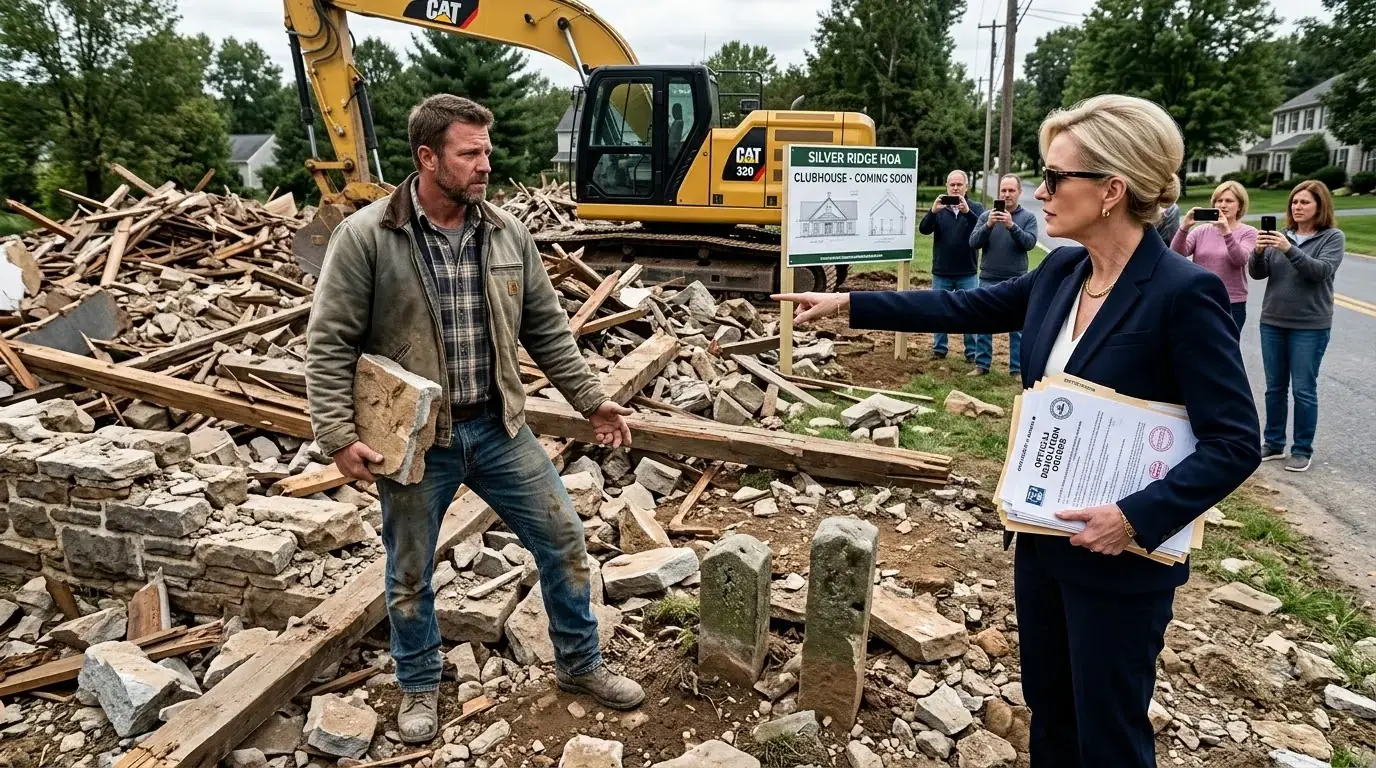
If someone challenged her, inspections appeared.
Complaints were filed.
Approvals were delayed.
Letters arrived.
Sometimes nothing serious happened.
That was the point.
Marla did not need to destroy people.
She only needed to make resistance exhausting.
Celeste had watched it happen for years.
"I knew something wasn't right with the demolition," she said.
"What did you know?"
"Marla had already hired an architect."
Tessa looked up.
"Before the emergency vote?"
Celeste nodded.
"Yes."
"How long before?"
"At least two weeks."
That was important.
Because the supposed emergency had not caused the project.
The project had caused the supposed emergency.
Tessa wrote it down.
"What else?"
Celeste hesitated.
"Marla wanted the hill."
Grant looked at her.
"She told you?"
"Not directly."
"Then how do you know?"
"Because she said the HOA would never become a serious community without that property."
Celeste opened her folder.
"I copied these before I came here."
Inside were financial records.
Payments.
Invoices.
Transfers.
Summit Crest Consulting.
Grant looked at the totals.
"How much?"
Tessa calculated.
"More than four hundred thousand dollars."
Celeste swallowed.
"I didn't approve most of these."
"Who did?"
"Marla."
That was not the only witness.
Two days later, Wade Mercer contacted Tessa.
The demolition contractor sounded frightened.
"I want to cooperate."
Tessa asked him why.
"Because I made a mistake."
"What kind?"
"I trusted her."
Wade explained everything.
Marla had told him the paperwork was complete.
She promised there would be no legal consequences.
She pressured him to finish before Grant returned.
She offered additional money if the site was completely cleared.
"She told me the owner was a problem."
Grant listened silently.
"What did she say?"
Wade hesitated.
"She said, 'He always fights. That's why we remove the problem before he realizes what happened.'"
Grant closed his eyes.
Tessa asked:
"Do you have proof?"
Wade handed over his phone.
Messages.
Emails.
Voice recordings.
Invoices.
Everything.
One message was particularly damaging.
Marla had written:
Make sure nothing remains that can be restored.
Tessa stared at it.
"This is exactly what we needed."
But Grant was thinking about something else.
"Why would Wade cooperate?"
Wade answered.
"Because I realized I was being used."
He looked toward the destroyed hill.
"I thought I was doing a legal demolition."
"Then I found out the engineer never inspected the place."
"I knew something was wrong."
"But by then it was too late."
Grant understood.
The case was not about one villain and everyone else being innocent.
It was about a system where people stopped questioning what they were told.
Marla's greatest weapon had never been authority.
It had been confidence.
She spoke as though everything had already been decided.
People followed because she made hesitation feel dangerous.
The evidence continued accumulating.
The fake inspection.
The forged agreement.
The unauthorized demolition.
The hidden financial relationship.
The private messages.
The contractor's testimony.
The residents' statements.
And then Tessa found the final piece.
A private ledger.
It showed projected revenue from the planned clubhouse.
Fourteen million dollars.
Beside it were handwritten calculations.
Construction costs.
Property acquisition.
Consulting fees.
Expected returns.
And one line:
Hollis property — essential.
Grant stared at it.
For the first time, the entire plan became visible.
Marla had not suddenly decided to destroy his house.
She had been planning for months.
Perhaps years.
She had simply been waiting for the right moment.
The day Grant returned, she believed the battle was already over.
She believed she had created a new reality.
A hill without a house.
A property ready for development.
A community too invested to turn back.
She underestimated the evidence.
She underestimated Grant.
And she underestimated what would happen when the residents finally stopped being afraid.
The court issued an emergency order freezing the property.
No construction.
No transfers.
No development.
No new permits.
The Summit Ridge project was dead.
But Marla was not finished.
She went to the media.
She called Grant a bitter homeowner.
She claimed he was trying to punish the community.
She said the demolition had been necessary.
She said the HOA had acted responsibly.
She said the house had been dangerous.
The problem was that every public statement created another contradiction.
Reporters began asking questions.
If the house was dangerous, where was the valid inspection?
If the demolition was legal, where was the authorization?
7 Part