The first thing Clara Whitmore noticed about the stranger was not his black hat, the dust on his boots, or the long brown coat that moved around him like a shadow.
It was the way the entire street seemed to grow quieter when he stopped in front of her pie stall.
Late-afternoon sunlight poured between the wooden buildings of Red Creek, touching wagon wheels, hitching posts, and drifting dust with a pale golden glow. The town remained alive with merchants calling prices, children racing between barrels, and horses stamping impatiently near the saloon. Yet around the stranger, the noise felt distant.
Clara straightened behind her counter.
She had been standing there since noon, selling apple, peach, and blackberry pies she had baked before sunrise in the cramped kitchen behind her rented room. Only six remained. If she sold them all, she could pay Mr. Talbot another week’s rent and perhaps buy enough flour to continue.
If she did not, she would be sleeping beneath the church steps by Monday.
The stranger’s eyes moved across the pies.
“Can I help you, sir?” Clara asked.
His face was weathered but not old. Thirty-five, perhaps. Strong jaw. Light stubble. A thin scar near his right eyebrow. He carried himself with the stillness of a man who had learned not to waste movement.
“I’ll take them all.”
Clara blinked.
“All?”
He reached inside his coat.
For one sharp second, her body tensed.
Instead of a weapon, he brought out a thick bundle of bills and dropped it onto the counter.
The money struck the wood with a heavy thud.
Clara stared at it.
There was more cash in that bundle than she had earned in six months.
“Every… every pie?” she whispered.
The stranger nodded once.
He picked up a burlap sack leaning against a post and began lowering the pies inside, one by one, careful not to break their crusts.
Clara watched him in growing confusion.
“Sir, that is far too much money.”
“No.”
“You could buy the entire bakery on Willow Street for this.”
“I know.”
“Then why give it to me?”
He placed the final blackberry pie into the sack and tied the cord.
The camera of the moment seemed to drift around them, circling past the empty pie plates, the bundle of money, Clara’s tightening fingers, and the stranger’s unreadable expression.
“Will you be here tomorrow?” he asked.
Clara frowned.
“Yes. Every afternoon.”
A faint smile appeared on his face.
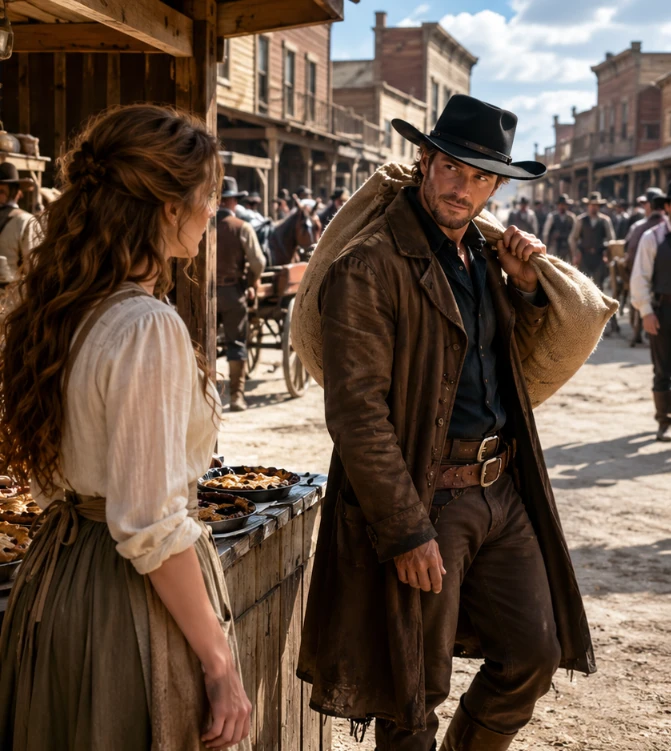
“No,” he said softly. “Tomorrow, I’d like to meet you.”
Before she could ask what that meant, he lifted the sack over his shoulder and walked into the crowded street.
Clara stepped around the counter.
“Wait!”
He did not stop.
She watched him pass the blacksmith, cross in front of the saloon, and disappear behind a wagon carrying cedar planks toward the edge of town.
Only then did Clara look down at the money again.
Beneath the bills lay a small silver button engraved with a symbol she had not seen in twenty years.
**A circle split by a single lightning bolt.**
Her breath vanished.
Clara snatched up the button and closed her fist around it.
That mark had belonged to her father.
Silas Whitmore had worn the same symbol on his coat the night he disappeared.
She had been eight years old.
He had kissed her forehead, promised to return before dawn, and ridden away beneath a storm-dark sky. The next morning, his horse was found beside the river, its saddle covered in blood.
His body had never been recovered.
Clara turned toward the street, but the stranger was gone.