Police Thought They Found an Easy Arrest at the Store — Then They Opened the Badge Wallet in Her Bag
⏱️ 1 min read 27/08/2026 15:49
Some buyers settled.
Others filed lawsuits.
The company issued statements about “miscommunication.”
Rachel hated that phrase.
“Miscommunication suggests everyone had the same information and misunderstood it.”
She tapped the email file.
“That isn't what happened.”
“What happened?”
“People told themselves what they wanted to believe.”
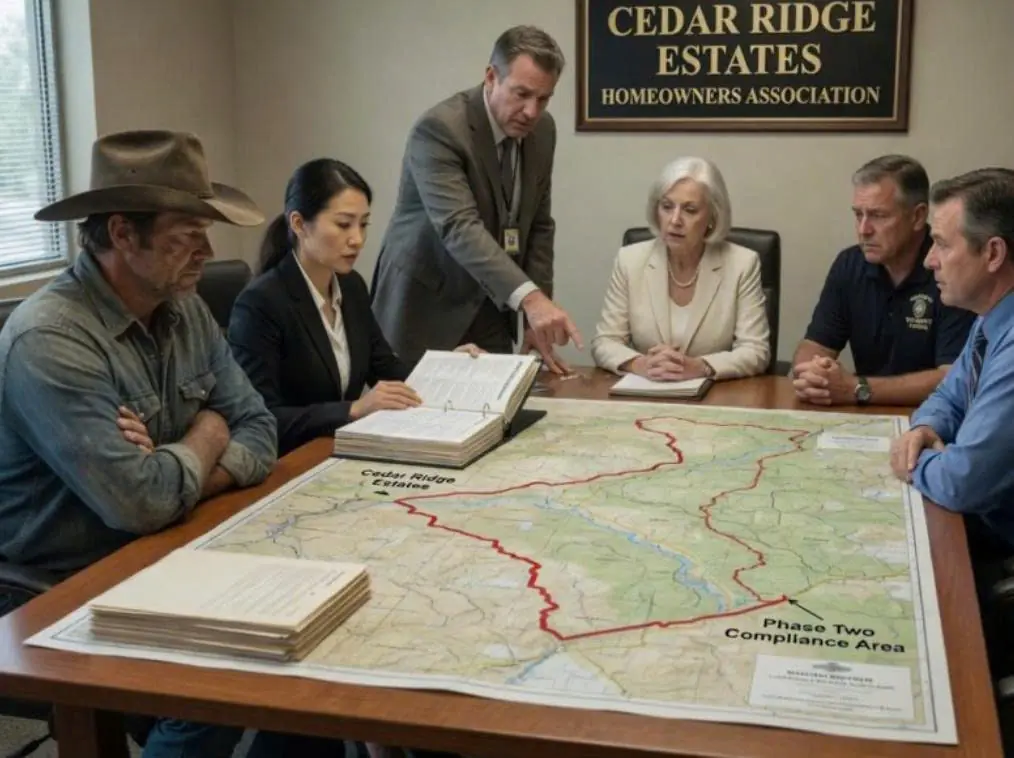
The Briarwood HOA held an emergency meeting.
The clubhouse was too small, so they used the local high school gym.
The place was packed.
Buyers.
Residents.
Reporters.
Attorneys.
Horizon executives.
Board members.
And Karen.
I attended with Rachel.
The meeting started badly.
Daniel Price, a Horizon executive, stood at the microphone.
“Our company acted in reliance upon information supplied by community representatives.”
Residents booed.
The HOA attorney stood next.
“The board never formally authorized Ms. Whitmore to bind the association to any development partnership.”
Horizon representatives immediately began whispering.
Then Karen stood.
She looked different.
Not physically.
She was still polished.
Still composed.
But she had lost the one thing that had always protected her.
People's willingness to believe her.
“I acted to protect Briarwood's future,” she said.
Someone shouted:
“We needed the truth!”
Karen raised her voice.
“This community needed a plan!”
A father stood near the front.
“My wife and I gave notice on our rental because your newsletter said Phase Six was moving forward.”
Karen responded, “The newsletter shared planning updates.”
“You called them confirmed milestones!”
Another woman held up an email.
“You said reservations were a once-in-a-generation opportunity!”
Karen looked toward the HOA attorney.
He didn't look back.
Then Rachel stood.
The room became quiet.
She walked to the microphone.
“My client, Ethan Mercer, did not sell this land.”
Silence.
“He did not option this land.”
More silence.
“He did not authorize site plans.”
“He did not authorize marketing.”
“He did not authorize surveys, tree markings, road layouts, lot reservations, or public representations that his property was part of Briarwood Estates.”
She placed the recorded deed on the projector.
“This ownership record was available the entire time.”
Then she displayed Karen's expansion packet.
“This is not a deed.”
Next page.
“It is not a purchase contract.”
Next.
“It is not land control.”
She looked at Karen.
“It is a wish presented as fact.”
The phrase seemed to hang in the gym.
A wish presented as fact.
Karen stood.
“That is an oversimplification.”
Rachel looked at her.
“No.”
The room was silent.
“It is the simplest part of the case.”
She pointed toward the projector.
“You cannot sell homes on land you do not own.”
Someone clapped.
Then another person.
Then dozens.
Within seconds, the entire gym was standing.
The applause wasn't for me.
It was the sound of people finally admitting they had been deceived.
Karen slowly sat down.
Her face had gone white.
And that was the moment her authority ended.
Not when the county stopped the project.
Not when the website disappeared.
Not when the lawsuits began.
It ended when people stopped believing her.
The consequences continued for months.
Horizon refunded deposits.
Some buyers received settlements.
Others pursued lawsuits.
The company lost contracts.
Two executives resigned.
An internal review concluded that land-control verification had failed at multiple levels.
The real estate board disciplined several agents involved in the marketing.
And Briarwood itself began to fracture.
Residents who had tolerated Karen for years started examining everything she had done.
They reviewed old budgets.
Committee records.
Meeting minutes.
Vendor agreements.
Architectural approvals.
They discovered how often she had operated beyond the authority granted to her.
One resident told me:
“She didn't suddenly become dishonest.”
“What do you mean?”
“We just finally had a reason to look.”
That sentence stayed with me.
Karen resigned before the HOA recall vote.
It didn't matter.
The board was dissolved anyway.
The recall was overwhelming.
The county election monitor said she had rarely seen anything like it.
A new board was elected.
The first thing they did was review the governance rules.
The second was to create restrictions on future development proposals.
No officer could present plans involving land outside HOA ownership without documented proof of authority.
No newsletter could call a project “confirmed” without executed agreements.
No expansion committee could be formed without resident approval and legal oversight.
No one could use private property in marketing materials without written permission.
The rules were painfully obvious.
They should have existed from the beginning.
Meanwhile, buyers were still angry.
I understood why.
Many had lost money.
Some had delayed moves.
Some had changed jobs.
Some had told their children they were moving into a beautiful new neighborhood.
They had been sold a dream.
And I had become the face of the obstacle.
One couple wrote to me.
Their daughter had been excited about living near the pond.
When the project collapsed, she cried.
The parents wrote:
We were angry at you before we knew you had been lied to first.
I read the sentence several times.
Then I put the letter away.
It was one of the few things from the entire ordeal that made me feel something other than anger.
Because that was the ugliest part.
Karen hadn't just tried to take my property.
She had rewritten the story around it.
She had made strangers believe I was selfish.
That I was blocking progress.
That I was the unreasonable owner refusing to cooperate with a community project.
But I had never been asked.
Never contacted.
Never offered a contract.
Never given a choice.
The entire argument had been built without me.
That is how entitlement works.
It doesn't always begin by taking something.
Sometimes it begins by telling everyone else that the thing already belongs to them.
The courts eventually forced the various parties to resolve their disputes.
Horizon paid settlements.
The HOA reached its own agreements.
My claims were resolved as well.
The exact terms were private.
Rachel told me that was a good thing.
“You don't need a public victory,” she said.
“What do I need?”
“To get your land back to normal.”
So I did.
We removed the survey stakes.
The pink ribbons came off the oak trees.
The tire tracks were repaired.
The damaged grass was reseeded.
The sign disappeared.
The brochure disappeared.
The fake street names disappeared.
But something remained.
A memory of how close it had come.
One Saturday, months later, I drove out alone.
7 Part