Pause Unmute Remaining Time - 9:37 Fullscreen
**PART ONE — THE EMPTY PLACE**
**The first time my husband tried to bury me, he used a family portrait instead of a grave.**
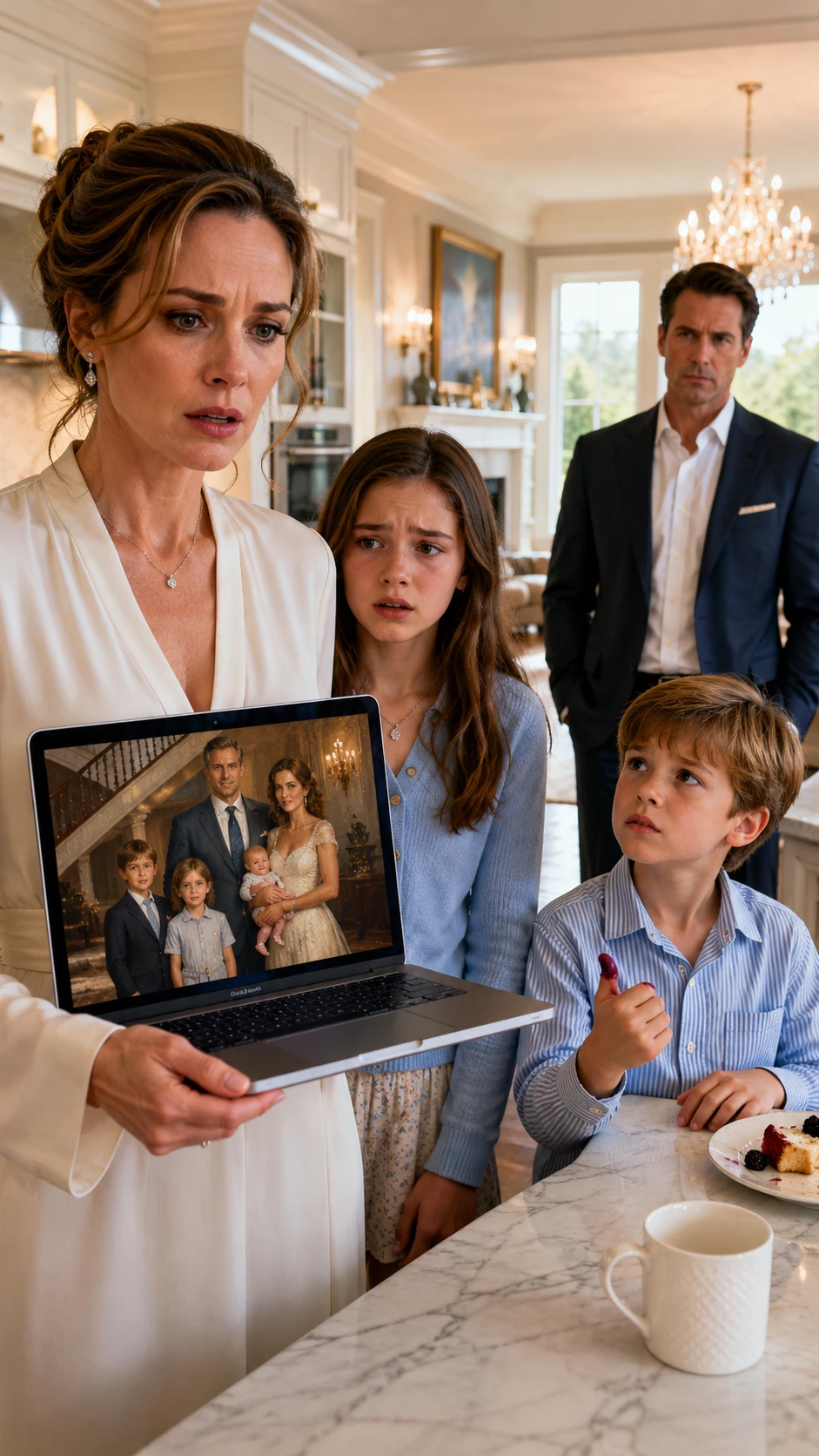
The proof arrived by email on a rain-darkened Thursday evening while my daughter, Ava, divided a blackberry tart into equal pieces for herself and her younger brother.
The subject line read, “Revised Family Portrait Ready for Approval,” which sounded harmless enough to belong among lighting changes, background samples, and other details for Harrison’s annual foundation gala.
I opened the attachment expecting softer shadows beneath the staircase or a warmer shade of gold in the antique frames.
Instead, I saw my husband smiling beside another woman while she held a baby against her ivory silk dress.
Ava and Theo stood beside them.
I did not.
For several seconds, I believed the image had failed to load correctly because the human mind will invent almost any explanation before accepting that it has been deliberately wounded.
I refreshed the screen.
Nothing changed.
Harrison stood beneath the grand staircase of our Connecticut home with one hand on Theo’s shoulder and the other curved confidently around the waist of Celeste Arden, the foundation’s communications director.
Celeste occupied the exact place where I had stood in every formal family photograph taken during the previous thirteen years.
Her expression was serene, almost maternal, and the infant in her arms wore the christening gown Harrison’s grandmother had preserved in cedar for nearly a century.
Ava had been positioned close enough to Celeste that a stranger might assume she trusted her.
Theo had been instructed to look toward the baby with brotherly pride.
Harrison had tilted his face toward them with the satisfaction of a man admiring a completed renovation.
**I had not merely been moved to the edge of the picture.**
**I had been erased from my own family and replaced by a woman holding a child I had never been told existed.**
The cruelty of the image did not come from disorder or anger.
It came from its perfection.
The lighting was warm.
The colors were tasteful.
The staircase rose behind them like the entrance to an inheritance.
The portrait did not look scandalous.
It looked official.
That was when Ava saw it.
She was twelve years old, with my dark eyes and Harrison’s habit of studying people before deciding whether to trust them.
Her fork stopped halfway to her mouth.
She stared at Celeste’s hand on her father’s arm, then at the baby, then at the empty space where I should have been.
“Mom,” she whispered.
There are moments when a child becomes older without moving, and I watched one happen across the dining table.
Theo was nine and still carried softness in his cheeks, although he fought it by combing his hair the way Harrison did before important meetings.
He looked from Ava to me with blackberry filling on his thumb.
May you like

# She Wore My Face Beneath the Chandeliers. By Dawn, My Husband Had No Name.
# My Sister Bore My Husband’s Son. The Signature They Forged Buried Them All.
# The Throne He Gave Away. The Woman Who Owned the Kingdom.
“Is that our picture?” he asked.
I closed the laptop so quickly that the silver edge struck the table.
“It is something your father needs to explain,” I said.
“Who is the lady?” Theo asked.
Ava answered before I could.
“She works for Dad.”
Her voice was flat, but her face had gone pale.
“Why is she holding a baby in our house?” Theo asked.
I reached across the table and took his sticky hand.
“I don’t know yet.”
Ava looked directly at me.
“You do know.”
Her accusation was quiet because she was not angry with me.
She was frightened that I might lie to protect her.
“I know what the picture suggests,” I said.
“Is Dad leaving us?”
“No one is leaving you.”
“That is not what I asked.”
I wanted to tell her that families survived storms, that adults sometimes made terrible mistakes, and that love could remain even when trust did not.
Those words felt dishonest while my absence glowed behind the closed screen.
“I don’t know what your father plans,” I said.
Ava lowered her eyes.
Theo began rubbing his thumb against his napkin until the purple stain spread like a bruise.
“Is the baby ours?” he asked.
The question nearly broke me because children do not possess the vocabulary for betrayal, so they ask about ownership.
“I don’t know who the baby belongs to,” I said.
Ava flinched.
“Babies don’t belong to people.”
She was right, and I hated Harrison for forcing her to correct me at such a moment.
“You’re right,” I said.
“The baby is innocent.”
“Then who isn’t?”
Before I could answer, the grandfather clock in the hallway struck eight.
Harrison was already three hours late.
I took the children upstairs, helped Theo wash the blackberry stain from his hands, and sat on the carpet between their rooms until both doors went quiet.
Ava did not sleep.
I knew because the thin line of light beneath her door remained until almost midnight.
Harrison came home at twelve twenty-seven.
I heard his car move across the wet gravel, the front door open, and his shoes cross the marble foyer.
He did not call my name.
He did not check on the children.
He went directly into his study and closed the door.
That small act told me more than an apology could have concealed.
**He already knew the portrait had been sent.**
I remained in bed with the lights off, listening to rain press against the windows of the house I had inherited from my first husband, Nathan.
Harrison liked to call it our home when donors visited and my house when repairs were needed.
By dawn, I had stopped asking myself whether the photograph could be explained.
I began asking why it had been created.
Harrison entered the kitchen at seven thirty wearing a navy suit, silver cuff links, and the expression of a man preparing to deliver a quarterly report.
Ava and Theo sat at the breakfast table in complete silence.
He looked at them, then at me.
“I assume we need to talk,” he said.
Theo stared at his cereal.
“What’s a mistress?”
Harrison stopped beside the coffee machine.
His face hardened, not with shame, but with irritation at the vocabulary.
“Where did you hear that word?”
“School.”
“That is not an appropriate subject for breakfast.”
“Is Ms. Arden your mistress?”
Ava’s voice was so calm that Harrison turned toward her slowly.
“Adults sometimes form relationships that are complicated.”
“You always say complicated is a word people use when they don’t want to tell the truth.”
The color rose in his neck.
I had once admired the way Harrison remained composed under pressure.
That morning, I understood that composure was not strength.
It was control.
“Yes,” he said at last.
“There is another woman.”
Theo’s spoon slipped into the bowl.
The sound was tiny.
It seemed to echo through the entire kitchen.
Harrison continued as though a quick explanation could make cruelty efficient.
“Celeste and I have a child together.”
Ava closed her eyes.
Theo looked at me.
I held his gaze because someone had to remain present while his world altered.
“The baby’s name is Asher,” Harrison said.
“He is six months old, and he is your brother.”
“No,” Ava said.
Harrison’s eyebrows lifted.
“You do not have to like the situation, but biology is not subject to your approval.”
“You don’t get to make him my brother after hiding him from me.”
“He did not choose to be born.”
“I know that.”
“Then do not punish an innocent child because you are angry with me.”
Ava pushed back her chair.
“You put us in a picture with him without telling us who he was.”
“The portrait was intended to introduce the situation in a positive way.”
“You used our faces to lie.”
Harrison glanced at me as if Ava’s clarity were evidence of my manipulation.
“This is exactly the emotional reaction I hoped to avoid.”
I had been married to him long enough to recognize the architecture of his sentences.
First, he caused pain.
Then he criticized the injured person for bleeding.
“What did you tell the artist?” I asked.
“That is a private professional matter.”
“The artist used our children in a fabricated family portrait.”
“It is not fabricated.”
“I was removed.”
Harrison poured coffee and added one teaspoon of sugar.
He always used two.
His hand was not as steady as his voice.
“Our marriage has not functioned properly for years.”
“That was not the question.”
“The family is changing, Eleanor.”
“Did you tell the artist to erase me?”
“I asked her to create an image that reflected the future.”
Theo began to cry without making a sound.
Tears simply moved down his cheeks while he stared at his father.
Harrison noticed and sighed.
“This is why I wanted to handle the transition carefully.”
“You mean secretly,” I said.
“I mean with dignity.”
“You placed your mistress in my home, dressed her in my place, and arranged our children around her like furniture.”
“You are choosing inflammatory language.”
“I am choosing accurate language.”
He set down his coffee.
“The gala is in three weeks, and the foundation cannot afford public chaos.”
Ava laughed once, but there was no amusement in it.
“Your foundation?”
Harrison looked at her sharply.
“The Hale-Vale Foundation belongs to all of us.”
“It has Mom’s name first.”
“It is not a competition.”
“No,” I said.
“It is a fact.”
My first husband, Nathan Hale, had established the foundation with money inherited from his family’s manufacturing company.
After Nathan died, I became controlling trustee and chair.