“Did you send the portrait email?”
She nodded.
“I used Mara’s account after she gave me access.”
“Why?”
“I needed you to see it before the gala.”
“You could have called.”
“I thought you might refuse to believe me.”
“I might have.”
“The picture was impossible to explain away.”
“Why include the children?”
“I did not create it.”
“But you posed for it.”
Her shoulders folded inward.
“Harrison brought Ava and Theo to the studio separately.”
“When?”
“During the foundation’s holiday video shoot.”
I remembered the day.
Harrison had said the children were recording a message for hospital donors.
“He photographed them against a green screen,” Celeste said.
“They never stood beside me.”
My nausea deepened.
The portrait had not merely lied about their consent.
It had assembled them without their knowledge.
“Why did Harrison need it?” I asked.
“He said appearances create legal momentum.”
“Legal momentum toward what?”
Celeste looked toward the church entrance before answering.
“He intends to have you declared incompetent.”
The words did not shock me immediately.
They were too calculated to enter an emotional mind.
“What did you say?”
“He has been collecting records for years.”
“What records?”
“Your grief counseling after Nathan died, your insomnia prescriptions, the panic attack you had at the hospital fundraiser, and every time you delegated foundation duties.”
“My panic attack happened when Theo stopped breathing from an allergic reaction.”
“He removed that context.”
I stood and walked toward the altar rail.
My shoes sounded loud against the stone floor.
“Harrison told the board you were becoming forgetful,” Celeste continued.
“He said the guest house would allow you to live nearby while he assumed responsibility.”
“He planned to move you out and call it care.”
“Yes.”
“And the portrait would show the world that the children had accepted the new arrangement.”
“Yes.”
“Asher would become part of the Vale family.”
“Yes.”
“Why?”
Celeste’s face went pale.
“I think it has something to do with Nathan’s trust.”
Nathan’s estate had been divided into personal assets, foundation assets, and a family trust containing Hale Manufacturing shares.
The company had been sold years earlier, but the trust retained substantial investments.
Under the terms I remembered, the principal would pass to Nathan’s biological descendants when they reached thirty.
Because Nathan and I had no living children, the trust would eventually support the foundation.
At least, that was what I had always believed.
“Harrison asked me to sign documents naming him Asher’s legal father,” Celeste said.
“Did you?”
“Some.”
“Which ones?”
“I don’t know.”
“You signed documents you did not understand?”
“I was pregnant, dependent on his insurance, and told the baby could be taken if I refused.”
Her voice sharpened.
“You may judge me after you have spent eight months carrying a child while the father controls your doctor, your salary, and the apartment where you sleep.”
“He is not the father.”
“I know that now.”
The sentence broke between us.
Asher woke and began to fuss.
Celeste lifted him from the carrier and held him against her shoulder.
He stared past her at me.
“What did Harrison name him?” I asked.
“Asher Nathan Vale.”
My breath caught.
“He used Nathan’s name?”
“He said Nathan was an old family name on his side.”
“It is not.”
Celeste closed her eyes.
“He wanted you to recognize it eventually.”
“Why?”
“I don’t know.”
I did.
Some part of Harrison had wanted me to understand the theft.
Not immediately.
Not when I could stop it.
He wanted me to recognize it after the portrait had been unveiled, after the public story had hardened, and after my objections could be dismissed as jealousy or instability.
**He did not merely want to defeat me.**
**He wanted me conscious while he inherited my life.**
Miriam filed for an emergency injunction the next morning.
We requested preservation of clinic records, independent testing of Asher, and a temporary prohibition against any change to his legal parentage.
Harrison’s attorneys responded within four hours.
They accused me of harassment, emotional instability, interference with an established parent-child relationship, and an irrational fixation on frozen embryos that had been destroyed more than a decade earlier.
The language was elegant.
The message was unmistakable.
Harrison had prepared for this.
That evening, he entered the guest house without knocking.
I was reviewing foundation bylaws at the kitchen table.
He closed the door behind him.
“You met Celeste.”
It was not a question.
“You have men following her.”
“She is vulnerable and easily influenced.”
“She is afraid of you.”
“She is afraid of losing financial support.”
“You mean your control.”
He removed his coat and placed it carefully over a chair.
“You have turned a private family matter into a legal spectacle.”
“You forged my signature.”
“I facilitated a decision you had already made.”
“I decided to destroy those embryos.”
“You decided while grieving.”
“I decided because they belonged to Nathan and me.”
“You married me.”
“That did not transfer ownership of my body.”
His eyes hardened.
“The embryo would have ceased to exist.”
“That was my choice.”
“It was waste.”
The word revealed him.
Not grief.
Not longing.
Not love for an unborn child.
Waste.
To Harrison, anything valuable that remained uncontrolled was waste.
“Is Asher Nathan’s son?” I asked.
He glanced toward the dark window.
“You should stop asking questions whose answers will hurt the children.”
“Which children?”
“All of them.”
The answer chilled me.
“What did you do at Wexler?”
“You signed documents.”
“You forged them.”
“Can you prove that?”
“I will.”
He stepped closer.
“You are fifty-six years old, Eleanor.”
“I know my age.”
“You have a history of depression, anxiety, insomnia, and complicated bereavement.”
“I have a history of being human.”
“You have confused memory with certainty before.”
“When?”
“Small things.”
“Name one.”
He smiled faintly.
“You see, this is the problem.”
I understood then how he intended to proceed.
Every denial would become agitation.
Every accurate memory would become obsession.
Every accusation supported by evidence would become paranoia.
“You have been planning to call me insane,” I said.
“I have been planning to protect the children if you deteriorated.”
“How long?”
He did not answer.
“How long, Harrison?”
His silence was more terrible than any number.
I moved closer until only the table separated us.
“Are Ava and Theo yours?”
For the first time, genuine alarm crossed his face.
It vanished quickly.
“Of course they are.”
“Biologically?”
“I am their father.”
“That was not the question.”
“Do not involve them in this.”
“You involved them before they were born.”
His mouth tightened.
“Celeste has filled your head with speculation.”
“The laboratory named me as Asher’s genetic mother.”
“Laboratories make errors.”
“It identified a Hale family marker.”
“Medical records are complicated.”
“Dynasties are complicated too.”
He looked toward the laptop.
“What have you found?”
There it was.
Not outrage.
Not confusion.
Fear.
I closed the computer.
“Enough to know you should be afraid.”
Harrison leaned over the table.
“You have always needed a tragedy to give you importance.”
The sentence struck with the accuracy of something selected long ago.
He continued softly.
“Nathan’s death made you a widow.”
“The miscarriages made you brave.”
“Your panic made you fragile.”
“Now you want my betrayal to make you righteous.”
I felt each word land.
A younger version of me might have defended every wound.
She might have explained that grief was not performance and survival was not vanity.
I looked at the man I had loved for thirteen years and finally understood that explanations were gifts.
He would receive no more.
“You are right about one thing,” I said.
“What?”
“Your betrayal is going to make me something.”
His expression remained still.
“What is that?”
“The last person you should have underestimated.”
**PART THREE — THE HOUSE BEHIND THE HOUSE**
The guest house had been built in 1912 for Nathan’s grandfather, who disliked sleeping beneath the same roof as visiting politicians.
It stood behind a line of hemlocks and looked small from the main drive.
Inside, it contained two bedrooms, a study, a kitchen, and a narrow basement corridor leading to an abandoned service tunnel.
Nathan and I discovered the tunnel during renovations.
It ran beneath the garden and ended behind the wine cellar wall in the main house.
We sealed the entrance after a raccoon family moved into it.
Harrison never knew it existed.
Three nights after our confrontation, Ava appeared at the guest-house door carrying a backpack and Theo’s winter coat.
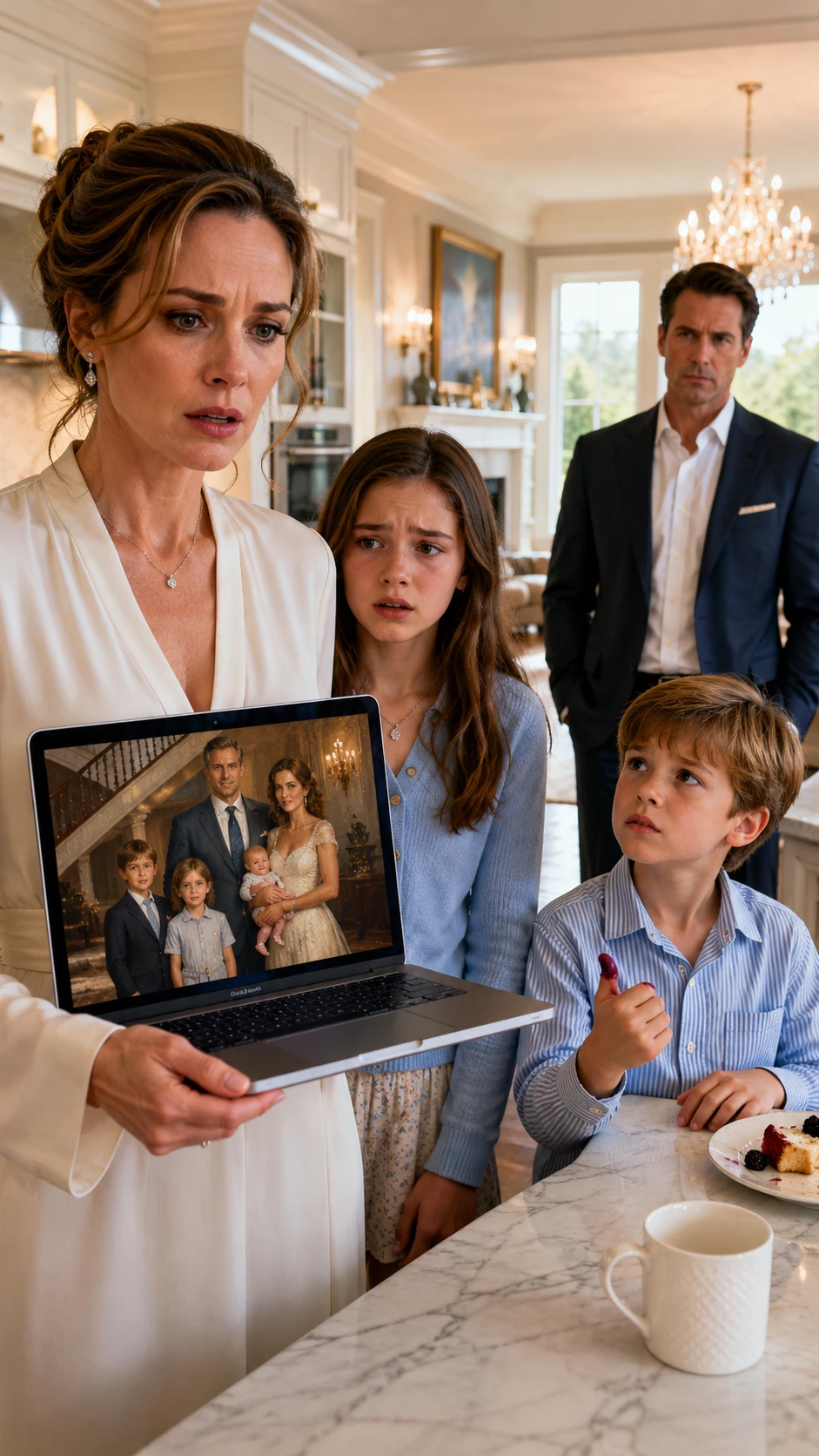
“We’re staying here,” she announced.
“Did your father agree?”
“No.”
“Then I need to call him.”
“He went to New York.”
“With Celeste?”
“I don’t know.”
Theo stepped from behind her.
“Dad said you were sick.”
The world narrowed around his small face.
“What exactly did he say?”
“He said your memories get mixed up when you’re sad.”
Ava dropped her backpack.
“He told us not to repeat adult conversations.”
“Then why are you repeating it?”
“Because he lies.”
Her certainty frightened me.
Children should not need suspicion as a survival skill.
I brought them inside and made cocoa.
Theo sat at the counter while Ava paced.
“Dad said the baby belongs to him,” she said.
“He said you’re trying to take Asher because you still miss Nathan.”
“What did you say?”
“I asked why a dead person’s baby would belong to Dad.”