The livery was seized.
Stone Hollow expected Anders to claim it as repayment for his brother’s death.
He refused.
Instead, the deed was transferred to Greta, whose unpaid labor and testimony established her rightful share.
The town that had once pitied her watched as she stood beneath the freshly painted sign:
**HALVORSEN & KADE MOUNTAIN STOCK**
But the greatest surprise came on opening day.
Greta hung a second sign beneath the first.
**LOUISA’S HOUSE — WAGES PAID FAIRLY TO WOMEN WITH NOWHERE ELSE TO GO.**
Elsie managed the accounts.
Louisa supervised the kitchen.
Anders trained mountain mules in the back corral, his leg permanently stiff but strong enough to carry him.
That evening, Greta found him repairing a harness.
“You lied to me,” she said.
His hands stopped.
“I did.”
“You followed me over a winter pass with a broken leg.”
“Yes.”
“That was foolish.”
“Yes.”
“You gave me the livery.”
“It was yours.”
She stepped closer.
“Do you still need someone who won’t blow away in a storm?”
Anders looked up.
“No.”
Greta’s face fell slightly.
Then he stood, took her hand, and placed it against his chest.
“I need you because the mountain was never home until you stood in it.”
Greta’s eyes filled.
Outside, the people of Stone Hollow moved through streets that no longer seemed quite so narrow.
She leaned forward and kissed the man who had first chosen her for her strength, then loved her for everything beneath it.
And Anders finally confessed the last truth he had hidden.
His mother’s brass wedding ring—the one he had placed on Greta’s hand—had never belonged to his mother.
Samuel had bought it twelve years earlier.
For Greta.
Before the fire, Anders’s brother had planned to ask her to marry him.
Otto had discovered the ring and understood that if Samuel married Greta, she would leave the livery—and Otto’s crimes would be exposed.
That was why Samuel had died.
Greta stared at the ring on her finger as the final piece settled into place.
She had not been unwanted.
She had never been unwanted.
**One man had died intending to choose her. Another had crossed a mountain to choose her again.**
And the town that had spent years teaching Greta Halvorsen to feel ashamed of the space she occupied was forced to watch as she built a life too large, too strong, and too extraordinary for any of them to ignore.
The moment Anders Kade asked Greta Halvorsen whether she wanted to leave Stone Hollow, the entire world seemed to hold its breath.
Wind slipped through the livery yard, lifting strands of pale hair from Greta’s thick braid. Behind her, three mules shifted against the fence, leather tack creaking softly. Beyond the corral, the town continued its noisy little life—hammers striking iron, men shouting over cards, wagon wheels grinding through mud—but Greta heard none of it.
She stared at the mountain trapper as if he had spoken in a language she had forgotten.
“What do you mean?” she asked.
Anders stood motionless in his weathered buckskin coat. His face had been carved by years of snow, hunger, and solitude, but there was no mockery in it.
“I mean exactly what I said.”
Greta gave a bitter laugh.
“You’re buying mules.”
“I am.”
“And now you’re offering to take me with them?”
“I’m asking whether you want out.”
Her arms tightened across her chest. “As what? A cook? A hired hand?”
Anders glanced toward the stable, where her brother Otto leaned against the doorway with a bottle hidden poorly behind his leg.
“As my wife.”
The words struck harder than any insult Stone Hollow had ever thrown at her.
Otto barked a laugh.
Two men on the boardwalk turned. Then a woman outside the mercantile stopped arranging apples. Within seconds, the whole street seemed to tilt toward the livery.
Greta’s face burned.
“You think that’s funny?” she whispered.
“No.”
“You don’t know me.”
“I know you handled a panicked gelding without hurting it. I know you understand winter stock. I know you’ve worked this place while another man drank the money.”
“That isn’t enough to marry someone.”
“It’s more than most men learn before they do.”
A ripple of laughter moved through the growing crowd.
Otto pushed away from the doorway. “She’ll eat you out of your cabin before Christmas.”
Greta flinched.
Anders did not even look at him.
“I’ve got food,” he said.
The laughter died unevenly.
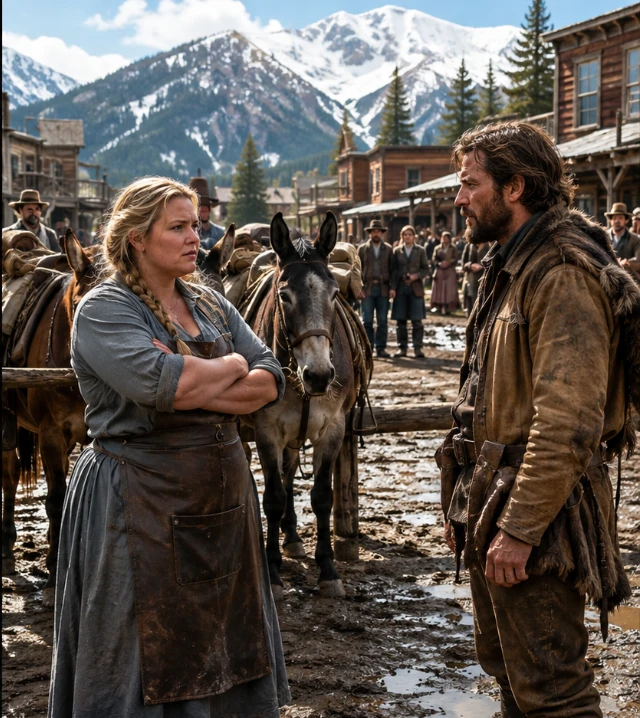
Greta searched his face for cruelty and found only exhausted honesty.
“Why me?” she asked.
Anders looked toward the snow-lined peaks beyond town.
“Because I’m not looking for someone who photographs well beside a parlor window. I’m looking for someone who can keep a roof standing when the wind comes down hard.”
His gaze returned to hers.
**“I need someone built for surviving.”**
For the first time in years, Greta had no answer ready.
A younger woman named Elsie Bell stood near the mercantile in a yellow dress, delicate as a wildflower. Men had crossed counties to court her. She lifted one hand to hide a smile.
Greta saw it.
She saw every amused face.
Every man who had once asked her to carry a flour barrel and then danced with someone thinner.
Every woman who had offered advice about eating less, speaking softer, or wearing darker colors.